A Judge from the People: Why Does Esports Really Need ESIC?

Esports has long since emerged from basements and computer clubs, evolving into a multi-billion-dollar industry. However, just like traditional sports, it has faced the destructive shadow of unfair play: match-fixing, doping, and the exploitation of software vulnerabilities. In 2016, the Esports Integrity Commission (ESIC) stepped into the spotlight in the fight for “pixel integrity,” becoming a recognizable yet controversial regulator.
For the community, ESIC is more of a “sword of Damocles” that always strikes at the wrong time and selectively, sparking waves of backlash. But is it fair to demonize an organization that has been building the legal foundation of esports for decades? In this article, we’ll examine the history of ESIC, the nature of public outrage, and the achievements hidden behind the scandals.
The History of Its Creation and the Backlash
The story began in June 2016, when British lawyer Ian Smith founded the Esports Integrity Coalition in London. ESL and DreamHack joined the coalition, hoping to bring order to the chaos of fragmented rules. Their first priority was an anti-doping code—at the time, the issue of Adderall was being openly discussed in CS:GO. In 2018, bookmakers were brought into the partnership to track suspicious bets. A year later, the coalition became a “commission” and began conducting actual investigations.
The storm broke in September 2020: 37 coaches were banned for using the “coach bug” in CS:GO, where coaches, while in the spectator slot, could hover over a specific area of the map and see more than they were supposed to. But even then, the traits for which ESIC would later be hated began to emerge—the investigation dragged on for years, and the punishment, in the opinion of many, was distributed unevenly. The situation reached its peak in May 2022: just days before the PGL Major Antwerp, the commission suspended Team Spirit coach Sergey “hally” Shavaev for a single incident that had occurred three years prior. The team was left without a coach for the main tournament of the year. The community erupted: the punishment for a microscopic infraction, handed down at the most inopportune moment, looked like outright bureaucratic cynicism.
It only got worse. The community accused the commission of double standards: when HUNDEN’s coach claimed that HEROIC’s players knew about the bug, almost everyone got off with warnings or excuses. Meanwhile, Tier 2 and Tier 3 teams continued to receive harsh disqualifications. The investigations dragged on for years, allowing the suspects to switch to Valorant before a verdict was reached. A former employee using the pseudonym yarabeu claimed that the staff consists of lawyers who do not understand esports. Add to this the lack of transparency in decision-making and close financial ties with bookmakers—whom the commission is supposed to regulate—and the image of a “black box” riddled with conflicts of interest was complete. Finally, in 2025, ESIC publicly refused to recognize the doping suspension of Tekken legend Arslan Ash, imposed by the IESF, creating legal chaos and calling into question esports’ Olympic prospects.
It would seem that we are looking at a useless and even harmful organization. But behind this trail of scandals, we risk overlooking the fact that it is precisely ESIC that, through a decade of hard work, is laying the very foundation without which professional esports simply cannot continue to exist.
What has ESIC actually done for esports?
Let’s start with the most painful issue—match-fixing, which has been eating away at esports from the inside for decades. Before ESIC came along, there was no unified system for detecting suspicious bets, and teams were “throwing” games with virtually no consequences. The commission built a global monitoring network that brought together the largest bookmakers and allows them to spot betting anomalies even before a match ends. These aren’t just empty words. In recent years, dozens of players and entire teams in Australia, North America, and Eastern Europe have received long-term bans. Just recently, in April 2026, the commission handed down lifetime bans for systematic corruption in Dota 2—and this is the result of months of behind-the-scenes work that would never have made headlines if it weren’t for the need to publicize the conclusion of the investigation. This is exactly how true prevention works: scandals are prevented, not blown out of proportion.
The second most important thing is standardizing the rules. Just ten years ago, every tournament had its own set of regulations: ESL penalized one thing, BLAST penalized another, and DreamHack turned a blind eye to a third. A player banned from one tournament could compete in another without issue. ESIC created a unified code of conduct, which is now recognized by virtually all major operators. Moreover, the commission went further by launching the industry’s first certification program for agents and player representatives in 2025. Previously, unscrupulous managers could sign young talents to exploitative contracts, taking advantage of the teenagers’ legal ignorance. Now, however, an agent who has not been accredited by ESIC is denied access to official tournaments. This is invisible, routine work that doesn’t make the news, but directly protects hundreds of budding careers from exploitation.
What esports needed
Now, about the coaching loophole, which is what the commission gets the most flak for. Despite all the scandalous baggage, it was the ESIC investigation that cleared the scene of the widespread cheating that had been undermining the spirit of sportsmanship in CS:GO for years. Until 2020, exploiting the spectator mode vulnerability was practically routine; today, the very idea of such a thing seems absurd. If not for that tough—albeit belated—crackdown, the professional scene might still be mired in an atmosphere of total mistrust and suspicion.
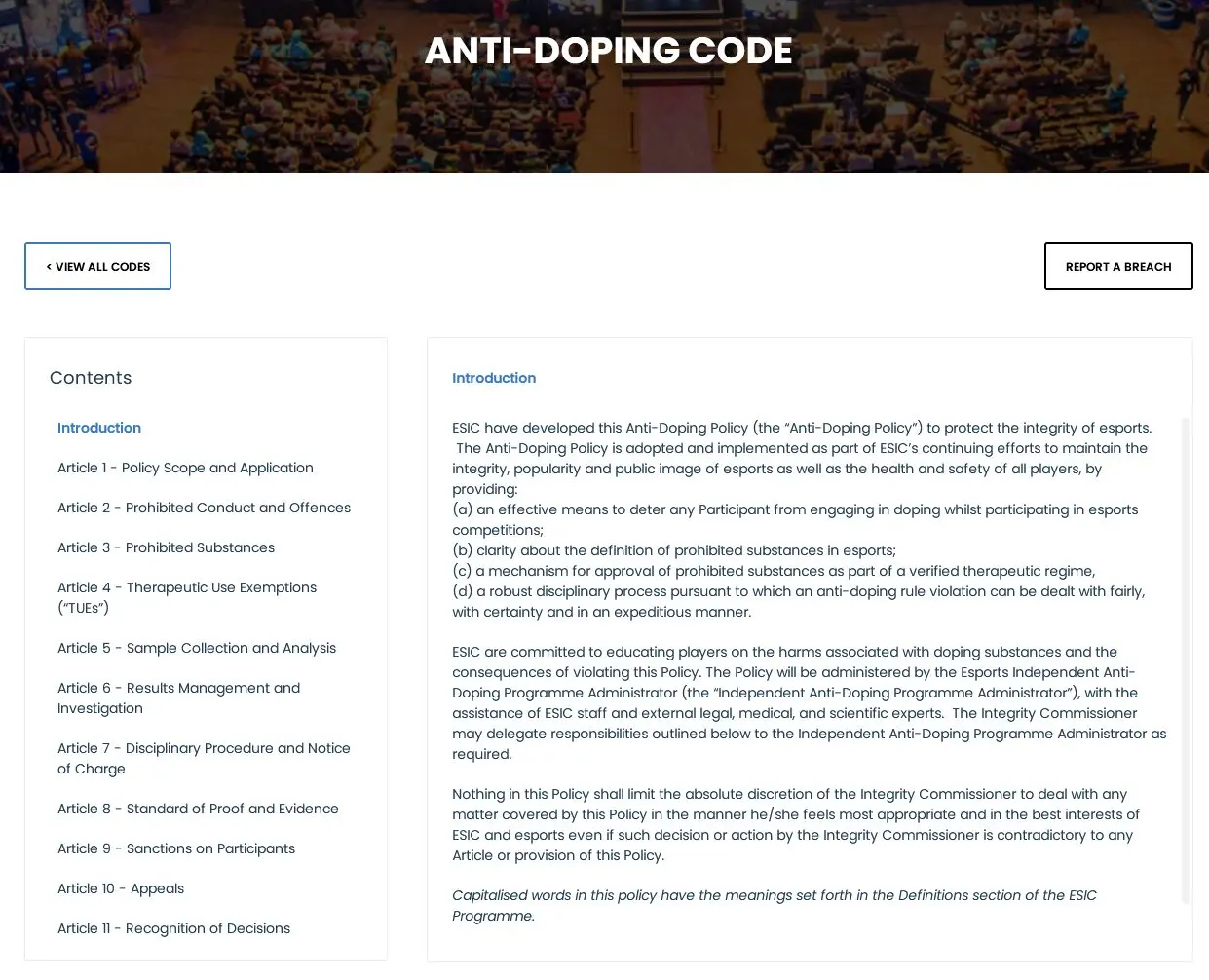
It’s worth mentioning anti-doping and educational efforts separately. ESIC regularly conducts testing at tournaments and educates players on the risks of uncontrolled use of psychostimulants. Contrary to popular belief, the problem isn’t limited to “someone over there in America”: the uncontrolled use of Adderall and its analogues destroys health, and in the long term—the player’s professional skills as well. At the same time, the commission is consistently fostering a culture of zero tolerance for physical violence and threats, emphasizing that such behavior is incompatible with the status of an esports athlete. This is a long and thankless task of cultivating a healthy environment, the results of which will not be immediately apparent, but without which the industry would remain a perpetually toxic space.
One of the most effective tools in recent years has been the practice of reducing penalties for cooperation. In October 2025, player Erhan “gokushima” Bagynanov had his ban lifted early for actively helping to identify other violators. This system incentivizes those involved in corruption schemes to break the code of silence and turn in the organizers, which is far more effective than catching low-level participants. Essentially, ESIC has built a mechanism that dismantles underground networks from within—and this is perhaps the most effective legal model for combating organized match-fixing across all sports, not just esports.
Things are getting more serious
Finally, the major breakthrough of recent times was the launch in April 2026 of the International Games and Esports Tribunal (IGET), established in collaboration with the World Intellectual Property Organization. Previously, any controversial decision by a commission could only be challenged in the media—there was simply no other way. Now, however, disputes will be resolved by professional arbitrators whose verdicts carry international legal weight. This puts esports on par with recognized sports federations and sets a precedent for government recognition of the industry worldwide. It was ESIC that initiated and pushed through this project, and without nearly a decade of methodical work to establish standards and regulations, such a step would have been simply impossible.
Rounding out the picture are annual global summits (the most recent took place on June 20, 2025, as part of Global Esports Week. Key topics: monetization, investment, and the long-term future of the industry), where investment, regulation, and the long-term future of the industry are discussed, as well as regular educational seminars for teams and coaches—and it becomes clear that what we have before us is by no means a “punitive parasitic body,” but rather the architect of the legal framework upon which professional esports rests.
A judge who continues to judge
ESIC appears before us as a tragically ambivalent figure. Its history is indeed full of mistakes, communication failures, and unforgivable delays. But the trail of hate obscures the main point: without this organization, esports would still be a gray area without uniform rules, where match-fixing thrives and players’ careers depend on the whims of unscrupulous agents.
The Commission has built a monitoring system that identifies threats before they become scandals, created a unified code of conduct for all major tournaments, launched a tribunal with international legitimacy, and, through a decade of methodical work, has earned the right to be called that very “judge of the people.” Not perfect, sometimes making mistakes, but persistently continuing to judge. And perhaps it is precisely this persistence that will ultimately make esports truly fair.