CS2 Esports Headphones: Pro-Gamer Models

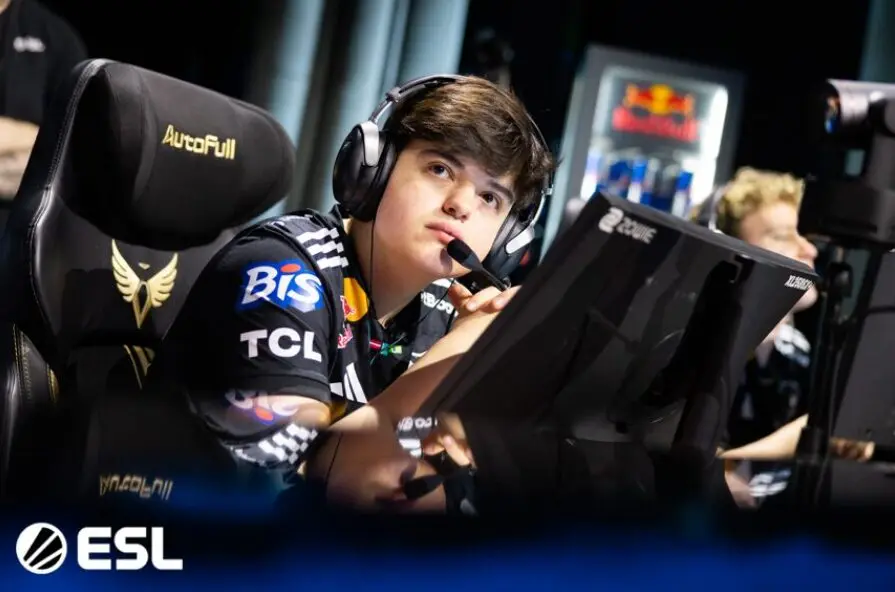
The CS2 esports headphones often look different during live streams than they do in the equipment profiles. That’s because at home, a player uses their own full-size headset, but at a LAN tournament, they might wear noise-canceling headphones provided by the tournament organizer over their personal earbuds.
Why do players wear two pairs of headphones on stage?
At major LAN tournaments, it’s not just the game audio that matters—sound isolation from the arena is crucial as well. Spectators react to the action, commentators discuss the round, and music and announcements play through the PA system. If a player hears a hint from the audience, the competitive conditions are no longer equal. That’s why the tournament operator controls the audio system and often provides all participants with identical over-ear headsets.
An external headset covers the ears, blocks out ambient noise, and provides the player with a tournament microphone. Underneath it, many esports players wear wired in-ear headphones. It is through these that the CS2 audio is typically transmitted, while the larger headset handles active noise cancellation and communication. At some events, the entire audio feed may be routed exclusively through the external headset—the rules and connection setup depend on the operator.
This setup originated back in the days of passive over-ear headphones worn over personal earbuds and has become an established practice in the scene. In a report on the BLAST.tv Austin Major, manufacturer AceZone confirmed that some players used in-ear models with the A-Live headset, even though the tournament headset itself is capable of transmitting audio and voice while simultaneously suppressing noise. Therefore, it’s impossible to accurately identify a CS player’s home headphones from a photo: the large, over-ear model is often provided by the organizer.
What Headphones Do Pro Gamers Use at Home?
In the practice room, at bootcamp, and during streams, pros usually switch to their usual full-size headsets. These are standard mass-market models: Logitech G PRO X 2, HyperX Cloud II or Cloud III, Razer BlackShark V3 Pro, SteelSeries Arctis Nova Pro. You can buy them in a store; there’s no need for a special “tournament” version for home gaming.
A gamer chooses a headset based on more than just the detail of footstep sounds. Other important factors include comfort during extended use, consistent sound quality across different computers, weight, the microphone, and familiar volume controls. Wireless connectivity is also no longer a rarity: models using the 2.4 GHz radio band offer low latency. Bluetooth is less suitable for competitive gaming, as latency and sound quality depend on the codec and the device’s mode.
Sponsorship deals influence the range of available peripherals, but gamers still get used to a specific fit and sound profile. For this reason, the same headset can remain in a gamer’s setup for years, even after the brand has released a newer line. You shouldn’t copy a star’s choice without trying it on first: what’s comfortable for one person might press on another’s temples or make their ears overheat.
Headphones Used by Players in the HLTV Top 20 for 2025
Below is a list of players from the HLTV Top 20 for 2025. Full-size headsets and in-ear models were verified using publicly available ProSettings profiles on July 13, 2026. Equipment changes over time, and the listed pair of earbuds isn’t necessarily used by the player at every LAN tournament.
| Player | Full-size headset | In-ear model |
| Mathieu “ZywOo” Erbo | SteelSeries Arctis Nova Pro | AceZone Earphones |
| Danil “donk” Kryshkovets | HyperX Cloud II | Shure SE215 Clear |
| Robin “ropz” Kol | SteelSeries Arctis Nova Pro Wireless | Razer Hammerhead Pro V2 |
| Ilya “m0NESY” Osipov | Logitech G PRO X 2 Black | Logitech G333 White |
| Dmitry “sh1ro” Sokolov | HyperX Cloud II | Bose QuietComfort 20 |
| Danil “molodoy” Golubenko | Logitech G PRO X 2 Magenta | Shure SE215 Black |
| Shahar “flameZ” Shushan | Logitech G Pro X | SteelSeries Flux Pro |
| David “frozen” Chernyansky | HyperX Cloud Alpha Wireless | Logitech G333 White |
| Kaike “KSCERATO” Serato | Logitech G522 Black | TRUTHEAR x Crinacle Zero Red |
| Lotan “Spinx” Giladi | Razer BlackShark V3 Pro White | Razer Moray Black |
| Russell “Twistzz” Van Dalken | SteelSeries Arctis Nova Pro Wireless | Simgot SuperMix 4 |
| William “mezii” Merriman | ASUS ROG Pelta | AceZone Earphones — not released |
| Azbayar “Senzu” Munchbold | HyperX Cloud III Wireless Black | Logitech G333 White |
| Ismailjan “XANTARES” Dörtkardesh | HyperX Cloud III Wireless | Razer Hammerhead Pro V2 |
| Mareks “YEKINDAR” Galinskis | HyperX Cloud II | KZ ZS10 Pro X |
| Dorian “xertioN” Berman | Razer BlackShark V3 Pro White | Razer Hammerhead Duo Green |
| Adam “torzsi” Torzash | Razer BlackShark V3 Pro Black | Razer Hammerhead Duo Black |
| Nikola “NiKo” Kovac | Razer BlackShark V3 Pro NiKo Edition | Linsoul 7HZ Timeless |
| Mihai “iM” Ivan | Logitech G PRO X 2 White | Sennheiser CX 300S |
| Valery “b1t” Vakhovsky | Logitech G PRO X 2 Magenta | Sennheiser CX 300S |
The table shows two distinct groups: for home and training, the Logitech G PRO X, HyperX Cloud, Razer BlackShark, and SteelSeries Arctis Nova Pro lines are the most frequently mentioned. Among “earbuds,” the range is wider: you’ll find affordable options like the Logitech G333 and Razer Hammerhead, the Shure SE215 for live performances, the older Bose QuietComfort 20, and more expensive audiophile models. There’s no single standard among professionals.
s1mple, electronic, chopper, and other popular players
A single-season ranking doesn’t cover everyone whose gear viewers are looking for. A separate selection includes stars from previous years and Maxim “kyousuke” Lukin, who has quickly become one of the most talked-about young players. Leonid “chopper” Vishnyakov is currently on Team Spirit’s bench and streams regularly, so his home headset is particularly noticeable to the audience.
| Player | Full-size headset | In-ear model |
| Alexander “s1mple” Kostylev | SteelSeries Arctis Nova Pro Wireless | Sennheiser CX 300S |
| Denis “electroNic” Sharipov | HyperX Cloud II Pink | Sony MDR-EX15AP |
| Leonid “chopper” Vishnyakov | HyperX Cloud III | Sennheiser IE 300 |
| Gabriel “FalleN” Toledo | Fallen Gear Morcego Pro Wireless | Bose QuietComfort 20 |
| Maxim “kyousuke” Lukin | HyperX Cloud II | AceZone Earphones |
Here we can see once again why the question “What kind of headphones do CS esports players use?” requires clarification. s1mple’s profile lists wireless SteelSeries headphones for regular gameplay and wired Sennheiser in-ear headphones. Electronic and chopper both use full-size HyperX headphones, but with different ear tips. However, in a tournament shot, each player might be seen wearing the same AceZone model provided by the venue.
Why Pro Gamers Choose Wired “Earbuds”
A wired in-ear model connects easily to the tournament audio system and doesn’t rely on a battery. The snug fit provides additional passive isolation, and the behind-the-ear cable helps keep the earbuds securely in place during long matches. For professionals, consistency is key: the sound must remain familiar after a flight, a computer change, and several hours on stage.
Price and the number of drivers alone do not guarantee an advantage. In CS2, you need to quickly distinguish the direction of footsteps, the height of a sound source, reloading, and grenade use. If the low frequencies are boosted excessively, gunshots and explosions mask the quieter details. That’s why some players stick with relatively simple models, whose sound they’ve long been accustomed to.
The fit is just as important as the technical specifications. An ill-fitting earpiece compromises the seal, alters the bass, and reduces noise isolation; one that’s too large can cause pain. Before buying in-ear headphones, it’s worth trying out several sizes of silicone or foam ear tips. Even the popular Shure SE215 will be useless if the shape of the housing doesn’t fit a specific ear.
Which Headphones Are Best for CS2
For gaming at home, a single comfortable closed-back headset is sufficient for most users. It should stay securely in place, not feel tight after two or three maps, and provide clear stereo positioning. Built-in virtual 7.1 surround sound isn’t necessary: spatial audio is already processed by the game, and the additional effect can sometimes blur directional cues. It’s best to try the standard stereo mode first.
If you’re choosing a wireless model, look for a bundled USB transmitter and a low-latency mode. For wired models, the length and flexibility of the cable are important, as is the compatibility of the plug with your computer. Evaluate the microphone separately: teammates should be able to hear a brief call without crackling, background hum, or the first syllables being cut off automatically.
Don’t look for a headset with the loudest bass. For Counter-Strike, a balanced midrange and precise high frequencies—where many important details lie—are more useful. You can use an equalizer for minor adjustments, but sharp boosts tire your ears and make the sound unstable. The best headphones for CS are those that provide consistent directional clarity on every map while maintaining comfort.
Should you replicate the tournament setup at home?
There’s no point in wearing full-size headphones over in-ear monitors in a quiet room. A dual-headset system is necessary in the arena, where the organizer is required to block out spectator noise and ensure equal conditions for all teams. At home, it adds pressure on your ears, extra cables, and yet another source of adjustments, but it doesn’t automatically improve positional awareness.
In-ear headphones are worth considering if you prefer that fit, if your surroundings are noisy, or if you often need to take your setup on the go. A full-size headset is more convenient for those who need a single device with a microphone and quick controls. You can use the list of CS2 pro-gamers’ headphones as a guide to tried-and-true options, but the final choice depends on the shape of your head and ears, as well as your own perception of sound.
Frequently Asked Questions
Дома и на тренировках популярны Logitech G PRO X 2, HyperX Cloud II и Cloud III, Razer BlackShark V3 Pro, SteelSeries Arctis Nova Pro. На LAN многие игроки используют проводные внутриканальные модели под внешней шумозащитной гарнитурой организатора.
Внутриканальные наушники обычно передают звук игры, а внешняя гарнитура подавляет шум арены и даёт микрофон. Конкретная схема зависит от регламента: некоторые турниры позволяют использовать внешнюю модель и для всего звука.
Турнирный оператор часто предоставляет внешние шумозащитные гарнитуры и контролирует подключение. Личные внутриканальные наушники игрок может привезти сам, если модель разрешена и прошла проверку перед матчем.
В открытом профиле donk указаны полноразмерные HyperX Cloud II и внутриканальные Shure SE215 Clear. На сцене поверх Shure может находиться другая гарнитура, предоставленная турнирным оператором.
Для m0NESY указаны Logitech G PRO X 2 Black и внутриканальные Logitech G333 White. Оборудование профессионалов меняется, поэтому перед покупкой стоит перепроверить свежий профиль.
В профиле s1mple указаны SteelSeries Arctis Nova Pro Wireless и Sennheiser CX 300S. Первая модель подходит для обычной игры, вторая — проводная внутриканальная пара.
Оба формата подходят для CS2. Дома полноразмерная гарнитура удобнее как единое устройство с микрофоном, а внутриканальная модель компактнее и лучше изолирует при правильной посадке. Выбор зависит от комфорта, а не от статуса модели у про-игрока.
Photo by Viola Schuldner, ESL