Making Money Selling CS2 Skins: How Trading Works

It is possible to make money from skins, but it doesn’t start with a case, a rare drop, or a promise to double your inventory in a week. A trader makes a profit when they buy a liquid item for less, sell it for more, and, after all commissions are deducted, still end up with a positive balance. A single mispriced skin, a delayed sale, or a phishing link can wipe out the profits from several successful trades.
Below, we’ll break down how to make money trading CS:GO skins without the myths about easy money: what strategies traders use, how much fees eat into your profits, what you need to prepare before your first purchase, and why your Steam balance shouldn’t be treated like regular money. For calculation purposes, we’ve used a rounded exchange rate of $1 (about 77 ₽); you should check the prices and exchange rate again before making an actual trade.
What Counts as Profit from Skins
A price increase in your inventory does not yet mean a profit. Profit is realized only after a sale and is equal to the amount received by the seller minus the purchase price, the marketplace’s commission, payment processing fees, and any currency conversion costs. If an item has increased in price by 8% but total expenses amount to 10%, the transaction remains unprofitable. Therefore, skin trading begins with calculating the net margin, not with a pretty graph.
Steam and platforms that allow you to receive money directly into a bank account serve different purposes. According to Steam’s terms of service, wallet funds cannot be transferred to another user or to a bank, have no monetary value outside of Steam, and cannot be exchanged for cash. Selling on the Marketplace increases your budget for games and in-game items, but it does not generate income that you can use outside of the Valve ecosystem.
Earnings from selling skins for regular money go through a third-party marketplace that operates in the user’s country and supports a suitable payment method. For such a marketplace, you need to check in advance the seller’s commission, transfer fees, limits, KYC requirements, payment processing time, and refund policies. A high price listed in the catalog is useless if no one buys the item for months.
What You Need to Start Trading Skins
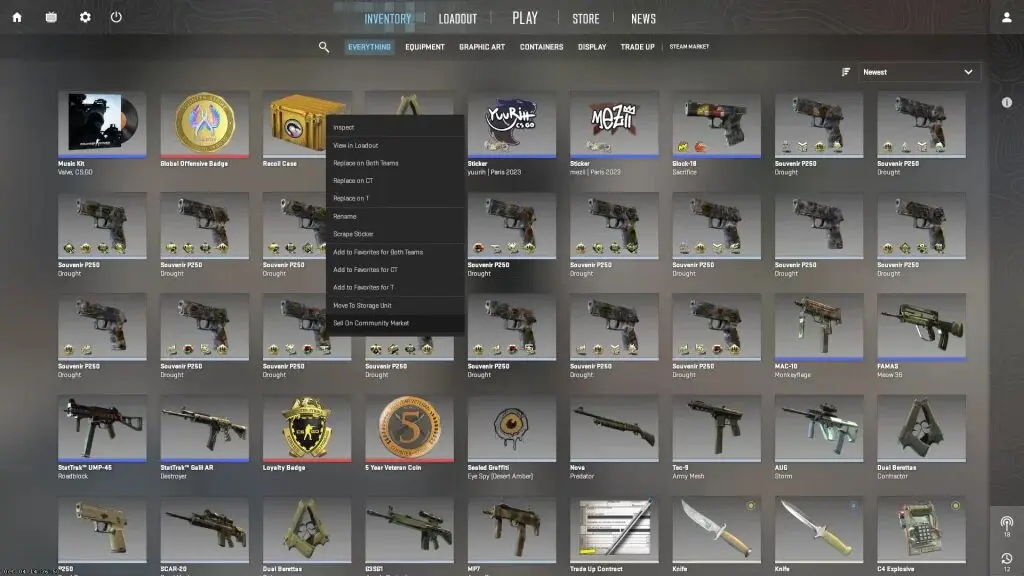
You’ll need a Steam account with no trading restrictions, Steam Guard Mobile Authenticator, a separate email address with two-factor authentication, and a starting balance that you can afford to lose without affecting your essential expenses. To access the Community Market, your account must meet Steam’s requirements: specifically, it must have a qualifying purchase and active Steam Guard. A third-party platform may require identity and age verification, and available payment methods depend on your region.
The second part is record-keeping. A simple spreadsheet listing the item name, float, pattern, stickers, date, purchase price, all fees, and the minimum break-even price is sufficient. A screenshot of your current inventory value is no substitute for such record-keeping. Without a log, it’s easy to mistake turnover for income and forget that some of your money is tied up in unsold items.
It’s wiser to start with a few popular skins rather than a single expensive knife. With a budget of $100 (about 7,700 ₽), it’s better to keep part of the amount available and test the mechanics with small transactions. A capital of $1,000 (about 77,000 ₽) doesn’t make a strategy safer on its own—it simply raises the cost of a mistake.
How to Make Money on CS:GO Skins: Proven Models
Reselling liquid items
The simplest approach is to buy below the usual price range and list closer to the market price. Skins for popular weapons in common conditions—for which many trades occur daily—are well-suited for this strategy. A small margin is offset by the speed of turnover, but only if the spread between buyers’ bids and sellers’ offers covers the commission.
Price Differences Between Platforms
A single item may be priced differently on Steam and the external market, but you shouldn’t compare the listed prices. A trader calculates how much they’ll actually pay upon purchase, how much they’ll receive after the sale, and whether they can transfer the item within the required timeframe. The difference between Steam balance and regular money isn’t free arbitrage: these funds have different uses and different restrictions.
Float, Pattern, and Applied Stickers
Some sellers list an unusual item at the price of a common one. A low float, a rare pattern, a favorable sticker layout, or an old sticker can sometimes command a premium. This requires knowledge of the specific market: the full value of applied stickers is almost never passed on to the weapon, and finding a buyer can take weeks. This is a model for selective purchasing, not for bulk buying everything in sight.
Long-Term Purchases
Investors hold onto capsules, cases, collectible skins, and items with limited supply in anticipation of future demand. Such a position has the potential to grow, but it ties up capital and depends on Valve’s decisions. In October 2025, a change to the Trade-Up Contract allowed players to trade five mystery-quality items for a knife or gloves, drastically altering the rarity distribution. A game update can render the old valuation model obsolete overnight.
| Model | Horizon | Main Risk |
|---|---|---|
| Liquid Resale | Days or weeks | Small net margin; risk of buying at a local peak |
| Differences between trading platforms | After restrictions are lifted | Commissions, exchange rates, unavailable payment methods |
| A rare find | From a few days to several months | Difficult to value and limited pool of buyers |
| Long-term storage | Months or years | Changes in demand, supply, and Valve’s mechanics |
Opening cases is not a trading strategy
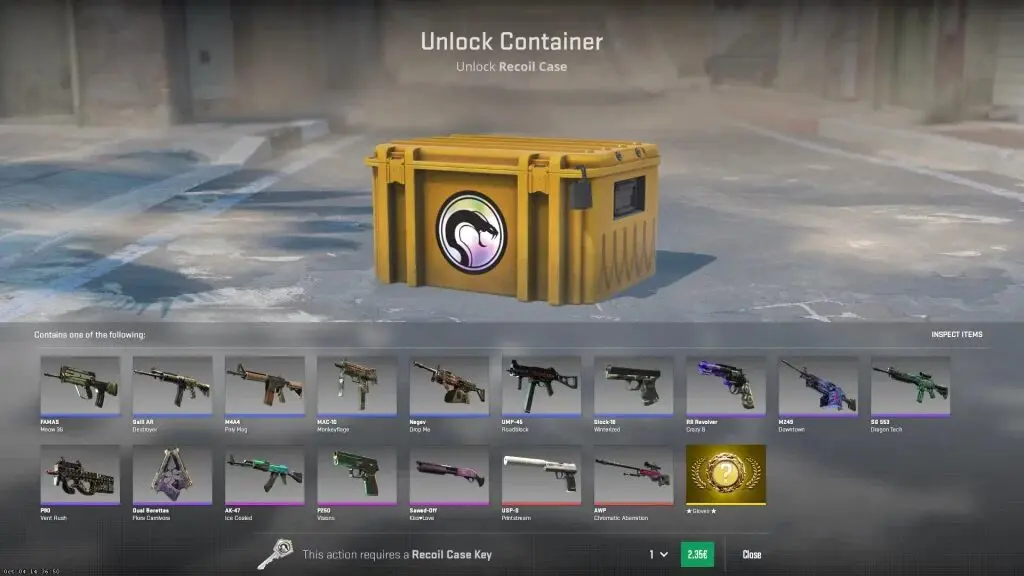
A case yields a random item, and a key is added to the cost of the case. Most openings do not recoup the amount spent, and the player cannot predict a profitable outcome in advance. A rare knife in a trailer is an event, not a reproducible pattern. If your goal is to trade CS:GO skins, it’s better to allocate that same budget toward an item with known stats and a resale value.
Exchange contracts also require precise calculations of probabilities, the float of input items, and the range of possible outcomes. They can be part of a specialized strategy but do not guarantee a profit. Buying a ready-made skin is usually easier to verify and allows you to determine the maximum acceptable price in advance.
How Much Can You Earn by Selling Skins
There is no fixed rate of return in this market. The result is determined by capital, the net margin per trade, turnover rate, and the percentage of unsuccessful purchases. The formula is simple: net profit equals total sales after all expenses minus the total cost of purchases. A month without any trades yields zero profit, even if the prices of some items in your store have gone up.
Let’s say a skin was purchased for $90 (about 6,900 ₽) and sold for $105 (about 8,100 ₽) on a platform with a 2% seller’s commission. The commission will be $2.10 (about 160 ₽), leaving $102.90 (about 7,900 ₽) in your balance, and the difference from the purchase price will be $12.90 (about 990 ₽). From this amount, you still need to subtract the payment fee, currency conversion fees, and any bank transfer fees.
Another example illustrates the role of turnover. If a $500 portfolio (about 38,500 ₽) yields 3% over one full cycle after all expenses, that’s $15 (about 1,150 ₽)—not a salary. You can only repeat the cycle several times with liquid items; a stuck skin slows down the process, and selling at a discount reduces the margin. Therefore, promising a specific monthly income without a trading history makes no sense.
Steam and Third-Party Platform Fees
The official Community Market FAQ lists a 5% Steam Transaction Fee and a 10% Counter-Strike 2 commission. Both amounts are paid by the buyer and are visible before confirmation; the seller sets the desired amount to receive, and the final price for the buyer is higher. For low-priced items, even minimal fees and rounding can eat into a particularly large portion of the profit margin.
On third-party marketplaces, fees vary and are subject to change. For example, CSFloat’s published rules specify a 2% seller commission and a 0.5–2.5% fee for fund transfers, depending on sales volume. This is a good guideline for calculations, but before listing a product, you should check the current fee page: the platform may change the percentages, available countries, and payment methods.
| Channel | What the Seller Receives | What to Check |
|---|---|---|
| Steam Community Market | Steam Wallet | 5% Steam + 10% CS2 paid by the buyer; funds remain within Steam |
| External P2P marketplace | Bank or other available method | Seller commission, payment fee, KYC, regional restrictions |
| Direct transaction | As agreed by the parties | Minimal protection, high risk of offer substitution and non-refunds |
How to Choose Skins for Trading
First, look not at the growth rate, but at liquidity: the number of sales, order depth, spread size, and how quickly the market absorbs multiple identical lots. A nominal increase from $20 (about 1,540 ₽) to $30 (about 2,310 ₽) means little if the last actual purchase was a week ago. It’s worth comparing price history across several platforms and distinguishing a one-off transaction from a stable price range.
Next, check the specific item. Condition, float, pattern, StatTrak, collectible status, and applied stickers can affect the price, but not equally for all buyers. For standard resale, items without rare features are more convenient: they’re easier to compare. Buy expensive craft or unusual patterns only after understanding the actual premium, not based on the seller’s word.
Finally, consider the source of the listing. A price that’s too low might indicate a rush sale, but it can also appear on a fake trade window or a copycat site. A genuine discount is visible in the item’s verified card and market history; a message from a stranger is no substitute for verification.
Trade Protection and Turnover Speed
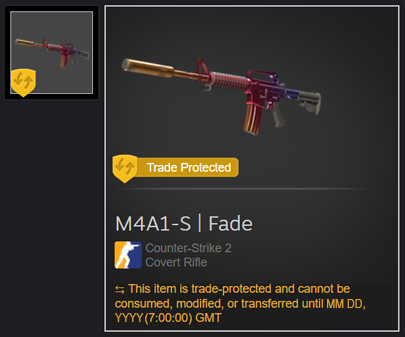
After a trade, CS2 items are protected for seven days. During this period, they can be used in-game but cannot be transferred, modified, placed in a Storage Unit, or used in another transaction. Steam describes Trade Protection as the ability to cancel recent trades after losing control of your account.
If the owner initiates a reversal, all protected trades from the past seven days are reversed, and their account is banned from trading and the Community Market for 30 days. For a trader, this means that an item cannot be instantly passed through multiple accounts or platforms. The seven-day window must be factored into the transaction timeline, and the protected item should not be considered free working capital.
How to Avoid Losing Your Inventory and Money
The most dangerous scams involve cloning the Steam login page, spoofing the platform’s URL, sending a fake bot, or replacing the recipient in a trade offer. It’s safer to access the marketplace via a saved bookmark rather than through an ad, private message, or a link from Discord. Before confirming in the mobile app, you should verify the account name, items, amount, and bot ID.
Never share your recovery codes, session file, password, or API key with anyone. Requests to “check the price,” vote for a team, verify an item on a third-party site, or temporarily send it to a friend are all reasons to stop the transaction. Steam also prohibits automating interactions with the service using bots, scripts, or other non-human means; therefore, suspicious trading software poses not only a risk of theft but also a risk of account restrictions.
Direct transactions with strangers offer minimal protection. It’s safer to use a well-known platform with transparent fees, a transaction history, two-factor authentication, customer support, and dispute resolution policies. Systematic trading may also result in tax obligations; these depend on the country and the seller’s status. Steam explicitly recommends consulting a local tax professional regarding such matters.
Steps for Your First Transaction
First, select ten to fifteen liquid skins and spend a week monitoring actual sales, offers, and the spread. Then calculate the break-even price for each platform and set a maximum purchase price. If the expected profit margin doesn’t cover all expenses with a buffer, skip the transaction—the opportunity to buy isn’t the same as the opportunity to make a profit.
It’s best to make your first purchase a small one, go through the entire process until you receive payment, and record your actual expenses. After the trade, compare the planned and actual margins, the waiting time, and the discount required to make the sale. You should only increase your trading volume after a series of repeated transactions, not after a single successful trade.
Successful CS2 skin trading is similar to trading any illiquid collectible: profit comes from discipline, turnover speed, and accurate risk assessment. The less a decision depends on hearsay, emotion, or a random discovery, the easier it is to determine whether a strategy is actually profitable.
FAQ: Making Money on CS2 Skins
Заработок на скинах в КС2 возможен, если цена продажи после всех комиссий выше полной цены покупки. Доход не гарантирован: скин может подешеветь, зависнуть без покупателя или потребовать скидку для быстрой продажи.
Проверить механику можно с нескольких недорогих ликвидных предметов. Важнее не размер капитала, а запас на комиссии и готовность потерять вложенную сумму. Заёмные деньги для такой торговли не подходят.
Единой суммы нет. Результат равен чистой марже сделки, умноженной на число успешно завершённых оборотов, минус убытки по неудачным позициям. Без истории продаж прогноз месячного дохода будет спекуляцией.
Steam подходит для увеличения баланса внутри сервиса. Средства Community Market нельзя перевести на банковский счёт или другой аккаунт, поэтому для получения обычных денег нужна сторонняя площадка, доступная в стране пользователя.
Новичку проще работать с популярным оружием, распространёнными состояниями, регулярными продажами и небольшим спредом. Редкие паттерны, старые наклейки и дорогие ножи требуют отдельной экспертизы.
Случайное дорогое открытие возможно, но кейсы не дают воспроизводимой торговой модели. Большинство результатов стоит меньше суммы контейнера и ключа, поэтому считать открытие стабильным способом заработка нельзя.
Полученные в обмене предметы CS2 защищены семь дней. Пока защита активна, предмет нельзя изменить или передать дальше; отмена защищённых обменов владельцем приводит к 30-дневному ограничению его аккаунта на торговлю и Community Market.
Правила зависят от страны, регулярности операций и статуса продавца. Площадка может запросить KYC и налоговые сведения. При систематическом доходе лучше сохранить историю сделок и уточнить обязанности у местного специалиста.