The Esports World Cup 2026 has come to an end—the expected champion and the unexpected heroes of CS2


Team Spirit arrived in Paris as one of the favorites and ended the 2026 Esports World Cup with the trophy, confirming the initial predictions. However, the journey proved more important than the result: FUT Esports reached its first major tournament final, and Legacy took third place. Most of the usual favorites were eliminated before the semifinals, so the results of the EWC 2026 CS2 tournament turned out to be a rare combination of an expected champion and an almost entirely unexpected top tier.
Team Spirit won as expected, but not at all according to the expected scenario
A Spirit title didn’t seem like a bold prediction, though the team wasn’t the clear-cut favorite either. They had reached the finals in four of their previous five tournaments and won PGL Astana 2026, but they consistently struggled against Team Vitality. Therefore, the main question wasn’t about the roster’s overall potential, but rather its ability to get past its only formidable opponent.
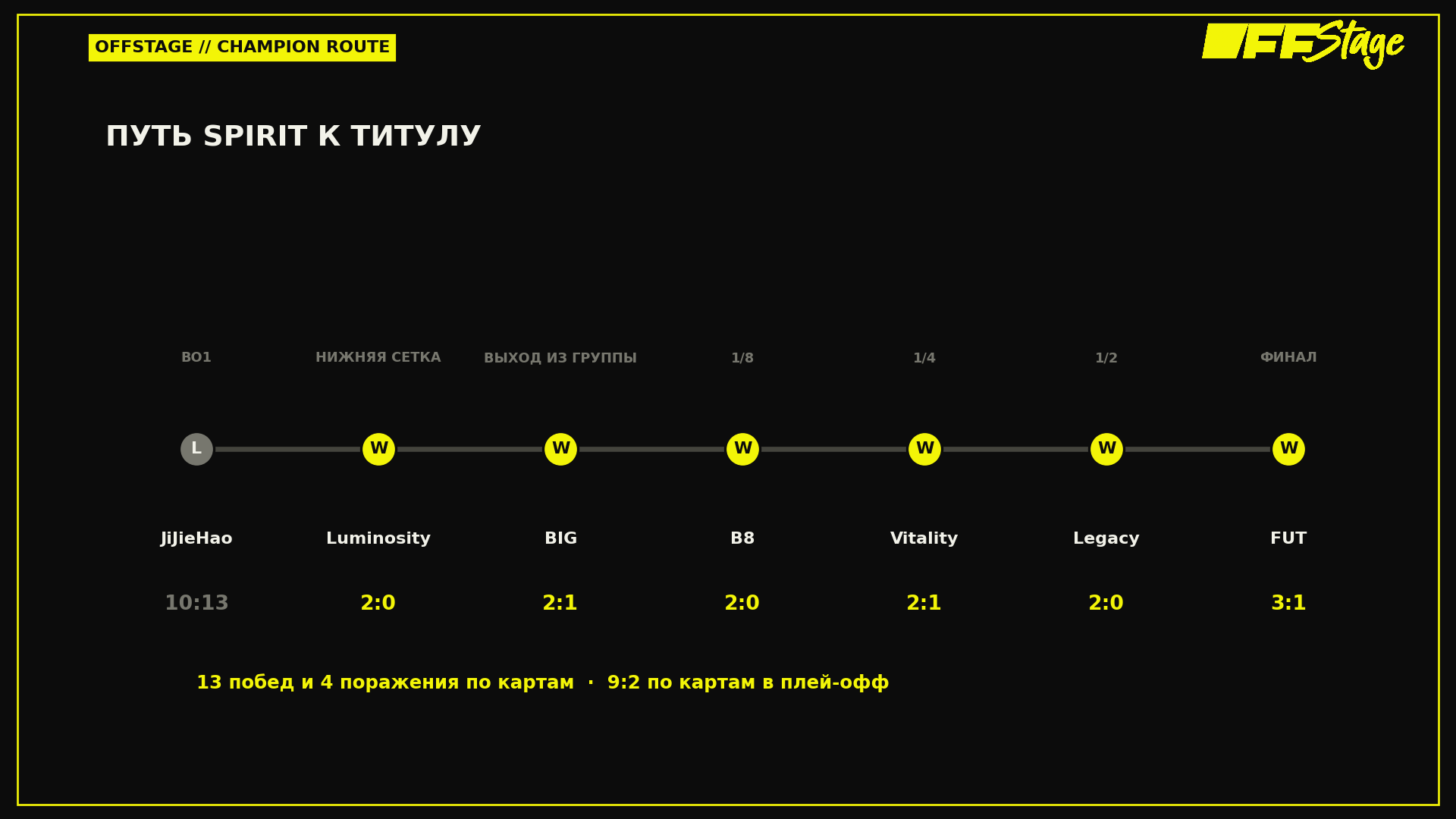
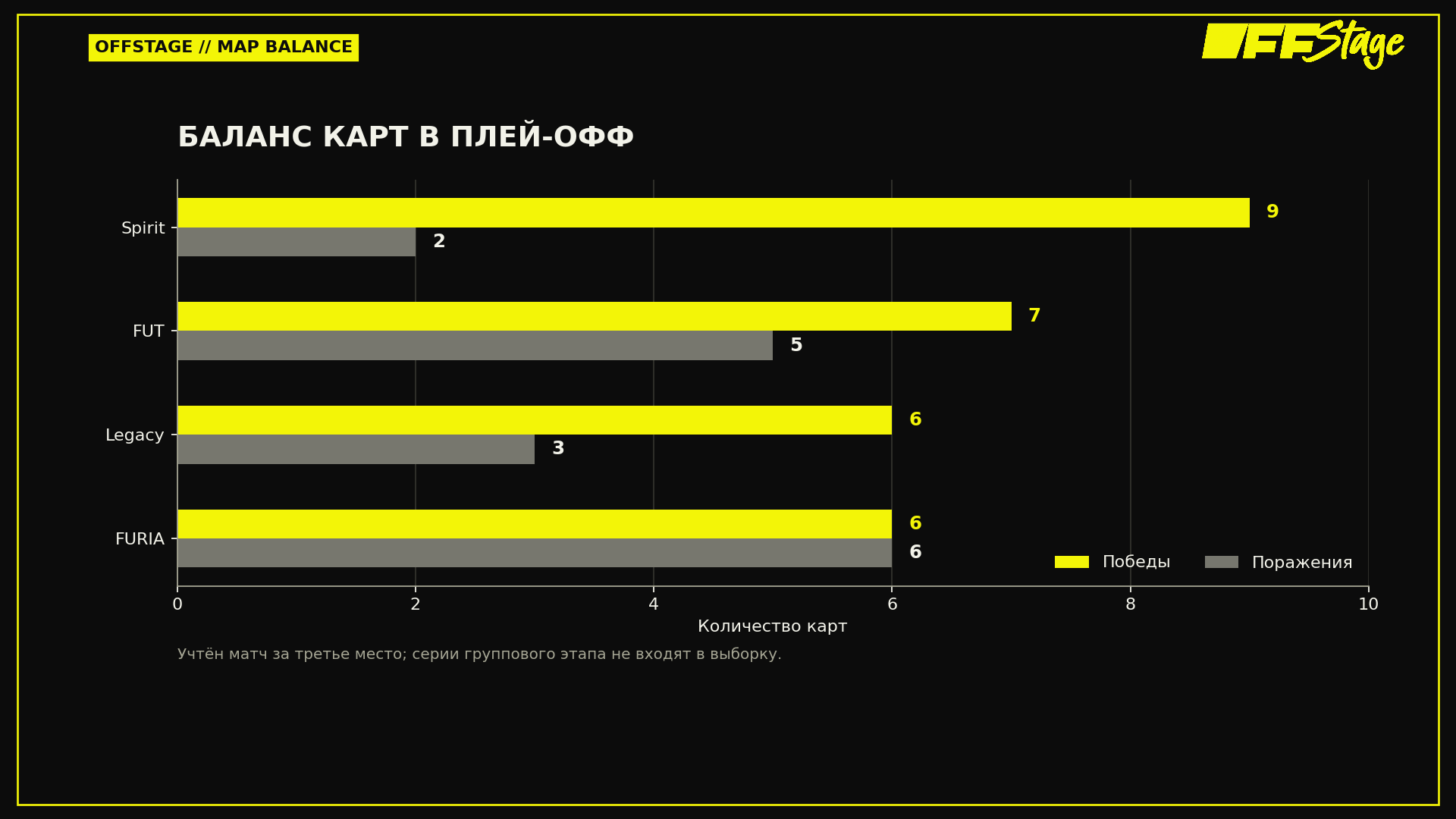
The first day of play only reinforced those doubts: JiJieHao’s VRS team, ranked 58th in the pre-tournament standings, defeated the top-ranked team on Mirage with a score of 13–10. Spirit then bounced back against Luminosity, dropped a map to BIG, and still managed to advance from the lower bracket. In the playoffs, that early stumble no longer defined the team’s play: across seventeen maps, Spirit secured thirteen victories, with the future champions winning nine out of eleven playoff maps.
The turning point came in the quarterfinals against Vitality, where Spirit snapped a six-game losing streak that had stretched back to October 2024. The teams traded close matches on Anubis and Nuke, after which the decisive Mirage map ended 13–3. That match turned Spirit’s solid tournament into a championship-winning one, as there were no more opponents of comparable caliber left in the bracket.
The final was closer than the 3–1 score suggests
FUT entered the final undefeated and selected Cache, even though they hadn’t played the map in the tournament before. The gamble paid off: aggressive defense and Yasin “xfl0ud” Koch’s 140 ADR helped the underdog secure a 13-10 victory. After that, the series ceased to resemble a matchup between an experienced favorite and a rookie team. On Anubis, FUT rallied from a 5–11 deficit and forced the map into overtime, but eight kills by Andrey “tN1R” Tatarinovich over three rounds gave Spirit back control.
On Ancient, the final could have gone either way: FUT led 12–9 and was almost one map away from the title. The team failed to capitalize on their lead, and Dmitry “dem0n” Miroshnichenko was one bullet short of a clutch one-on-three. It was right after that that Spirit clinched their second straight overtime victory in the finals. The first three maps were decided by just eight rounds total, but on Nuke, the accumulated fatigue took its toll instantly.
The 3-1 score, therefore, merely reflects the series’ final result but obscures its true essence. FUT didn’t crumble under the pressure of their first finals appearance; they won a map and twice forced the champions to defend their own leads. The difference lay in Spirit’s ability to weather two nail-biting finishes and maintain their composure heading into the fourth map.
FUT turned one standout match into a full-fledged breakthrough
This upset didn’t come out of nowhere: in the spring, FUT won PGL Bucharest 2026 and demonstrated their ability to withstand a long playoff bracket. In Paris, the team raised the bar, defeating third-seeded MOUZ twice in the pre-tournament VRS and overcoming FURIA in a tense semifinal. Before facing the “Dragons,” the roster hadn’t lost a single series, so the result can’t be attributed to a favorable seed or a fluke shooting spree.
The second victory over MOUZ is particularly significant, as in the group stage the favorite could still attribute the loss to their opponent’s unexpected playstyle, but by the quarterfinals, MOUZ had footage from the previous match, time to prepare, and a new map selection. However, FUT once again proved to be the stronger team—16–13 on Dust2 and 13–5 on Ancient. xfl0ud finished the series with a rating of 1.48, and all five players on the Turkish squad remained above 1.1. Such consistency in their stats clearly demonstrates the team-oriented nature of this success.
The final highlighted the next hurdle for the young roster: their boldness works as long as their decisions remain disciplined. On Anubis, FUT nearly punished Spirit for squandering their lead, but on Ancient, they failed to close out the 12–9 lead themselves. After that, the team lost its emotional edge on the decisive Nuke map. They don’t need to change their identity, but they’ll have to separate productive aggression from unnecessary risk-taking in the most critical rounds.
Legacy was the most convincing disruptor of the hierarchy
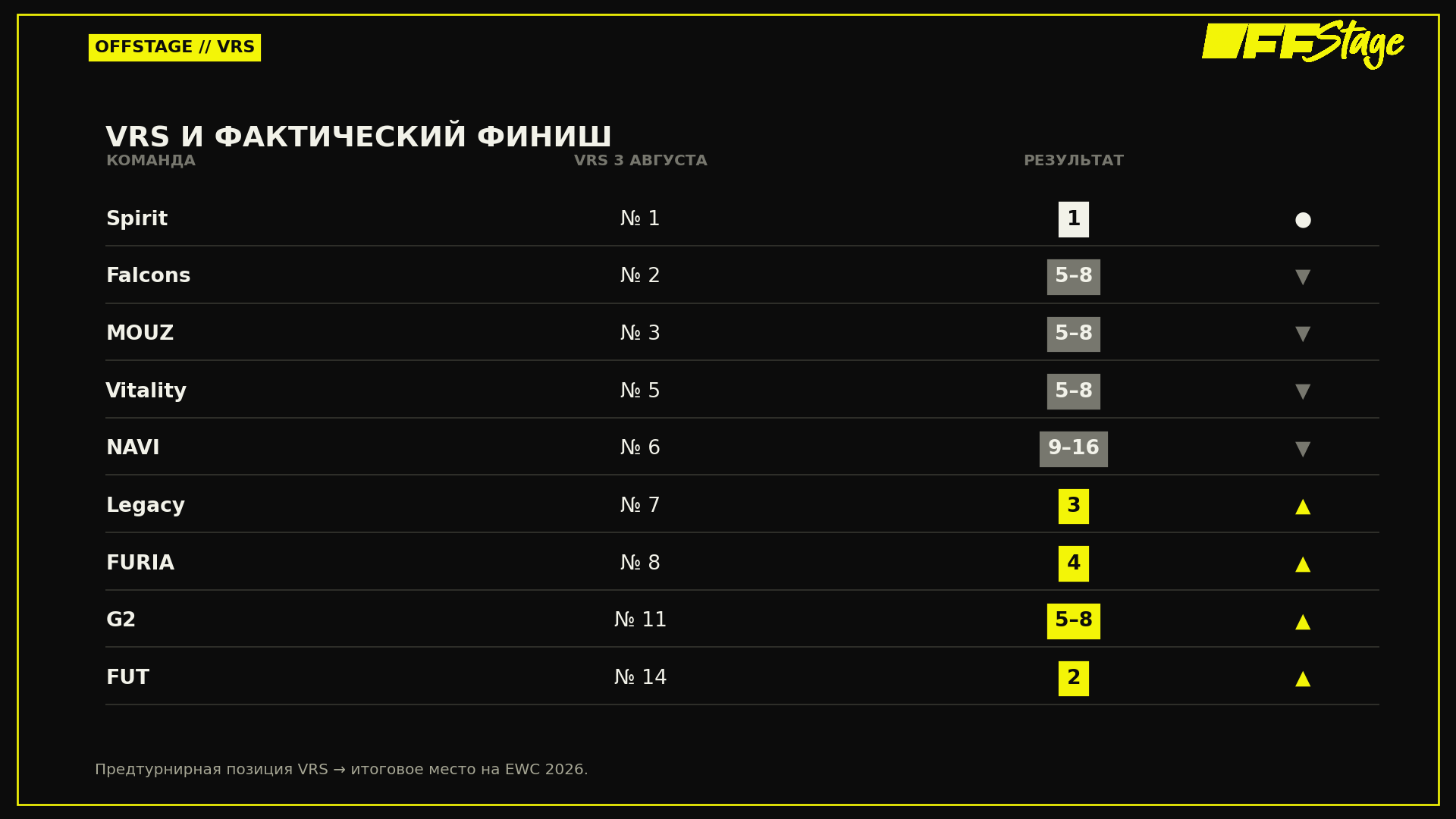
While FUT at least had a recent trophy to its name, Legacy’s third-place finish seemed far less predictable. The seventh-ranked team in the pre-tournament VRS rankings routed NAVI on Inferno and Ancient, then swept second-seeded Team Falcons. After losing to Spirit, the Brazilian squad regrouped for the bronze medal match and defeated FURIA—thus, their run included three series wins against top-8 VRS teams.
On Ancient against Natus Vincere, Vinícius “n1ssim” Pereira racked up 23 kills, an ADR of 151.9, and a rating of 2.91. However, Legacy held its own thanks to Santino “try” Rigal, who finished fourteen maps with a rating of 1.26. In the bronze medal match, he helped turn the series around after a loss on Ancient, and identical 13-9 victories on Nuke and Dust2 sealed the result.
Legacy is also notable for not trying to beat everyone the same way. Against NAVI, the team quickly built two 10–2 halves; against the “Falcons,” they held their ground in a positional series; and they outplayed the “Panthers” after a grueling semifinal. This range of performance distinguishes true tournament form from a one-off upset, and that is precisely why Legacy’s bronze medal was one of the most meaningful results of the entire EWC.
Not all losses by favorites mean the same thing
The top 4 consisted of Spirit, FUT, Legacy, and FURIA, while Falcons, Vitality, MOUZ, and G2 were eliminated in the quarterfinals. The distribution itself already looks unusual, but reaching the same stage does not make these results equal. For the new G2 Esports—in its second tournament with Artem “r1nkle” Moroz—a top-8 finish can be seen as part of their development. FURIA’s loss after two close series also doesn’t negate their strong run.
For the “Bees,” the situation is more concerning: the EWC marked their fourth consecutive tournament without a top-4 finish and their third straight LAN event ending in a quarterfinal loss. The team is still capable of producing individual masterpieces—Mathieu “ZywOo” Erbo finished Cache against FaZe with a rating of 2.22! However, Vitality’s usual dominance over the long haul is currently lacking. The loss to Spirit was particularly painful because of the decisive Mirage map, where the series ceased to be competitive.
Falcons arrived as VRS’s second team and the Major champion, so their sweep loss to Legacy was the biggest upset among the favorites. MOUZ received an even clearer assessment of their roster’s condition, and NAVI cannot be excused by just one bad night in Paris—against Legacy, they started both maps down 2-10 and finished Ancient with a score of 2-13.
donk played the entire tournament without a single weak map
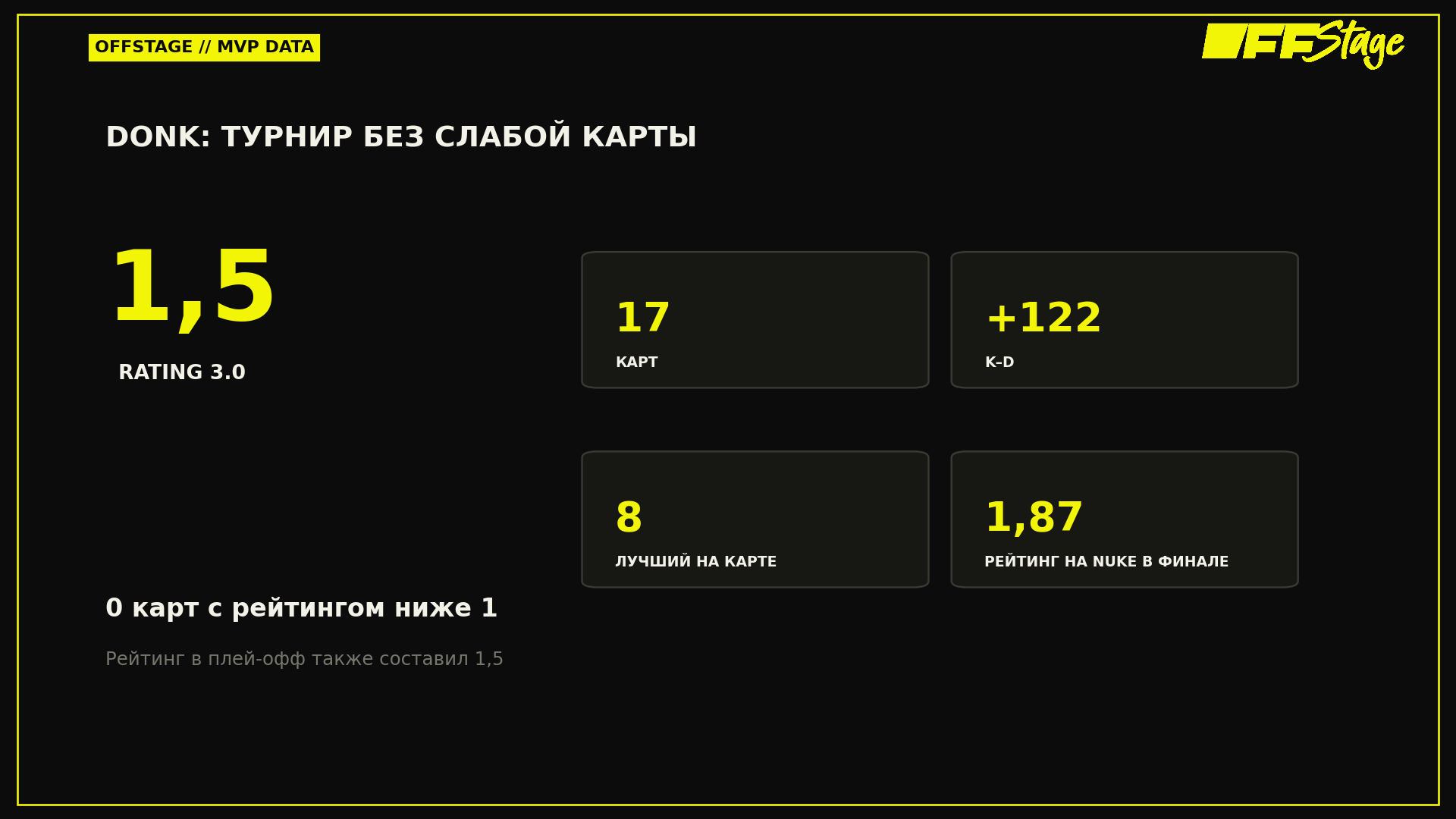
On an individual level, the Esports World Cup once again came down to donk’s performance, though his value isn’t defined by a single record-breaking match. Over seventeen maps, he posted a rating of 1.5, recorded a +122 difference, never dropped below 1.0, and was named the best player of the map eight times.
Against B8, he started Dust2 with a rating of 2.43 and posted a 1.46 rating in the series against Vitality. Donk finished the final map of the championship with a rating of 1.87. At the same time, Spirit didn’t require its leader to follow the same script every night. On Anubis in the final, tN1R saved the day; on Cache, Miroslav “zont1x” Plakhotya stepped up; and Dmitry “sh1ro” Sokolov stabilized the rounds with the AWP. donk remained the team’s main force, but the title didn’t feel like a solo effort.
The MVP award was the twelfth of donk’s career and his ninth at a major tournament. He tied with Nikola “NiKo” Kovač for fourth place on the all-time list. These numbers are particularly impressive given the early loss to JiJieHao: instead of a perfect bracket, the player faced seventeen maps. As a result, the most consistent performance at the EWC coincided with the most challenging path among the finalists.
What the EWC Is Changing Ahead of the Fall Season
The tournament confirmed two things that only seem contradictory at first glance. Team Spirit remains a championship-caliber team capable of winning a major event through the lower bracket; however, there is no longer a closed circle of contenders.
At the same time, Paris doesn’t give anyone the right to declare a new hierarchy after just one week. FUT Esports must now prove it can adapt to its own style, while Legacy must carry its form into the next tournament without the element of surprise. Team Vitality, Team Falcons, MOUZ, and Natus Vincere all exhibited different issues, but each will now have to prove themselves without the protection of their status as favorites.
The results of the 2026 CS2 Esports World Cup are therefore more interesting than the simple formula of “Spirit is once again the strongest.” The champion finally overcame its main tough rival, while two second-tier teams survived the long playoffs—and four favorites didn’t even make it to the tournament’s semifinals. If the fall events maintain this level of intensity, Paris will not be an exception but rather the moment when the season truly became wide open.