BLAST Tournaments Are Now in Mongolia: What Does This Mean for Players and Spectators?

Mongolia is an unusual location for BLAST, but for Russian fans, traveling there might be more convenient than for Europeans. For The MongolZ, this is a chance to play at home, whereas a flight from Brazil would take about a day.
The first event, the BLAST Premier Open Ulaanbaatar 2027, will take place from May 10 to 23—let’s break down how teams can get to Mongolia and how much the trip will cost fans.
What’s Different About the Tournament in Mongolia
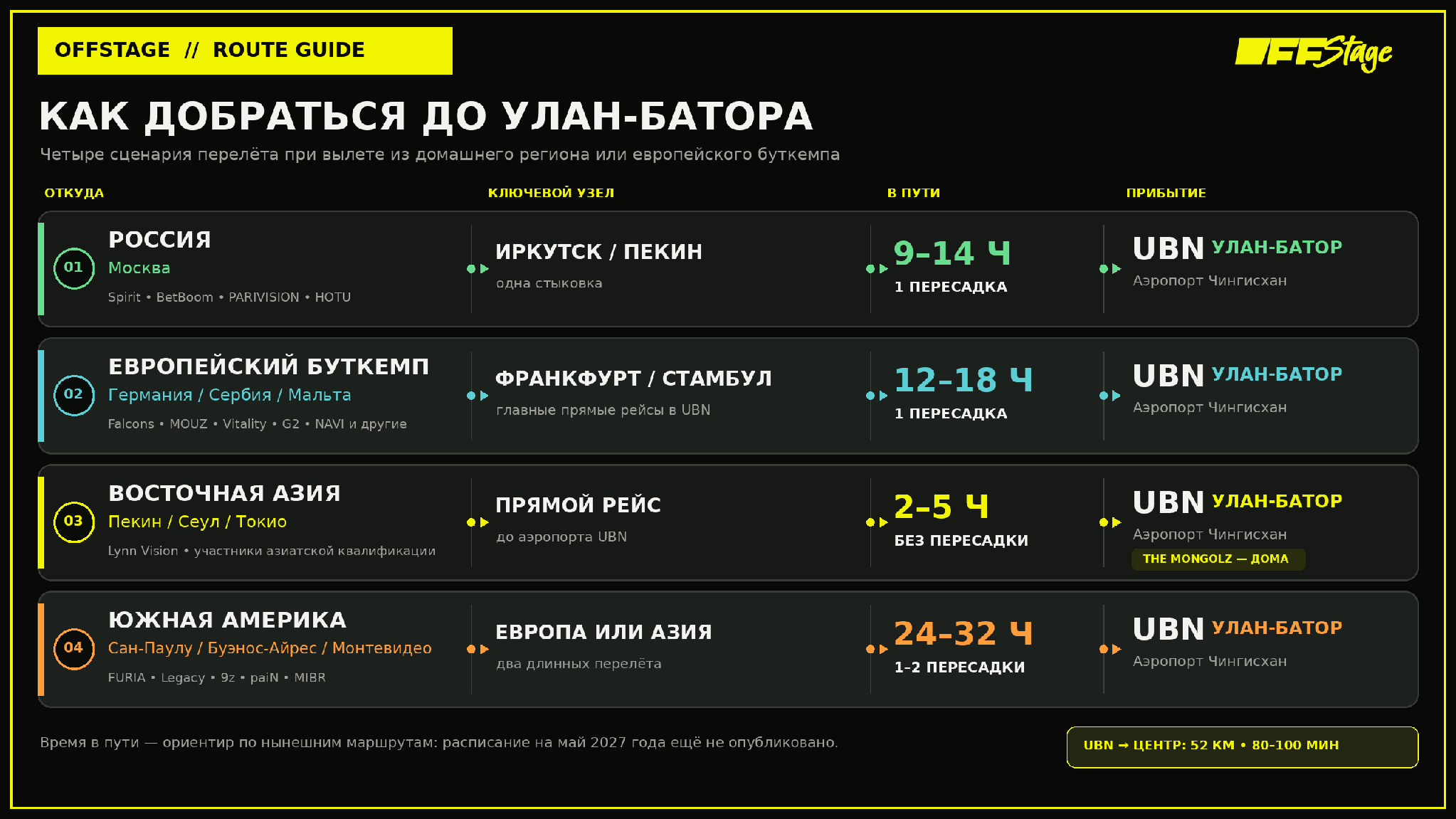
From Europe, the journey to Ulaanbaatar will take about 12–18 hours, and after the flight, travelers will have to adjust to the local time: the time difference with Central Europe is six hours. From Beijing, Seoul, or Tokyo, you can fly directly in about 2–5 hours, so for teams preparing in those cities, the trip will be significantly shorter.
The participants have not yet been announced: teams will receive invitations via the VRS, and two additional spots will be decided at the Asian qualifiers. For now, let’s take a look at what the trip will be like for the teams ranked in the world’s top 32 as of September 7, 2026, focusing in more detail on the top 16. Travel times are based on current routes, as a complete schedule for May is not yet available.
How Teams Will Travel to Ulaanbaatar
If FURIA Esports is at a boot camp in Serbia or Malta before BLAST, the trip to Mongolia will take about as long as it does for other European teams. If, however, the players return to Brazil first, they’ll face a journey of about a day involving two long flights. Therefore, it might be more convenient for the team to continue training in Europe and travel to Ulaanbaatar from there.
The main airport for such a trip is Chinggis Khan (UBN), which has direct flights from Seoul, Beijing, Tokyo, Hong Kong, Istanbul, and Frankfurt. The latter two cities are convenient for connecting flights from Europe, and travelers from the Americas can also reach Ulaanbaatar via Asia. The airport itself is located 52 km from Ulaanbaatar, so after landing, you’ll need to allow an additional 80–100 minutes for the trip to the city center.
European teams will have to adjust to the new time zone
When flying from Europe, Team Falcons, MOUZ, and Team Vitality can travel via Frankfurt or Istanbul: from there, it’s another 8–9 hours by plane to Ulaanbaatar, making the total journey time for Europeans about 14–18 hours. These routes are suitable for FUT Esports, G2 Esports, Aurora Gaming, Natus Vincere, FaZe Clan, Astralis, and B8 Esports. One layover is usually sufficient, but the total travel time will depend on the wait for the next flight.
Arriving the day before matches is risky: when a daytime match begins in Ulaanbaatar, it may still be early morning in Central Europe. After a long flight, players need to rest and get in some practice, so it’s best to arrive a few days before the first match.
The route from Russia is shorter, but it also involves a layover
Team Spirit and BetBoom Team, departing from Moscow, can reach Ulaanbaatar via Irkutsk or Beijing in about 9–14 hours, but the time difference with Ulaanbaatar will still be five hours. For those traveling from Irkutsk, it will be easier: the cities are in the same time zone, and a direct flight takes about an hour and a half. Since the 2027 summer schedule hasn’t been published yet, it’s not worth counting on a direct flight from Moscow to Ulaanbaatar. It’s better to plan for one layover and check available flights and layover times closer to the tournament.
FURIA, Legacy, and 9z Team, when departing from São Paulo, Buenos Aires, or Montevideo, will spend approximately 24–32 hours in transit with a layover in Europe or Asia. This time includes time spent on planes and between flights, excluding travel to the airport and possible delays. After such a trip, the players will need more rest than after a flight from Russia or Europe. Ulaanbaatar is 11 hours ahead of those cities, so a daytime match in Mongolia will take place in the middle of the night according to the players’ home time zones. It may be difficult to return to regular training immediately after such a flight. If the team holds a training camp in East Asia in advance, it will begin adjusting to the new schedule even before arriving at BLAST.
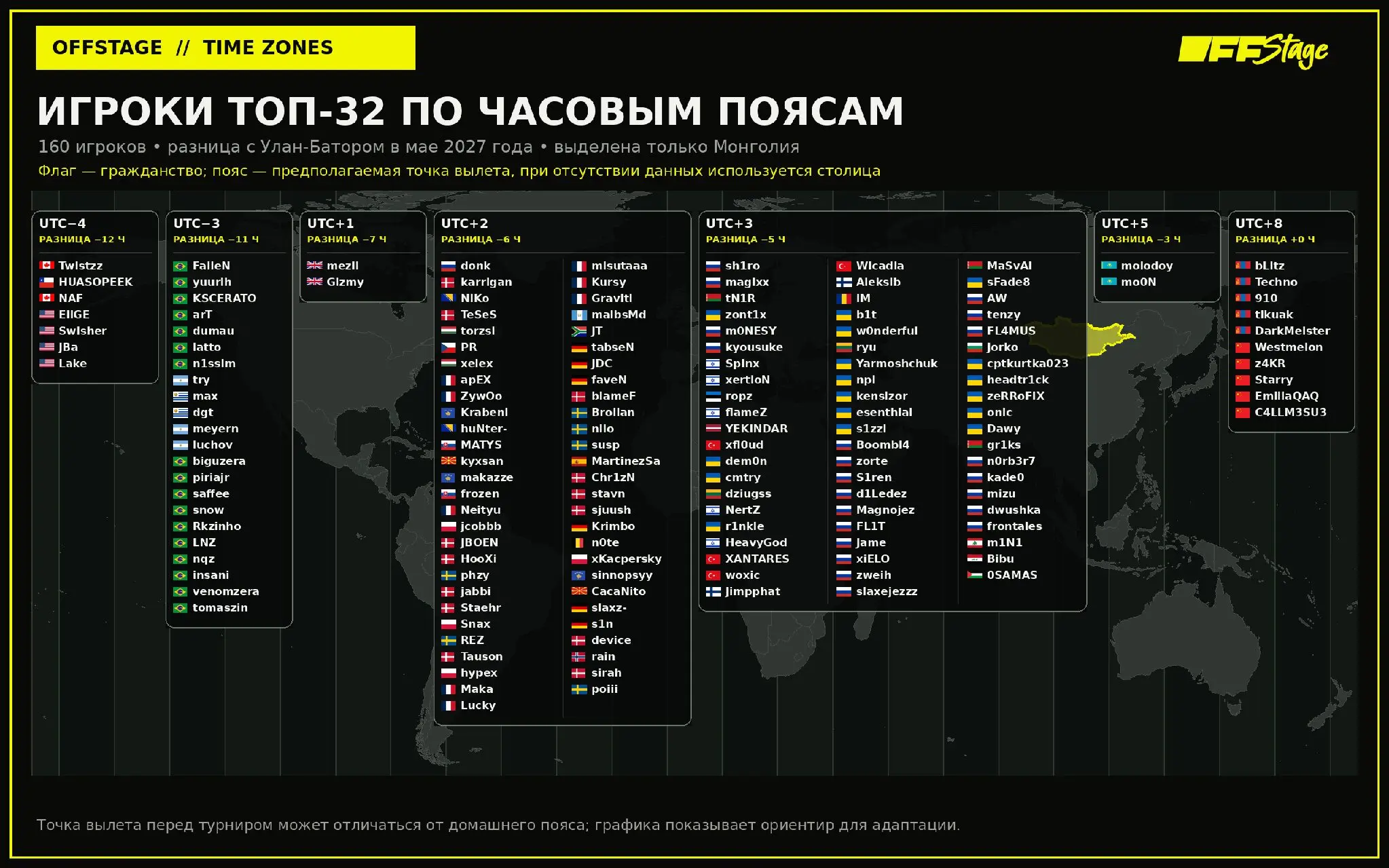
The map shows the players’ approximate time zones prior to departure, not their confirmed locations. For Danil “donk” Kryshkovets, the time shown is based on Belgrade, where he has been living recently. For Mario “malbsMd” Samayo, the same time zone is used, reflecting his time playing on Team Liquid’s European roster. If a city is unknown, the capital of the player’s country of citizenship is used. Flags indicate citizenship; only Mongolia is highlighted in color.
Should the team adjust its preparation for BLAST?
If a team plays another tournament in Europe before BLAST, it should weigh a direct trip to Mongolia against returning home. With a short break between tournaments, an additional flight will leave less time for rest and training, especially for teams from South America.
Staying at a training camp isn’t a free option either: the club will have to pay for lodging and a training facility, and the players will have to go longer without a trip home. Therefore, the convenience of the itinerary must be evaluated alongside the team’s schedule: with a long break, the team will have more options than if there are only a few days off between tournaments.
Who Needs a Visa
Under current short-term entry rules, 35 of the 80 players from the top 16 can enter without a visa. Another five members of The MongolZ are Mongolian citizens who do not need a visa to enter their own country. However, to participate in the tournament, you must separately verify the requirements regarding the purpose of the trip.
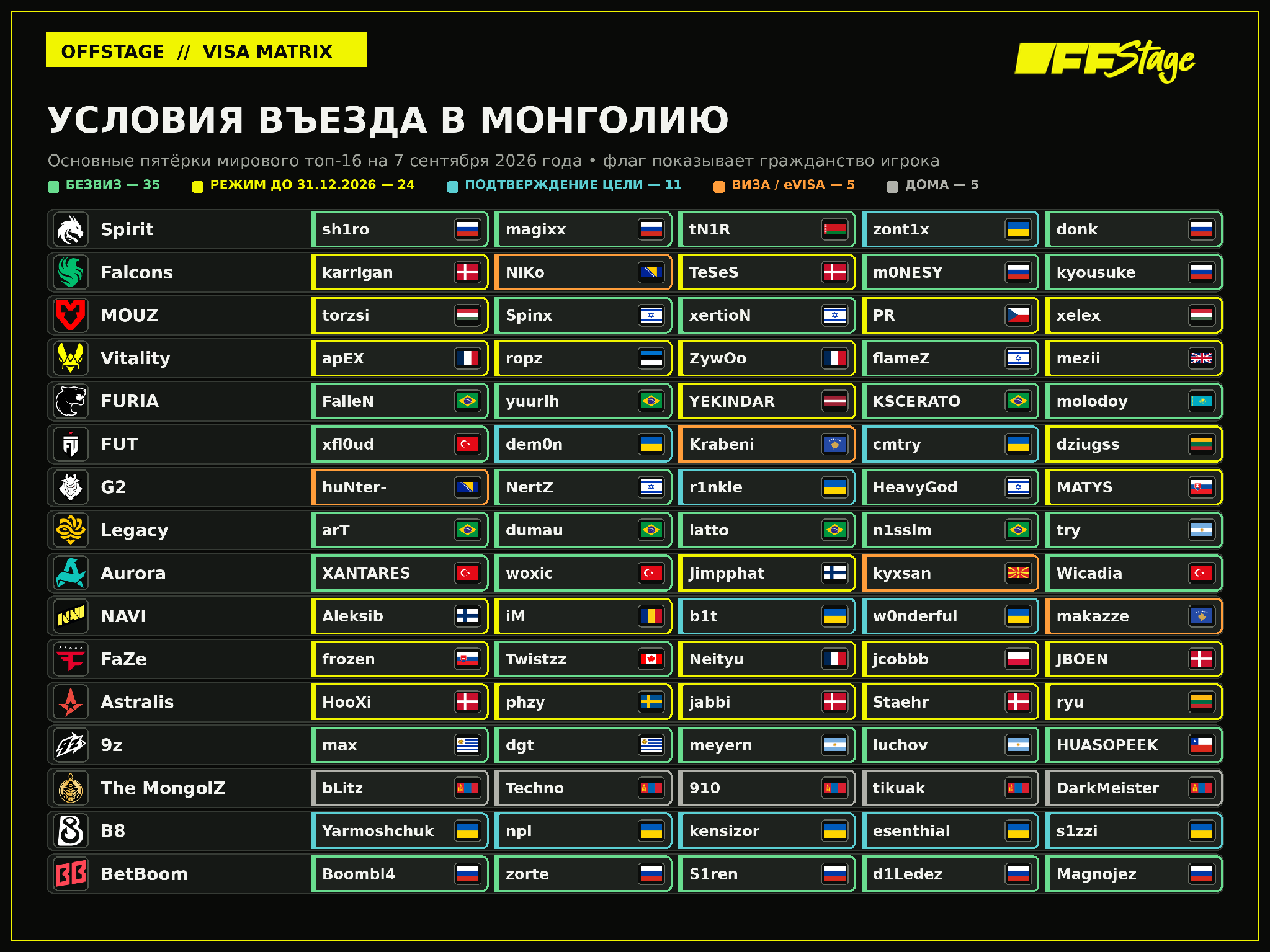
For the 23 EU citizens and one British citizen in the top 16, the visa-free regime is valid only until December 31, 2026. What will happen after that remains unknown. Eleven Ukrainian players will need to provide proof of the purpose of their trip, while citizens of Bosnia and Herzegovina, Kosovo, and North Macedonia will need to obtain a visa.
For example, Team Falcons faces different conditions even within its own roster: Ilya “m0NESY” Osipov is eligible for visa-free entry, Nikola “NiKo” Kovač needs a visa, and Finn “karrigan” Andersen qualifies for a temporary exemption. These are the general rules on which the schedule is based. BLAST has yet to clarify whether participants will need a K4 visa for sports and cultural events. The documents for coaches and managers, who are not included in the schedule, also need to be verified separately.
What’s changing for teams ranked 17th through 32nd
PARIVISION and HOTU can take routes via Irkutsk or Beijing when departing from Russia, while paiN Gaming and MIBR will face a journey of about a day when departing from Brazil. If GamerLegion, 3DMAX, BIG, HEROIC, Ninjas in Pyjamas, Team Liquid, and 100 Thieves prepare in Europe, they’ll be able to fly via Frankfurt. The same applies to Inner Circle and magic.
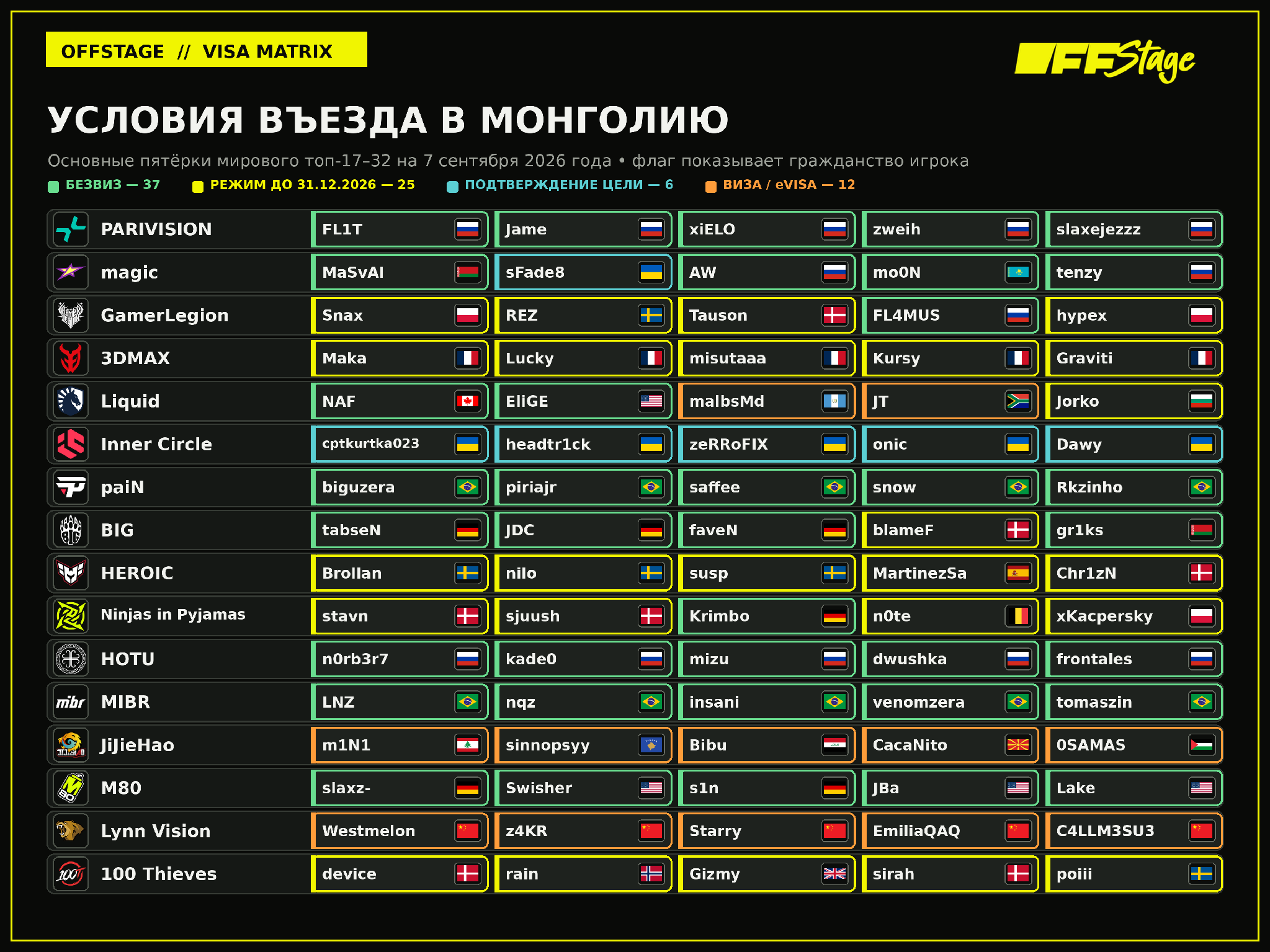
All players from PARIVISION, HOTU, paiN, MIBR, and M80 are eligible for visa-free travel, while the five-player teams JiJieHao and Lynn Vision will need visas. Team Liquid has five different nationalities and three options for visa processing. Among these 80 players, 37 qualify for visa-free entry, 25 have temporary exemptions, 6 must confirm the purpose of their trip, and 12 need to obtain a visa.
How much will the trip cost a fan?
For Russian fans, Mongolia offers the opportunity to attend a major CS2 tournament without a tourist visa. Citizens of Belarus, Kazakhstan, Kyrgyzstan, and Uzbekistan also do not need a visa for a short trip. Citizens of Armenia, Azerbaijan, and Tajikistan should check the requirements for obtaining a regular or e-visa. Europeans are advised to wait for a decision on whether the visa exemption will be extended beyond December 31, 2026, before purchasing non-refundable tickets.
From Moscow, you can fly via Irkutsk, Beijing, or Istanbul; the estimated travel time of 9–14 hours applies to the first two options. From Astana and Almaty, you can consider connecting flights in Beijing or Seoul, while from Minsk, Yerevan, Baku, Tashkent, Bishkek, and Dushanbe, you should expect one or two layovers. For departures from major European cities, the estimated travel time remains the same as for group tours: about 12–18 hours.
A week in Ulaanbaatar without a flight will cost approximately 38,000–81,000 rubles, or €420–900, and with flights from Russia—93,000–156,000 rubles. The same weekly budget, including a flight from Kazakhstan, would be approximately 430,000–805,000 tenge. From Belarus—4,000–6,900 Belarusian rubles; from Armenia—455,000–802,000 drams; from Azerbaijan—2,030–3,650 manats.
From Tashkent, the trip will cost 12.3–24.5 million soums; from Bishkek, 94,000–188,000 som; from Dushanbe, 9,900–19,800 somoni; and from Europe—€1,000–1,800. Tournament tickets and visa fees are not included; prices were verified on September 10, 2026, and may change by May. It’s best to choose flights and accommodations after the spectator schedule is published, rather than booking for the entire two weeks of the tournament.
How Suitable Is Mongolia for a Major Tournament?
It’s more important for teams to choose their training location and arrival date in advance. European teams will have to adjust to the time difference, while those flying in from South America will also have to spend about a day traveling. This unusual location is particularly convenient for those training in East Asia: the short flight means they can avoid a separate, lengthy trip before the BLAST.