Five Tournaments Before Singapore: How BC.Game Can Qualify for the Major


The loss to 100 Thieves knocked BC.Game out of the Esports World Cup, but it showed that the new roster is capable of quickly racking up VRS points. There are 79 days left until the cut-off for the PGL Major Singapore 2026, and now it’s not enough for the team to simply play a lot: they need to plan their schedule wisely, defeat strong opponents at LAN events, and avoid early eliminations as much as possible.
Where Does BC.Game Stand Ahead of the VRS Cutoff?
BC.Game has 79 days left until the ranking cutoff on November 2. Valve uses this specific cutoff to distribute invitations to the PGL Major Singapore 2026, which will feature 32 teams: Europe will receive 18 spots, the Americas nine, and Asia five. For Emil “Magisk” Reif’s international roster, this means competing on the European leaderboard, where the competition is fiercer than on the global one.
In the August 3 ranking, BC.Game was in 81st place with 1,051 points, but the data did not yet include the EWC qualifiers. According to a preliminary calculation by analyst Jesper Larsen, the team should boost its score by about 1,357 points to reach 50th place in the world. The exact ranking will change after the results of the other participants are recalculated, but the scale of the leap is already clear.
In the August rankings, Europe’s 18th-ranked team had 1,468 points, and by November, the cutoff will almost certainly rise even higher. To qualify BC.Game for the PGL Major Singapore 2026, it’s not enough to simply make up the current 111-point deficit: the team must accumulate points faster than the rivals already ranked above them.
Why another small LAN tournament won’t be enough
After winning the Elisa BreakOut and securing three series victories in Paris, there was a sense surrounding BC.Game that simply repeating this path a few times would be enough; however, the VRS system is more complex than that. The calculation takes into account the quality of opponents, accumulated “bounties,” and connections through the results network. For the LAN component, Valve counts only the top ten wins over a six-month period.
The new five-man roster has recorded eight LAN wins: five at Elisa and three in the EWC qualifiers—against BASEMENT BOYS, 1win, and OG. Technically, the limit hasn’t been reached, but only two slots remain open. Once the quota is filled, the next victory will replace a less valuable result, so weaker opponents will no longer provide the same boost as before. A series against a top-30 team, on the other hand, can improve several parts of the formula at once.
Where BC.Game Should Enter
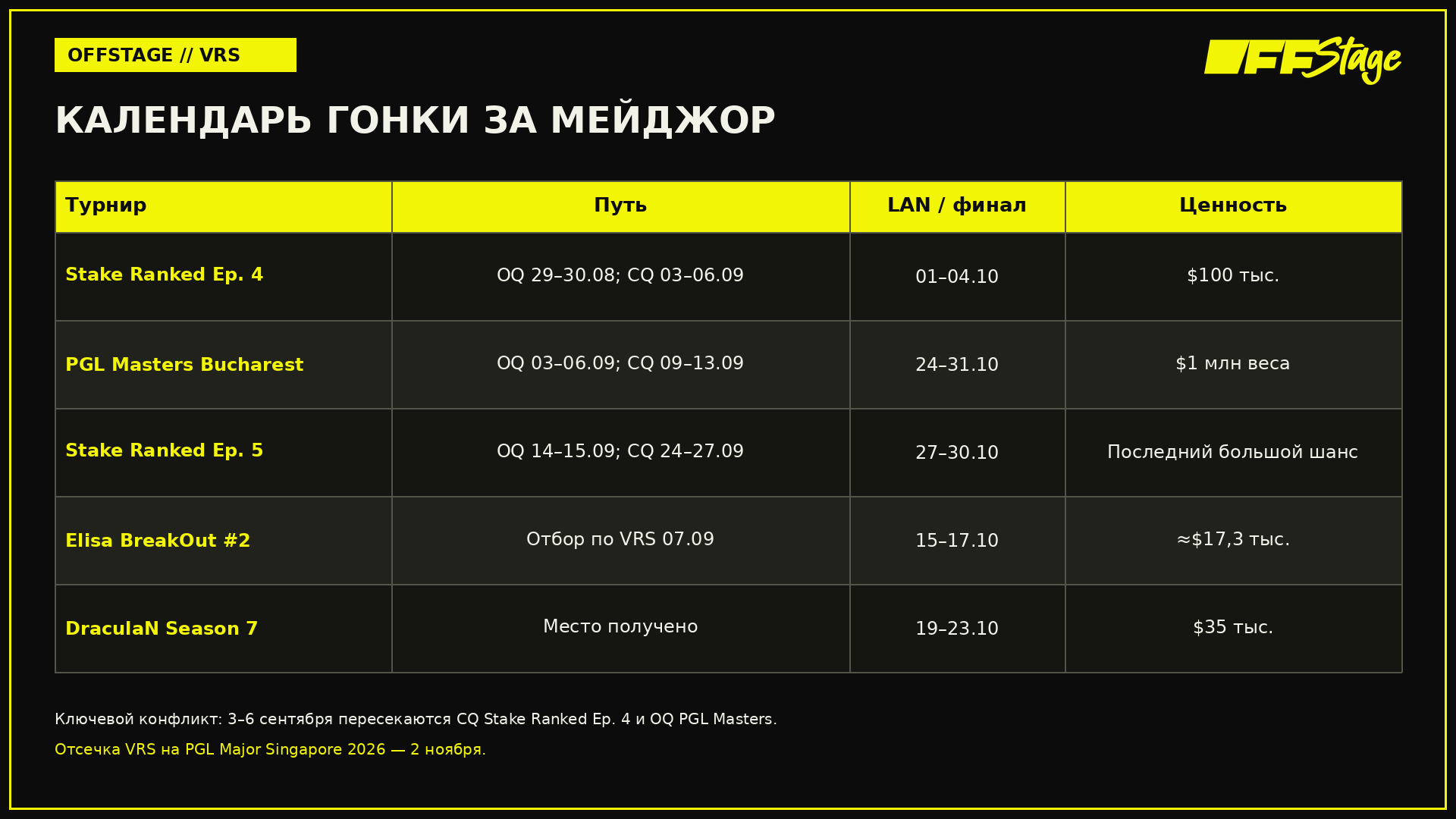
A must-attend tournament is Stake Ranked Episode 4: the open qualifier will take place on August 29–30, the closed qualifier on September 3–6, and the LAN event on October 1–4. The series is designed for teams looking to climb from Tier 2 to major invitational tournaments, so this opportunity should not be missed. The most valuable path leads to PGL Masters Bucharest 2026, with European qualifiers on September 3–6 and 9–13. The winner will earn a slot in the tournament with a $1.25 million prize pool and a $1 million VRS weight. A few wins there are more valuable than a perfect run at a small LAN, so if there’s a scheduling conflict, PGL should take priority over Stake.
There are still three other opportunities: the qualifiers for Stake Ranked Episode 5 will take place on September 14–15 and 24–27. The Elisa BreakOut Series 2 is accepting applications from around the world for a LAN event on October 15–17. BC.Game has already secured a spot at DraculaN Season 7, which will take place October 19–23 in Bucharest.
Elisa, with a prize pool of about $17,300, and DraculaN, with $35,000, require a near-certain victory, whereas qualifying for PGL significantly raises the ceiling for points earned. Stake Ranked Episode 5 ends on October 30, three days before the cutoff, and may be the last chance to improve one’s standing. The sixth episode of the series will take place after November 2 and will not affect invitations to Singapore.
Why Registration Alone Doesn’t Guarantee a LAN Spot
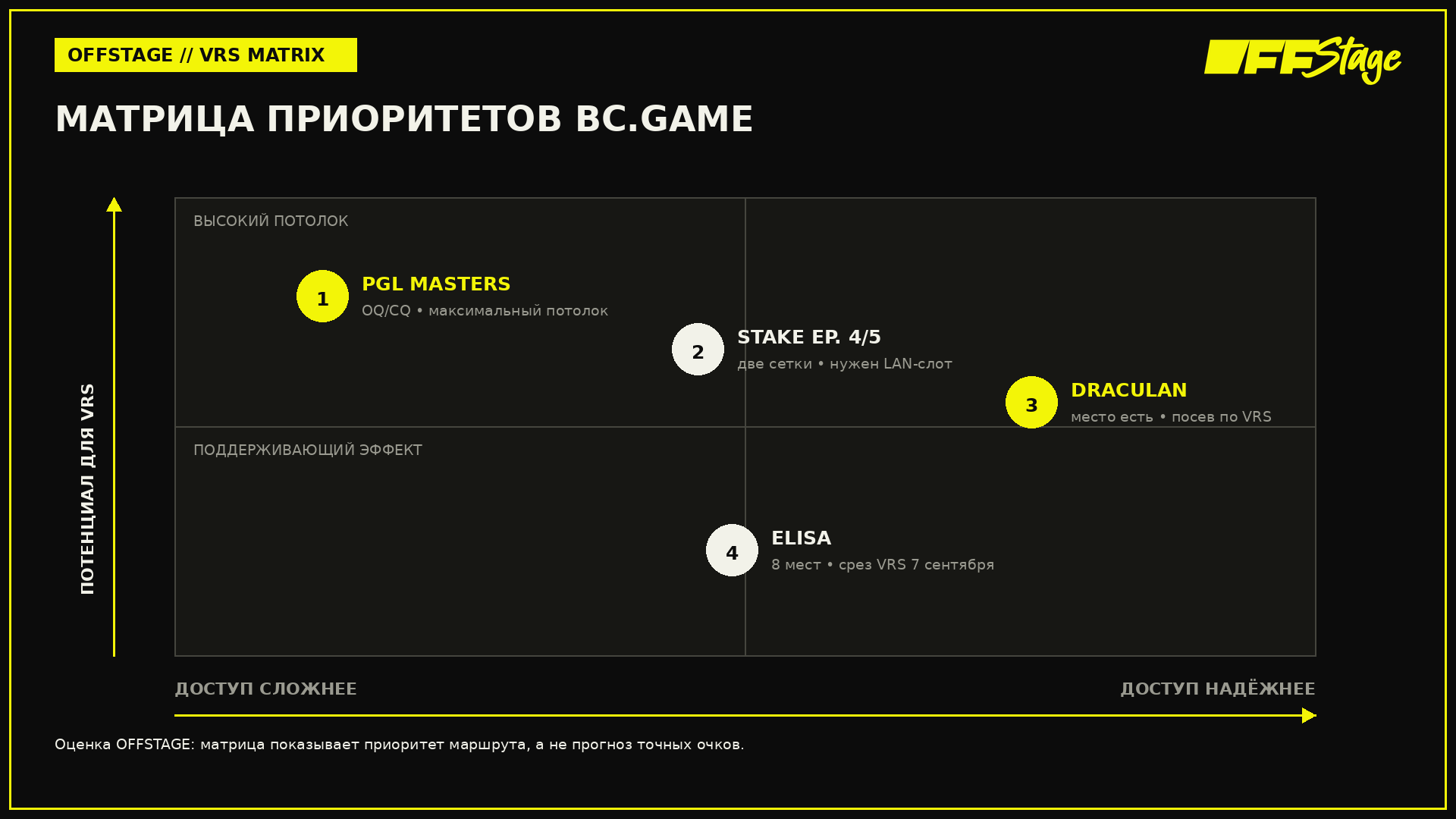
For the Elisa BreakOut Series 2, simply submitting an application isn’t enough. Registration will run from August 21 through September 15, after which eight spots will be allocated among registered teams based on the global VRS as of September 7. For BC.Game, this makes the matches in August and early September doubly important: they’re needed both for the Major and for access to the October LAN.
With DraculaN, the situation is the opposite: BC.Game already has a spot, but the October VRS will determine the length of their path. The top eight registered participants will receive a direct seed into the playoffs, while the rest will be distributed across four LAN groups. The opening and winners’ matches there will be played in a best-of-one format, so a high seed eliminates at least two rounds with high variance. This changes the dynamics of the race: BC.Game needs the VRS not only on November 2, but also at intermediate points. First, the September cut determines a spot at Elisa; then, the October ranking simplifies the DraculaN bracket; and only after that will the November cut determine the Major participants.
The schedule will have to be pieced together like a tournament bracket
A challenge will arise in early September: the closed-door Stake Ranked Episode 4 overlaps with the PGL Masters qualifiers. BC.Game must register for both events and determine the exact match slots in advance. If the brackets cannot be reconciled, PGL should be chosen, since betting on a less valuable tournament contradicts the very purpose of the race.
In October, Elisa ends on the 17th, DraculaN begins on the 19th, PGL on the 24th, and Stake on the 27th. If a team qualifies for PGL, skipping Episode 5 would be logical: the main stage in Bucharest is incomparably more valuable. After failing to qualify for PGL, the Stake tournament, on the other hand, becomes essential insurance ahead of the cut.
Failing to qualify for the EWC wasn’t a failure of the team’s play, but a failure in the closing stages
The loss to 100 Thieves did not prove the roster’s weakness: BC.Game took Inferno 13–7 and pushed Nuke to overtime. On Anubis, the team lost 11–13, falling just a few rounds short of the main tournament. After the match, Viktor “TaZ” Voitas discussed the details: the team forgot to use grenades, lost setups, and reacted inconsistently to their opponents’ advantages. This series aptly illustrates the project’s current stage. Magisk and TaZ combine the playstyles of Alexander “s1mple” Kostylev and Denis “electroNic” Sharipov with the approach of the Mongolian duo, but the system doesn’t always hold up yet. For a young five-man squad, these rough edges are natural, but with a November 2 deadline, they’re dangerous: a single poor finish can ruin a week’s worth of planning.
The decisive Anubis map is particularly telling: s1mple finished the map with a rating of 1.69, while electronic ended at 0.99, Magisk at 0.96, Ayush “mzinho” Batbold at 0.79, and Azbayar “Senzu” Munhbold at 0.62. BC.Game doesn’t build its entire game around the sniper, but at the most crucial moment, he was the only consistent source of an advantage—this imbalance must be addressed before the next knockout stage.
s1mple just needs to maintain his level—the rest of the team needs consistency
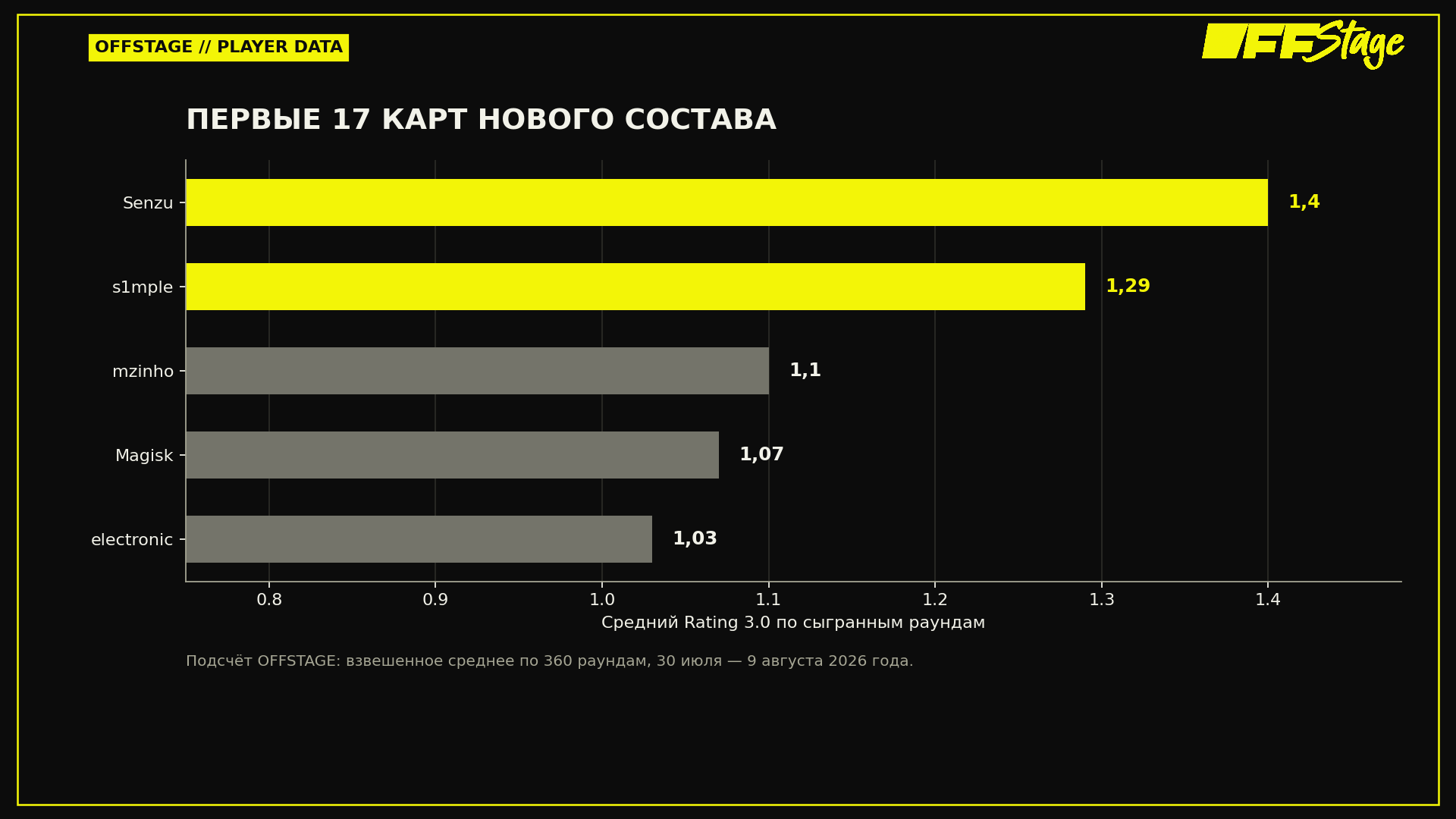
Over the first 17 maps, the new roster played 360 rounds, and OFFSTAGE’s weighted calculation places Senzu in first place with a rating of about 1.4, while s1mple follows closely behind at 1.29. Alexander is already meeting the necessary standards: he doesn’t demand that every round start with his play, maintains his impact with the AWP, and is capable of single-handedly keeping the team in the game during a tough, decisive map. Asking more of him right now would be a way of masking systemic problems.
The average ratings for electronic and mzinho—roughly 1.03 and 1.1—are acceptable, but they mask overly noticeable fluctuations. Denis posted a 1.69 against Trainwrecks and a 1.51 against HAVU, but finished the match against 100 Thieves with a 0.87. Ayush was the best player in the final against ENCE, but on certain maps at EWC, he dropped out of rounds and left the team without a trade. In tournaments where there’s no room for error, five series at 1.08 are more useful than alternating between 1.4 and 0.8.
Senzu remains the driving force of the offense and the best player of the first few weeks, so his overall form is not in question. The team needs Azbayar to maintain his impact specifically in the closing stages of series: his 0.62 rating on the decisive Anubis map against 100 Thieves stands in stark contrast to his dominance over OG and 1win. The leader in the stats must remain the leader when the opponent has adapted and the match has reached the final weapon rounds.
Magisk’s main race isn’t for rating, but for time
Magisk’s average rating of 1.07 is sufficient for a captain who takes on challenging roles and reorganizes the team’s gameplay. The issue isn’t Emil’s aim, but his speed of adaptation: the Dane himself has acknowledged that the IGL role is very challenging. The captain has to simultaneously monitor his own play, the round plan, and the reactions of his four teammates.
Magisk has championship experience and players capable of winning any match, but that very fact increases the pressure. Failing to qualify for a Major with s1mple, electronic, Senzu, and mzinho would be a failure for the project, since the next viable opportunity won’t come for another six months. In two months, Emil doesn’t need a perfect Counter-Strike, but he does need a reliable set of strategies to close out even maps.
The practical goal is simple: to reduce the number of rounds in which players interpret the same situation differently. BC.Game has enough firepower, but lacks the reflexes needed after the first exchange, when defending the bomb site, and on late pushes. These situations will be more decisive than yet another complex play at the start of the round.
What a viable path to a Major looks like
The ideal path begins with the European qualifier for the PGL Masters: a victory pits BC.Game against strong opponents and increases the value of their results. Then Elisa and DraculaN serve as warm-ups, and Stake Ranked Episode 5 can be skipped due to a scheduling conflict with the main stage of PGL.
A more realistic scenario does not include a major invite, so it requires a nearly flawless fall season: qualifying for the Stake Ranked Episode 4 LAN, winning or reaching the finals at Elisa, making a deep run at DraculaN, and then advancing to Episode 5. The number of matches alone isn’t enough—BC.Game must defeat 3DMAX, HEROIC, Liquid, Luminosity, or other high-ranked opponents. Otherwise, even several tournament wins won’t guarantee a spot in the European top 18.
A worst-case scenario would be an early elimination from the PGL and Stake qualifiers, after which their hopes would rest on two small LAN events in October. By that point, competitors will have accumulated more valuable results, and BC.Game won’t have time to make up for its weak wins in the VRS formula. Therefore, the true point of no return isn’t November 2, but the first half of September.
79 days with no room for a week off
The path to Singapore requires a coherent series of decisions: enter Stake and PGL, take advantage of the open entry to Elisa, and accept the invitation to DraculaN. Then they’ll have to set the right priorities in a packed October. If electronic and mzinho get their form back, Senzu won’t falter in the decisive maps, and Magisk secures the late rounds, BC.Game will make the cut. Missing even one step in this chain will leave no time for a calm recovery.