How Alliance Climbed to the Top 20 in CS2: The Evolution of the Roster

Alliance is one of the few organizations in Counter-Strike to have consistently moved up the ranks. It didn’t make a single transfer that instantly made the Swedish roster competitive; instead, it took a much more measured approach: retaining a solid core, replacing one problematic position at a time, and gradually raising the bar for its players. As a result, the current lineup doesn’t look like a random lucky combination, but rather the culmination of nearly three years of work. There is no star player around whom the rest are forced to play; instead, there is a clear-cut captain, a dedicated sniper, a true entry-fragger, and two riflers who have been assigned more natural roles.
As of July 18, 2026, Alliance ranks 17th in the global Valve Regional Standings and 12th in Europe. This isn’t enough for an undisputed Tier 1 spot just yet: the team hasn’t established itself at the biggest tournaments and hasn’t proven it can consistently beat teams from the top ten. However, the label “Tier 1.5” no longer seems like an overstatement. Alliance is on the verge of breaking through, winning events and frequently defeating opponents who are themselves vying for spots at the Major.
A Start That Didn’t Promise a Quick Breakthrough
Alliance’s first roster, unveiled in 2023, clearly reflected the project’s initial scope. It included Jonathan “b0denmaster” Bodenmalm, Niklas “PlesseN” Plessen, Robin “robiin” Sjögren, Arvid “avid” Oberg, and Simon “twist” Eliasson. A few of the nicknames were familiar to those who followed the Swedish scene, but the team didn’t look like a future contender in major LAN tournaments. It lacked both obvious international-level talent and a ready-made core of players who simply needed the organization’s support.
Alliance itself set a realistic goal at the time—the club planned to focus on the local scene first, while simultaneously developing its academy and youth program, and to take a long-term approach to reaching the international level. This is an important detail: the first roster wasn’t marketed to the audience as a team expected to quickly qualify for a Major. It served as an entry point into the Swedish Counter-Strike scene and a way to understand what resources the organization needed in this new discipline.
That five-man roster had a noticeable ceiling. b0denmaster combined the captain’s role with that of a sniper, robiin was responsible for in-game leadership, and PlesseN and twist already had fairly long careers. Such a roster could win individual series thanks to their experience, but it didn’t give Alliance an advantage in either mechanics or team strategy. At the same time, it was precisely at this stage that the club avoided the most dangerous mistake for a young organization: it did not replace the entire roster after every unsuccessful qualifying cycle.
It’s no coincidence that twist and avid survived the roster shakeup
Of Alliance’s original starting five, only two players remained—twist and avid. On the surface, this might seem like excessive loyalty to the original roster, but keeping them around followed a distinct and entirely understandable logic. twist gradually became the in-game leader and unified several roster iterations under a single gameplay philosophy. avid, on the other hand, proved to be the rifler who could be rotated between less prominent roles without the need to build the entire offense around him.
Twist’s evolution is particularly important. At the start of the project, his value stemmed from his experience playing for Ninjas in Pyjamas, fnatic, and GODSENT, but a strong past alone isn’t enough for the team’s development. In the current Alliance, Eliasson is needed first and foremost as an IGL who understands his players’ capabilities and doesn’t try to artificially complicate their roles. For a roster without a superstar, this is a sensible model: the advantage comes not from the freedom of a single standout player, but from the fact that everyone knows their role in the round in advance.
Avid’s value has been demonstrated through consistency: even when switching out the sniper, the aggressive rifler, and the fifth player, Alliance retained someone familiar with the captain’s requirements. This continuity reduces the time required for each re-adjustment and allows for the replacement of specific roles, rather than having to re-train the team on basic coordination.
The Shift from a Roster Based on Names to One Based on Roles
By mid-2025, Sean “eraa” Knutsson and Marcus “upE” Johansson were already playing alongside twist and avid. PlesseN still held the fifth rifleman position. This was an intermediate version of Alliance: a dedicated sniper and a younger marksman had raised their individual skill levels, but the team remained far from the top tier of European competition. In the global VRS as of June 2, 2025, it ranked only 76th.
The team’s trajectory was more important than any single ranking. By December, Alliance had climbed to 48th place in the VRS, and by early 2026, it had reached 42nd. The growth was not linear, and the roster continued to change, but the club never fell back to its starting point. Each subsequent lineup retained the core quartet of twist, avid, eraa, and upE—meaning the organization had already established its core and was only looking to fill the missing roles.
The first major catalyst was the six-month “loan” of Liam “MaiL09” Tugel from Metizport. The young rifler added pace and firepower, and Alliance provided him with an environment where he didn’t have to carry the entire project right away. In this lineup, the team won the Svenska Cupen 2025, CCT Season 3: Europe, and JOURNEY Spring 2026. These trophies alone don’t elevate the roster to Tier 1, but three victories in different competitions can no longer be explained by just a lucky draw.
In the spring of 2026, Alliance began winning matches against higher-tier opponents. Among the results tracked by VRS are victories over Team Liquid, Aurora Gaming, GamerLegion, Passion UA, and 3DMAX. There were also painful losses to lower-ranked teams, so it’s too early to speak of complete stability. Still, by April, Alliance had climbed to 23rd place in the world—from this position, it’s already realistic to compete for invitations to major tournaments.
bobeksde clarified the roster’s balance
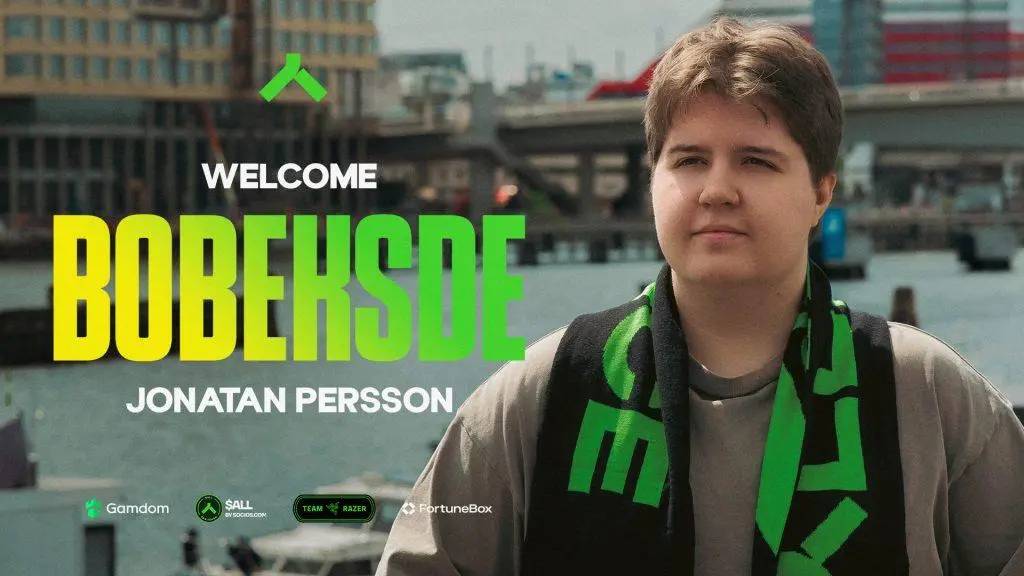
In June 2026, MaiL09’s loan period ended. Metizport chose not to renew the agreement and kept the player on their roster, so Alliance had to look for a replacement. The club signed Jonathan “bobeksde” Persson from EYEBALLERS.
bobeksde was a good fit for Alliance primarily because of his role. He’s a specialized entry-fragger who initiates trades and creates space for the team. The forced replacement of MaiL09 also made the roster more balanced.
The new lineup quickly earned a seal of approval, albeit on a local level so far. During their first LAN weekend with bobeksde, Alliance played eight matches over two days and won seven of them. Among those they defeated were fnatic and Metizport, and the team avenged their sole loss to Nexus with a rematch on the same day. This series doesn’t prove they’re ready for Tier 1, but it shows that the roles clicked without a long adjustment period.
Why the current starting five is truly balanced
Alliance’s balance starts with the absence of competition for the same resource. eraa is the permanent sniper, so there are no internal disputes about who should get the AWP or how to adjust the economy around him. twist calls the plays and is responsible for the overall structure. bobeksde gets first pick, while avid and upE can choose positions for continuing the attack, trading, and the late stage of the round.
This system has another advantage: it requires each player to deliver a realistic performance. Alliance doesn’t expect twist to be both the captain and the main fragger at the same time. eraa isn’t required to win every map single-handedly against elite snipers. Riflemen can contribute in various ways rather than competing for the most advantageous positions. In Tier 1.5-level teams, the distribution of responsibilities is often more important than having another standout shooter.
Analytical coach Simon “Hawk” Wevingren plays a distinct role. As the job title suggests, Alliance relies not only on in-game management but also on preparation for specific opponents. This is particularly beneficial for a team with a packed schedule. Opponents change quickly, and there’s almost no time for a full training cycle. The coach’s job is to help twist conserve energy for in-round decisions.
That said, balance doesn’t mean there are no weaknesses. Alliance doesn’t yet have a player who is guaranteed to maintain a high rating against the world’s top ten once the team-based system stops producing straightforward one-on-one matchups. Eraa faces a test against elite AWP players, while twist faces opponents who read set plays faster and punish him for repeating the same tempo. The current lineup seems logical, but its resilience has yet to be tested.
Tier 1.5—not a compliment, but an accurate description of their position
The term “Tier 1.5” is often used too loosely, applied to any team near the top 30. In Alliance’s case, however, it has a specific meaning. The team has already outgrown the level of a roster that only earns points in local qualifiers. It wins tournaments, takes series from teams in the large European pool, and hovers near the cutoff for invitations to major LAN tournaments under Valve’s system.
At the same time, Alliance is still separated from Tier 1 by a few key benchmarks. It needs to qualify for a Major or another major LAN event, where a loss cannot be made up for by a dozen subsequent online matches. They need a winning streak against opponents from the top 15 of the VRS, not just isolated upsets. Finally, the new roster must survive the initial period when opponents accumulate match history, study bobeksde’s opening rounds, and begin to deliberately target their weak maps.
The current global VRS ranking should also be interpreted with caution. This is a strong position for the Swedish team, which was ranked 76th a year ago, but the July ranking partly reflects the results from the version featuring MaiL09. The new roster has already earned its own points, but it will need to replicate its spring win total. Otherwise, Alliance will maintain a solid structure but slip out of the major invite zone.
Alliance’s main achievement is its clear trajectory
Alliance’s story is interesting not because of the scale of its investments or the sudden acquisition of a ready-made core. The organization has learned to improve its roster without starting from scratch. First, it retained twist and avid, then secured eraa and upE. The Swedes tested the younger fifth rifler through a loan, and they selected bobeksde specifically to meet a precise tactical need. At each stage, fewer details changed than were retained.
That is precisely why the current team inspires more confidence than many expensive projects. Alliance doesn’t need to explain who should call the plays, who takes the AWP, or who opens up space. The main questions now concern not the players’ chemistry, but their level of performance against the strongest opponents. This is a good kind of uncertainty: the system is already visible; all that remains is to test its limits.
Alliance’s next goal is clear: to turn their presence near the top 30 in VRS into consistent invitations and experience at major LAN tournaments. If bobeksde maintains his influence after opponents study his style, and twist expands the team’s offensive options, the team is capable of establishing itself in Tier 1.5. Periodically, it may even climb higher. For an organization that started out as a nearly obscure Swedish five-man squad, this is already a significant evolution. But for the first time ever in CS2, Alliance’s ceiling is determined not by the names of its players, but by how far their overall system can grow.
Read also: Has BC.Game assembled a Tier 1 team… or not?