Superfluous in the map pool: why Overpass has given way to Cache

The day after the conclusion of the IEM Cologne Major 2026, Valve announced another change to the competitive map pool: following the end of the fourth Premier season on July 6, Cache will replace Overpass. For this new version of the classic map, this will mark a full-fledged return to the professional scene after a seven-year absence, while Overpass will leave the map pool just one year after its previous return.
At first glance, Valve’s choice seems controversial. Overpass remains one of Counter-Strike’s most unique and tactically deep maps, while Cache’s layout has remained virtually unchanged since the days of CS:GO. However, the developers’ decision isn’t based on the maps’ age or even a desire to capitalize on nostalgia: Overpass proved to be unsuitable for two of the game’s main audiences. Professional teams rarely picked it at major tournaments, and casual players banned the map even more frequently.
Overpass never became a full-fledged Tier 1 map
In 2026, Overpass was played 67 times at major tournaments. Only Anubis had fewer matches; it returned to the map pool in the winter and appeared in just 36 matches. Overpass lagged significantly behind the rest of its competitors: Dust2 was played 150 times, Mirage 147, Inferno 94, Ancient 84, and Nuke 83.
| Map | Played |
| Dust2 | 150 |
| Mirage | 147 |
| Inferno | 94 |
| Ancient | 84 |
| Nuke | 83 |
| Overpass | 67 |
| Anubis | 36 |
The Major results only confirmed the overall trend. Over the course of the tournament, Overpass appeared 21 times compared to 16 for Anubis, though this gap narrowed significantly compared to the start of the season. As the year progressed, Anubis gradually gained popularity, while Overpass, on the other hand, was increasingly left out of teams’ picks. This reflects the attitude of the professional scene: many teams were reluctant to include Overpass in their map pool and preferred to invest time in more in-demand maps, causing its standing to gradually weaken.
Against this backdrop, Cache’s return appears less risky. In the years leading up to its removal, the map was consistently used on the professional scene: in 2018, 109 matches were played on it at major tournaments—more than on Nuke and Dust2. A year earlier, Cache had 65 matches and also outpaced Nuke, which stopped at 53.
| Year | Cache | Nuke | Dust2 |
| 2017 | 65 | 53 | — |
| 2018 | 109 | 77 | 74 |
Cache didn’t require teams to completely overhaul their gameplay. Its simple three-lane structure, the fight for mid, and clear attack routes allowed the map to be added to the roster relatively quickly without turning it into a separate discipline within the game. Overpass, on the other hand, required a well-thought-out strategy; without it, a team would quickly find itself confined to a few narrow passages and lose the ability to apply pressure.
At the Major, the defense won more than 60% of the rounds
The map’s low popularity would have been less of an issue if Overpass had addressed another problem with the map pool. For example, Anubis held its place for a long time thanks to its offensive advantage, thereby balancing out maps where the defense felt more comfortable. Overpass, however, moved in the opposite direction.
At the IEM Cologne Major 2026, teams on the defense side won 61.4% of the rounds on Overpass. There wasn’t even such a pronounced imbalance on Nuke in 2019, when the map was considered the prime example of imbalance between the sides. Over the course of the entire season, the difference was smaller, but it still remained the most noticeable in the map pool: the defense won 54.2% of the rounds.
A single tournament sample cannot be considered the final word, but the annual statistics confirm that the Major merely highlighted an existing problem in its most noticeable form—the defense’s advantage is inherent in Overpass’s structure. CT players can contest the “fountain,” “connector,” and “short” early on, and then quickly adjust their positioning between sites once they’ve gathered intelligence. For the attackers, however, winning a single firefight isn’t enough. They need to push back the defenders with grenades, conserve players and time to advance, and then correctly read the rotations. Any mistake leaves the team facing a fortified backline at the end of the round.
The problem becomes more apparent when viewed against the backdrop of the entire map pool. In 2026, Ancient, Inferno, Mirage, Nuke, and Overpass saw the defense win more than 52% of the rounds. Five out of seven maps leaned heavily in one direction, and Overpass was the most pronounced example of this trend.
Cache has the potential to shift the balance. In 2017, the attacking side won 54.7% of rounds on it, and in 2018, 55.6%. These figures cannot be directly applied to CS2: the economy, grenades, movement, and half durations have all changed. However, Cache’s layout provides the attack with more opportunities to fight for mid, make quick pushes, and split the defense across different directions.
For the average player, Overpass turned out to be too complex
Tactical depth is considered Overpass’s main strength, but for the average player, it becomes a weakness. The map does a poor job of explaining its structure to newcomers: some areas are stacked on top of each other, transitions between directions are unclear, and distances on the radar don’t always match the actual route.
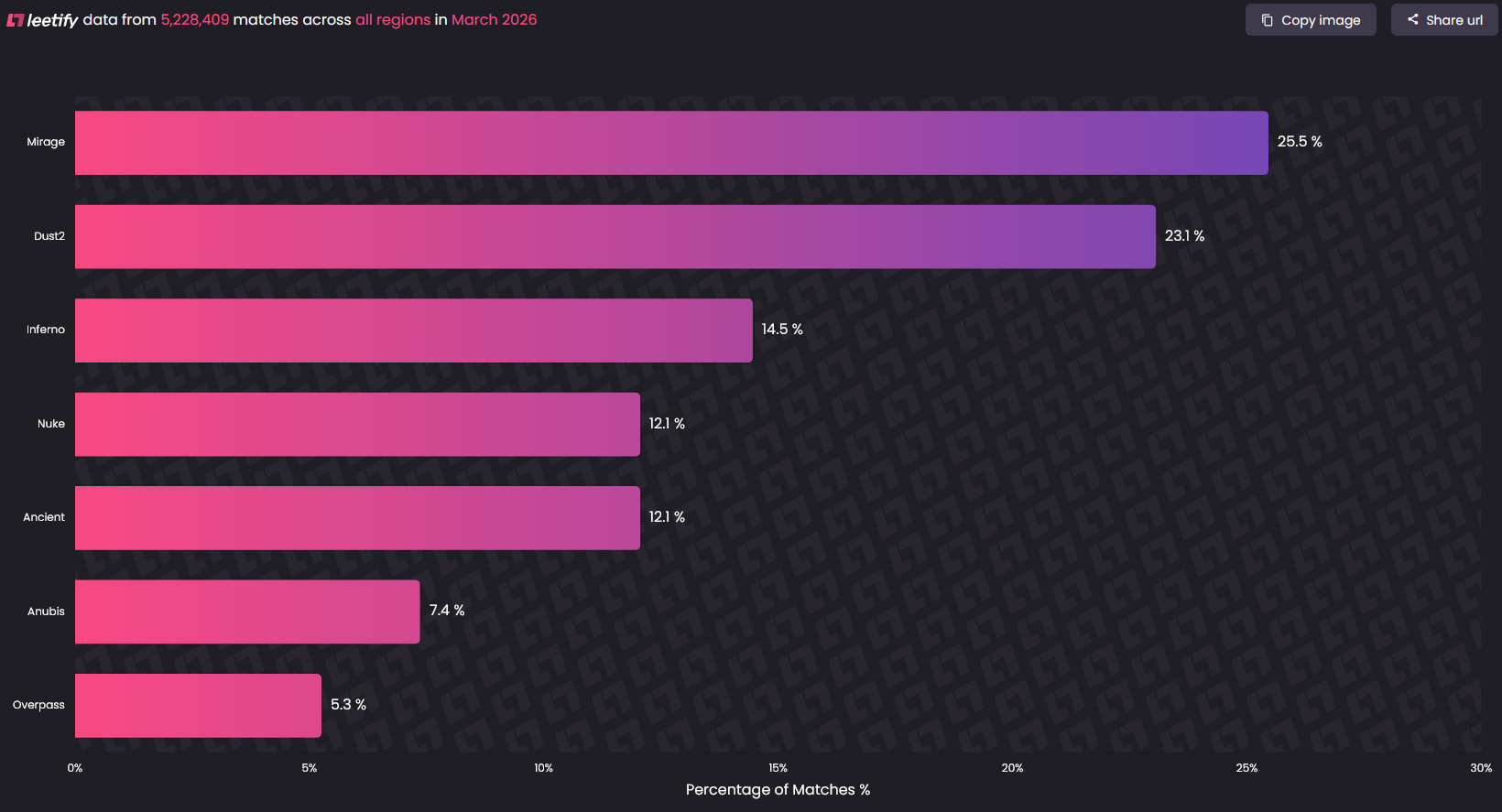
In March 2026, Overpass accounted for just 5.3% of Premier matches. The map lagged behind all its main competitors and ranked alongside the recently returned Anubis, even though players had had much more time to study it. It’s hard to explain this low performance solely by its novelty.
It’s hard to play on Overpass without coordination. Attackers need to agree on who takes the “connector,” who controls the aggression at the “fountain,” when the team starts pushing the defense out of the “bathrooms,” and how many grenades to save for the push. If five unfamiliar players act independently, the attack quickly breaks down into individual duels in different parts of the map.
Cache offers an almost opposite experience. The map is built around three clear routes, the fight for space is centered on the mid, and positions and rotations are easy to read even without in-depth knowledge of the location.
Cache was chosen even before Valve’s decision
Cache’s return in late April sparked a surge in activity that no other CS2 map could match. On April 29 alone, over 160,000 matches were played on it in Competitive and Premier modes—43.5% of the total number of games. The figures for other maps that day didn’t exceed 14%! Part of this result can be attributed to the novelty effect and nostalgia for CS:GO. However, interest didn’t fade after the first few days: Cache established itself among the most popular maps and continued to compete with Dust2 and Mirage.
The statistics from FACEIT are even more telling. Despite not being part of the official professional map pool, Cache accounted for 8.97% of matches, outpacing Inferno at 8.65%, Nuke at 6.77%, and Overpass at 2.84%. Players effectively voted to change the map pool even before Valve’s official decision.
Overpass lost its spot in the map pool
Removing Overpass doesn’t mean the map is bad. It can feature complex rounds, intense battles for space, and constant repositioning—elements that are almost nonexistent on more linear maps. For experienced teams, Overpass remains a powerful tool that allows them to turn preparation and macro understanding into an advantage.
The problem lay in its place within the specific map pool. Overpass was rarely picked in Tier 1; it exacerbated the overall bias toward defense and remained one of the least popular maps among casual players. Each of these factors could have been accepted on its own, but together they made the map the most obvious candidate for replacement. It’s worth noting that Cache doesn’t guarantee a perfect solution either. The historical advantage of the attack side may disappear in CS2; professional teams are capable of finding overly strong defensive positions, and the map’s current popularity will decline over time.
Valve didn’t simply bring back a beloved map and remove an unpopular one. The developers replaced a complex tool designed for a limited number of skilled teams with a map that both professionals want to practice on and casual players want to play. In this battle, Overpass didn’t lose to Cache—it lost its own place between Counter-Strike’s two audiences.