The Asian Collapse: How BC.Game Esports Managed to Avoid Punishment for Changing Their VRS Region


Valve restricted region changes ahead of the PGL Major Singapore 2026, but then made an exception for BC.Game Esports. But the controversy surrounding Valve’s Asian ranking system (VRS) cannot be reduced to just BC.Game—over the course of a few weeks, several teams attempted to improve their standing in the qualifiers by changing player lineups and nationalities. Sashi Esport went particularly far, openly announcing temporary roster changes in order to switch to the Asian region. That’s why I support Valve’s intervention. But the new rules should give participants time to prepare, and the developer has run into a problem with that.
Let’s examine how WW TEAM and Sashi Esport’s attempts to qualify through Asia exposed the VRS issue—and why a single ban wasn’t enough.
How WW Team Tried to Change Regions
In late September, WW Team invited Ermek “enzero” Kartanbayev from Kyrgyzstan to serve as a stand-in. The roster already included Boris “Ryujin” Kim from Uzbekistan, and Ivan “StRoGo” Shurpatov began representing Tajikistan. Together, this made for three players from the Asian region. To qualify for the relevant ranking, the new five-man roster needed to play five matches. The opportunity to move closer to the invitation zone arose thanks to the roster change, even before any new victories.
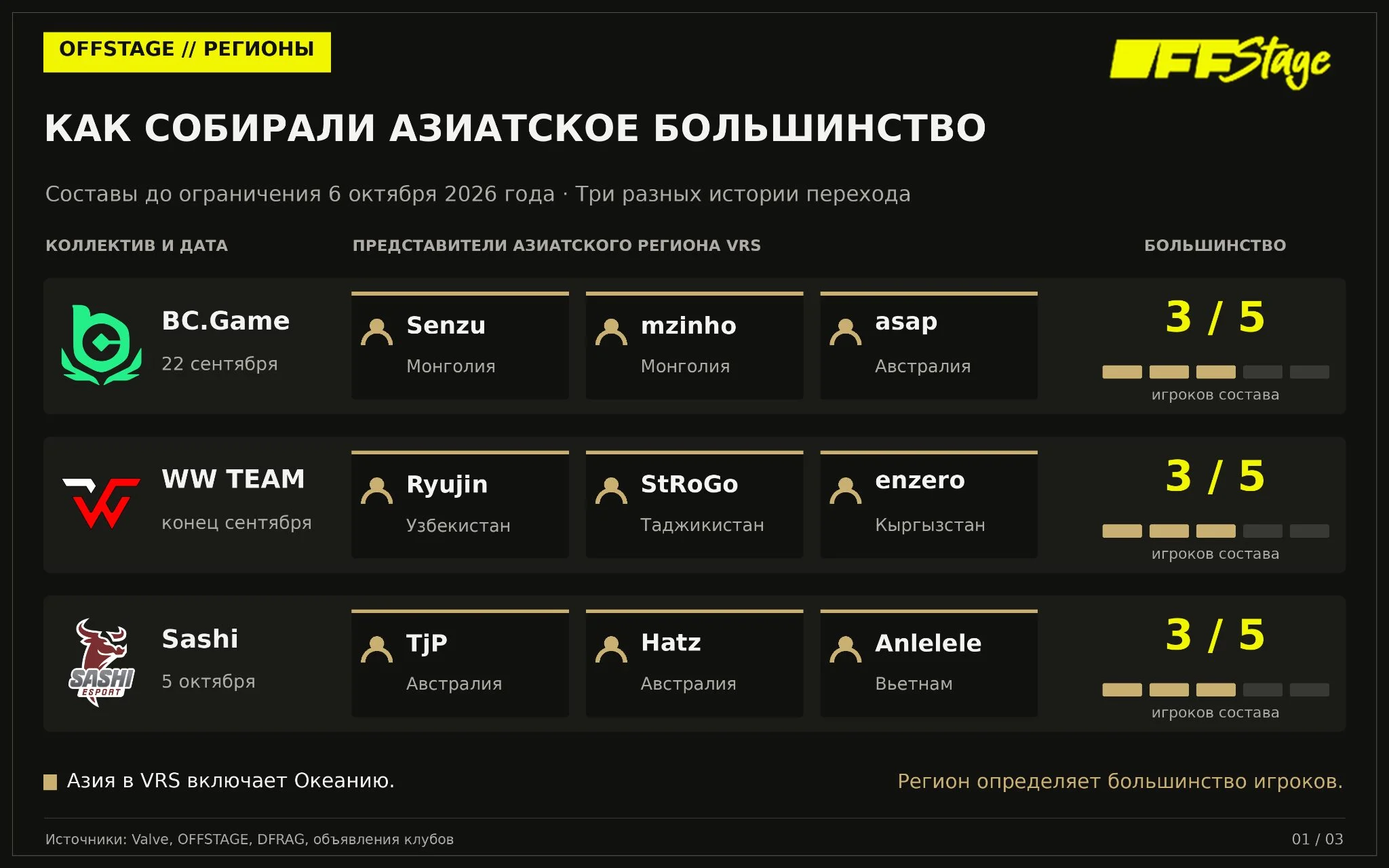
This mix of nationalities alone does not make a team a rule-breaker. However, the example of WW shows just how attractive it has become to seek out a favorable region: all it takes is to assemble the necessary majority to claim a higher ranking with the same number of points. For participants in the Asian qualifiers, this would mean the emergence of yet another competitor. The number of invitations would remain the same, and someone would have to give up their position without losing a match.
This move by WW did not bring immediate success. At FRAG Season 18, the team lost to ARCRED and DNK and was eliminated without a single win, even before the October rule change. But the poor result doesn’t negate the problem itself: participants could seek a shorter path to the Major by switching regions. If this option is more advantageous than a long struggle in the previous ranking, it’s no surprise that there’s interest in it.
Sashi Turned the Loophole into a Public Strategy
On October 5, Sashi announced the temporary signing of Australians Tainan “TjP” Pertell and Jordan “Hatz” Bajic. Two players from the previous roster were to give up their spots to them for the coming month. The third Asian representative was Anton “Anlelele” Huyn, who had previously been listed on HLTV as Danish. Management explicitly stated the goal of the roster changes—the Asian ranking—so it would be strange to explain it all as a routine search for reinforcements.
According to owner Sashi, Anlelele had held only Vietnamese citizenship from the very beginning. The player confirmed this information to HLTV, after which his country of origin was updated in his profile. There is no confirmation that a new passport was issued specifically for the Major. In my opinion, the real issue was something else—Sashi used this information, along with temporary substitutions, to secure an Asian majority before the selection process ended.
At the time of the announcement, Sashi was ranked 54th in the European VRS with 1,122 points; on the Asian list, that same score would have placed him fifth. This isn’t an invitation yet, but the difference explains the interest in this strategy. For FlyQuest, Lynn Vision Gaming, and other contenders, such a shift would mean a new competitor right on the cutline without a single additional win on their part. I see a contradiction here with the very idea of regional spots: they are meant to support representation from different scenes, yet their availability depends on reshuffles before invitations are issued.
The rule was necessary, but it came too late
On October 6, Valve added a condition: to qualify for a regional slot, a team must not have appeared in another region’s VRS during the previous three calendar months. SavageTech CEO Tom Jung Lemke reported after speaking with Valve that Sashi was the final catalyst. However, the restriction affected various teams, so it would be incorrect to view it as a measure specifically targeting BC.Game.
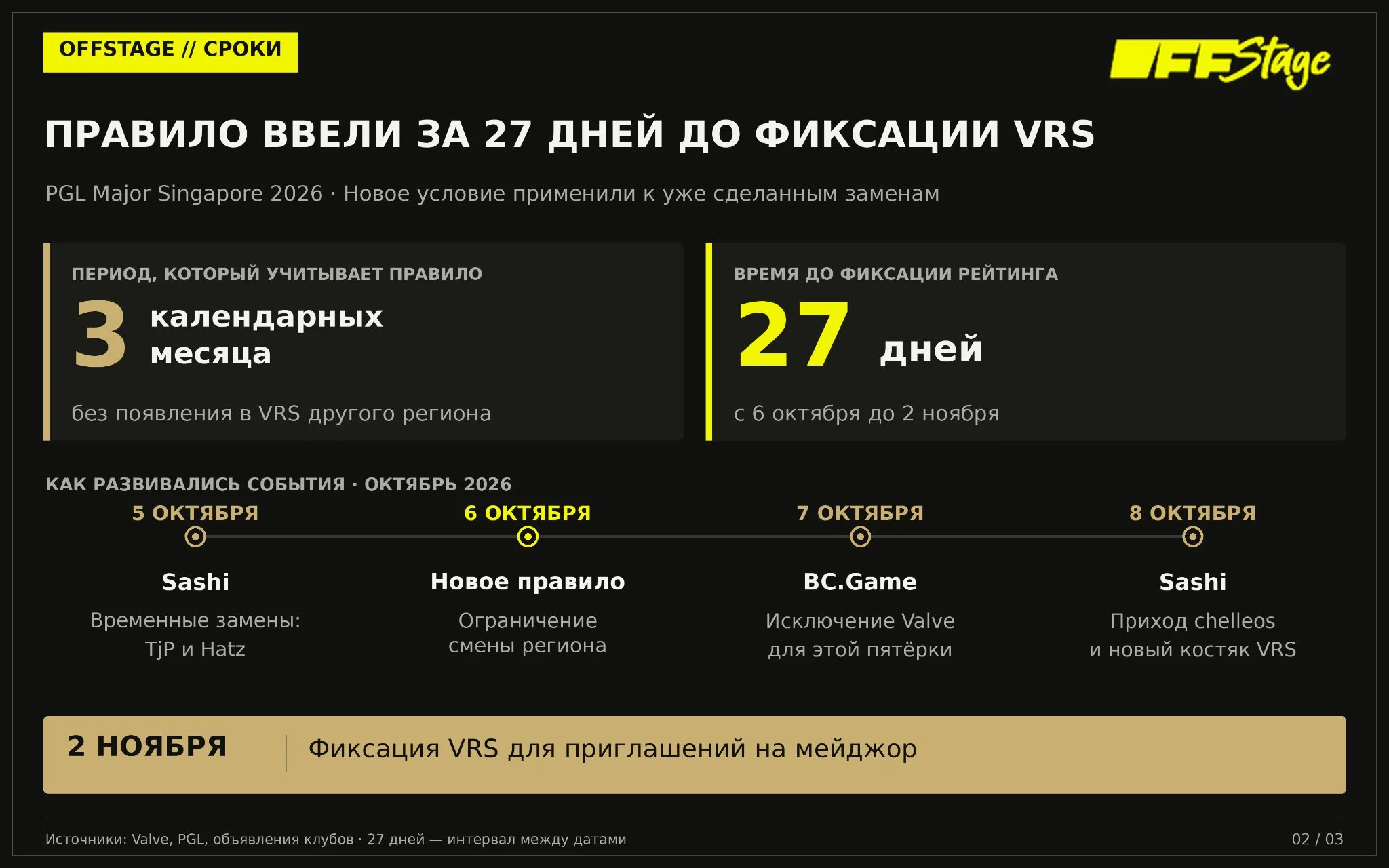
The ban on quick transfers diminishes the point of temporary signings aimed at securing a favorable rating. The problem lies in the timing: there were only 27 days remaining before the VRS for the PGL Major Singapore 2026, scheduled for November 2, was finalized. The three-month requirement was applied to teams that had already made roster changes. No amount of practice or matches won could alter the rating history for that period.
This is where I disagree with the “they found a loophole—so it’s their own fault” approach. One can condemn Sashi and WW’s strategy, support the Asian scene, and simultaneously demand a clear procedure for imposing the ban. If the existing conditions allowed for the transfer, the new restriction must explain what those who have already taken advantage of it should do. Otherwise, a team’s fate depends on urgent correspondence with the developer, and the consequences of the substitutions made only become clear after the contracts have been signed.
Why the exception for BC.Game is justifiable
BC.Game’s Asian majority emerged on September 22 following the arrival of Tyson “asap” Patterson: the Australian joined two players from Mongolia. By October, the roster had already qualified for the Asian VRS. Returning to Europe with the same five players wasn’t possible under the general rule, since the region is determined by the majority of players. The new ban blocked the path through Asia, and returning to the European roster required yet another roster shake-up.
BC.Game’s stated long-term vision for the project works in its favor. This differs from Sashi’s original plan, which involved monthly substitutions. However, the manager’s statements do not prove that the team’s standing in the VRS was not considered at all: a transfer beneficial to the roster could simultaneously improve their position in the VRS.
On October 7, Valve added this BC.Game five-man roster to the list of exceptions, assigned them to the Asian region, and allowed them to compete for an invitation. I consider this a reasonable solution for a roster that faced a new condition in the middle of the qualifiers. Valve did not publish a detailed justification, so the club manager’s statement cannot be considered a confirmed reason for the exemption. The published decision also does not require resetting points, although BC.Game had proposed this option. A spot in the Major still depends on the team’s ranking.
One exclusion isn’t enough
Sashi’s story continued even after the ban. On October 8, New Zealander Michael “chelleos” Hawkins joined the roster—already the third new addition in just a few days. Only two players remain from the original five, so the new roster will have to start from scratch in the VRS. This is a different path to qualifying for the Asian qualifiers: they won’t be able to carry over their previous European points and will have to earn their results all over again. This outcome cannot be equated with either Sashi’s original plan or the exception granted to BC.Game.
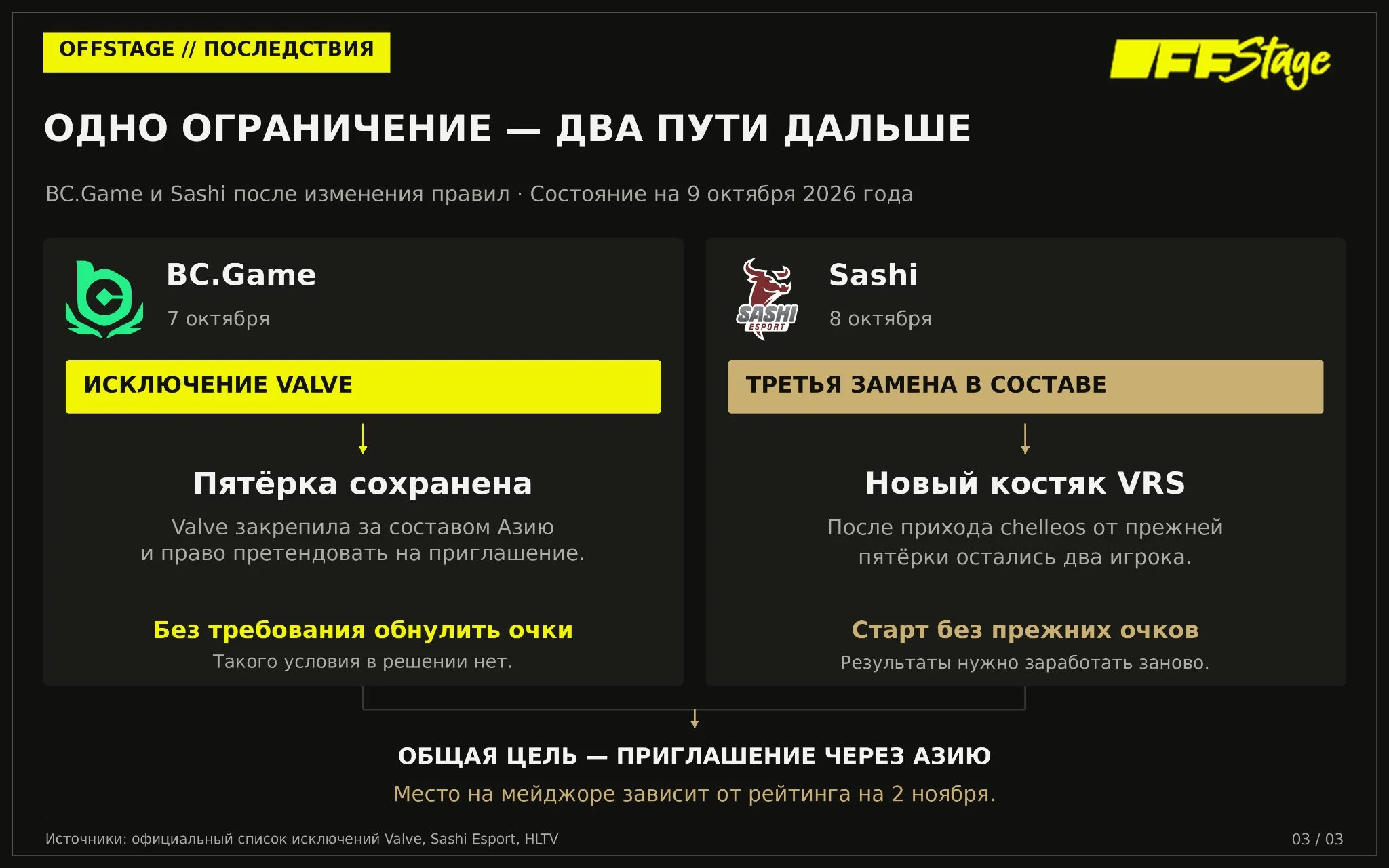
The individual decision for BC.Game does not answer the question of what conditions would allow other participants to receive the same exemption. A long-term contract indicates serious plans, but it does not prevent a player from being moved to the bench after a Major. I would like to see uniform criteria and a transition period announced before any substitutions are made. Then clubs will be able to assess the consequences of their decisions without having to guess whom Valve will accommodate.
WW tried to take advantage of the available opportunity, Sashi openly announced a temporary roster shake-up for the qualifiers, and BC.Game had to fight for the right to continue competing with their existing five-man roster. These cases differ, but they all demonstrate why a single last-minute ban isn’t enough. I support restricting transfers before the Major and the exception for BC.Game: there’s no contradiction here. The Asian scene needs to be protected under conditions that are known in advance. Requiring a three-month history 27 days before the rating is finalized leaves participants with too few ways to comply with the new rule.