Thorin’s Seasons: Who Would Benefit from a Card Rotation in CS2

A map rotation in CS2 could deprive a team of a strong map while simultaneously opening up new opportunities for competitors who were less suited to the previous set. A predetermined rotation schedule would allow clubs to plan their preparation for the entire year, but it would also present them with a choice: continue improving their current gameplay or devote more time to future maps.
Based on Duncan “Thorin” Shields’ idea, we break down what such a schedule might look like, and using the 2026 results of the top teams, we show who would benefit from the changes and who would face additional challenges.
What Thorin’s Idea Changes
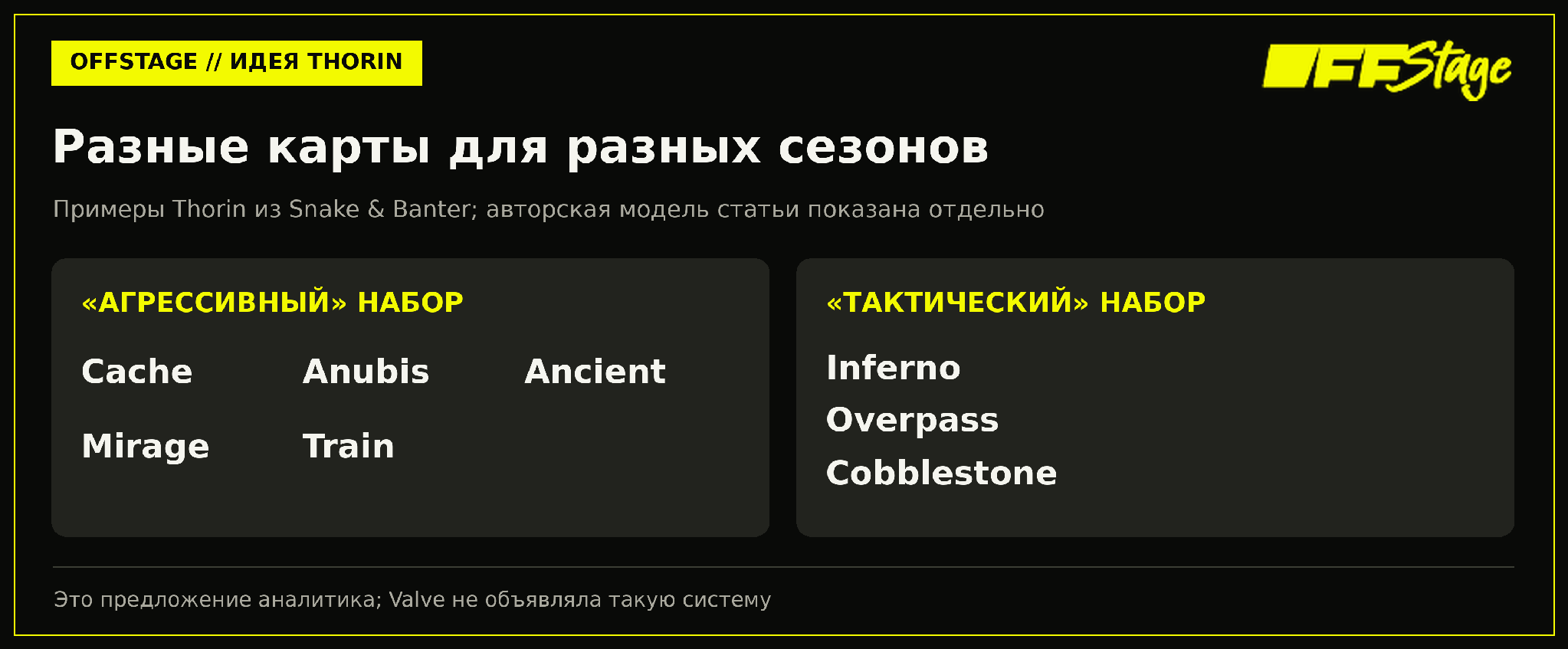
On the Snake & Banter podcast, analyst Duncan “Thorin” Shields proposed seasons with different maps, similar to the different surfaces in tennis. His “aggressive” set includes Cache, Anubis, Ancient, Mirage, and Train, while his “tactical” set consists of Inferno, Overpass, and Cobblestone. Each period would be designed to encourage specific gameplay qualities. Valve has not announced such a system.
Teams would have to split their practice time between the current and upcoming seasons. Should they perfect a strong map or master the one that’s about to be introduced in advance? Viewers would get an extra storyline: Will the leader be able to maintain its advantage after the rotation? Success on one map set wouldn’t guarantee equally confident play six months later.
The distinction between shooting and tactics is too simplistic here. On Ancient, coordinated grenade plays are also essential, while on Overpass, you can win by applying early pressure. It’s more useful to compare control of the center, long-range duels, and transitions between points. A season should vary the combination of these challenges, rather than granting an advantage in advance to a team with a certain reputation.
Working model: five permanent maps and two seasonal ones
The first condition is seven cards per season. In a standard best-of-three (bo3) series, teams make two initial bans, two picks, and two more bans: the remaining card becomes the deciding factor. Thorin sets of five and three maps require a different procedure. It’s impossible to assemble a full best-of-three series from three maps if at least one is allowed to be excluded.
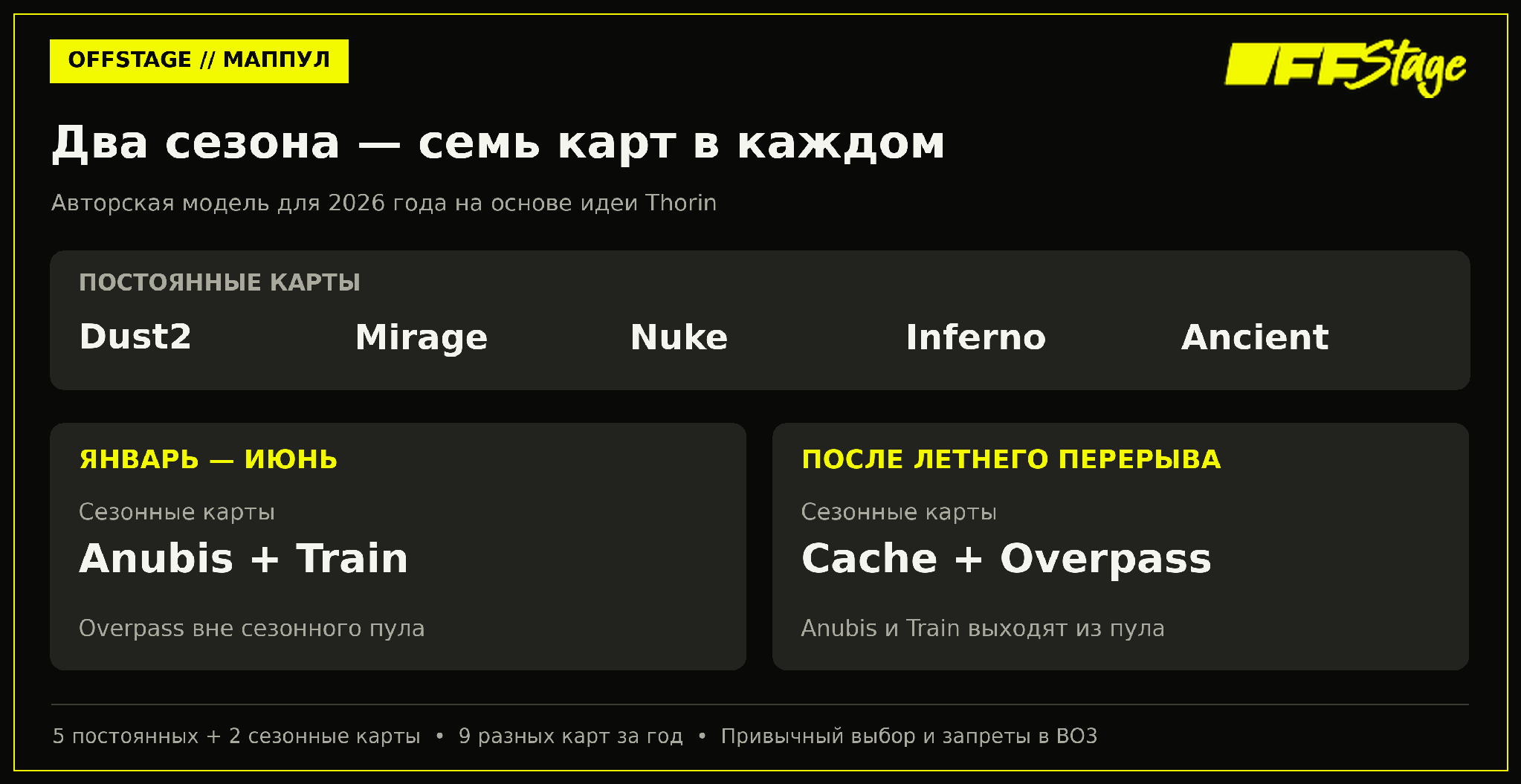
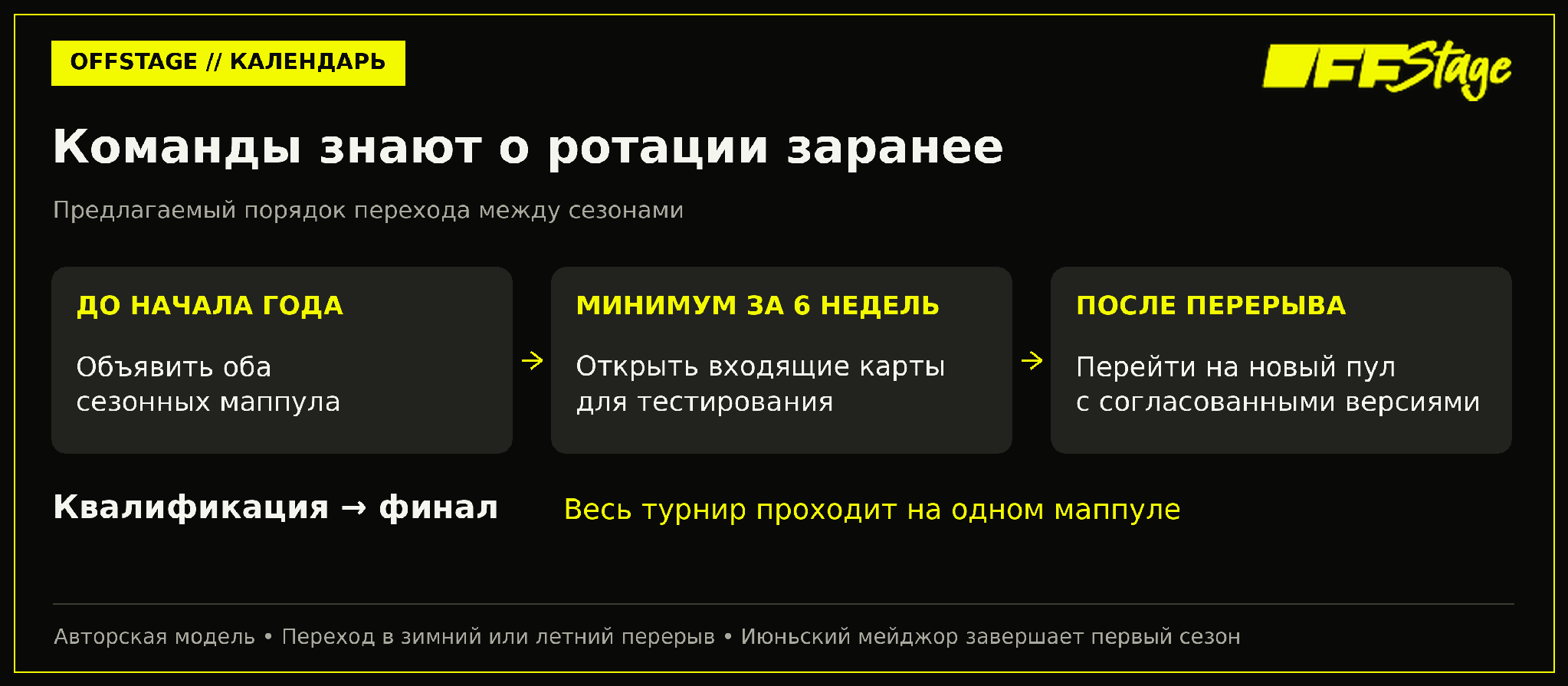
For the first year, we propose a moderate option: Dust2, Mirage, Nuke, Inferno, and Ancient remain permanent. This preserves both the long-range duels on Dust2 and the two-level combat on Nuke. From January through June, Anubis and Train are added to the rotation; after the summer break, Cache and Overpass are added. This is the author’s adaptation of Thorin’s idea: seven maps at a time and nine per year.
Instead of actually replacing Train with Anubis on January 21, 2026, Overpass would be removed from the pool, while the first two would remain available. In the summer, Cache would replace Train, and Overpass would return in place of Anubis. In reality, on July 8, Valve added Cache and removed Overpass. Taking into account Train’s inclusion in January, the actual map pool also featured nine maps. The difference in this model lies in the composition of the half-year cycles and the pre-planned returns.
Cache was released in CS2 on April 28, so it couldn’t have been included in the January season without an earlier release. By July, it was already available for preparation. Train and Overpass also existed in CS2; there would have been no need to promise a Cobblestone rotation for an arbitrary date. Before the transition, the organizers would only need to check for bugs and synchronize the map versions.
Five common maps preserve most of the familiar gameplay: a full-fledged equivalent of tennis court surfaces isn’t possible yet. For a more pronounced change in style, four maps could remain constant while three are rotated. However, such a move should be made only after evaluating the first year, once the workload on the teams becomes clear.
The schedule should begin with an announcement, not an update
The Premier seasons and Active Duty rotation already exist. An addition to the model: both sets are published before the start of the year, and the cards included are available for testing at least six weeks before the transition. The rotation takes effect after the winter or summer break; the June Major concludes the first season. Teams will be able to prepare new maps knowing which old maps are needed up until a specific tournament.
A tournament requires a single card pool from the qualifiers through the finals. If qualifiers are held using the previous card set, the entire tournament must be completed using that set; the transition to the new set for qualifiers is announced in advance. It’s also better to tie map layout changes to the start and end of seasons. A repositioned box can alter a familiar route more significantly than a new map name.
Rotating two maps complicates permanent bans. A team can immediately ban one map, but the opponent can still select the second one in a best-of-3 series. If neither team is prepared for both, they must rely on the opponent’s bans. This encourages teams to master at least one incoming map, though it does not force every participant to play the entire pool.
Vitality: A setback in the spring and an opportunity to strengthen in the summer
We’re comparing map results on HLTV from January 1 to September 30, 2026, including both LAN and online matches. Rosters and opponents could have changed, and a different rotation would have altered training. Therefore, actual results demonstrate the value of available maps but do not allow us to calculate alternative tournament placements. All conclusions apply to the proposed model.
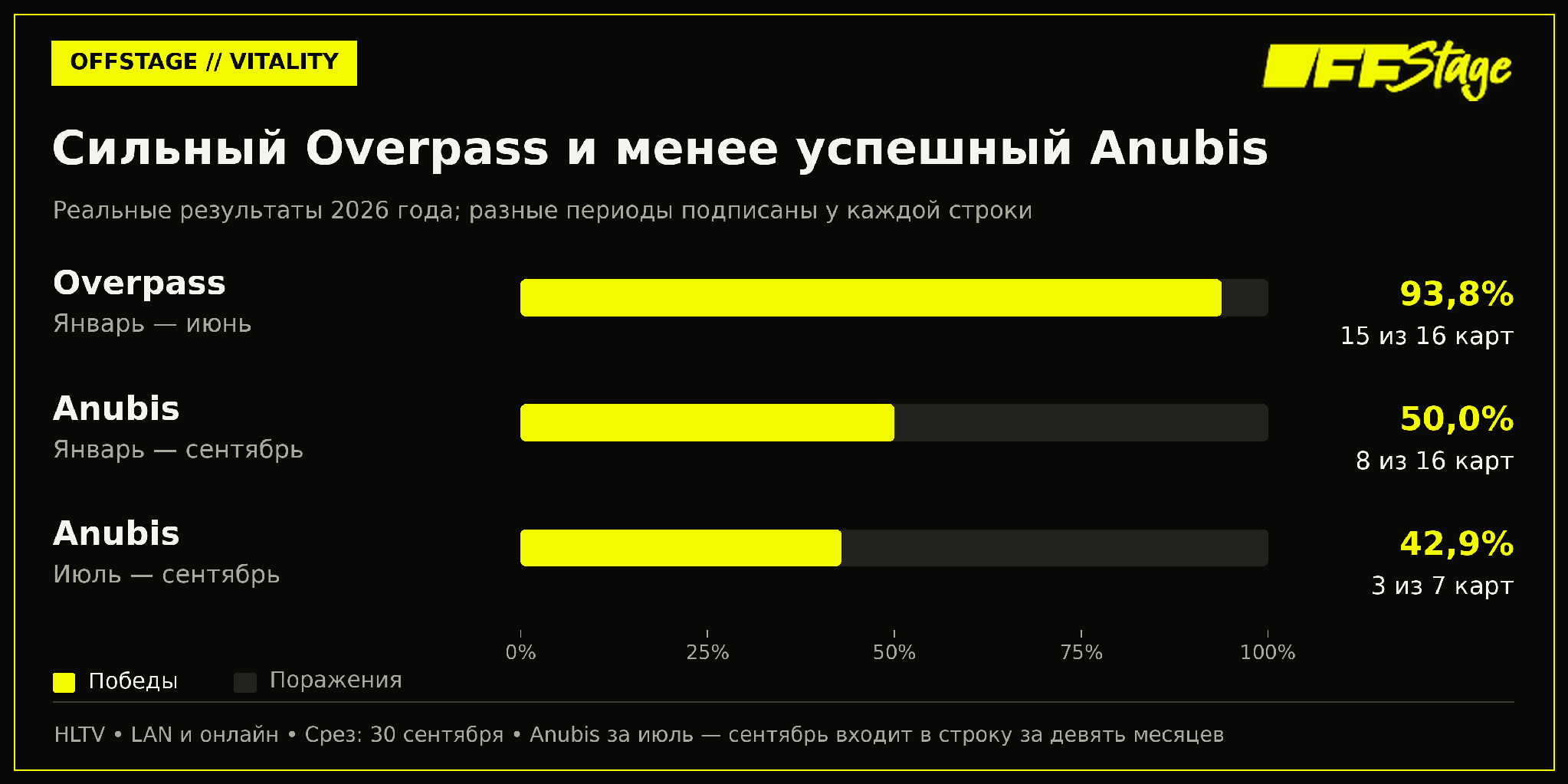
In the spring, Vitality would have lost its successful run on Overpass: in the first half of the year, it won 15 out of 16 maps. Among its victories were matches against FURIA, The MongolZ, and PARIVISION; its only loss came at the hands of G2. Opponents planning to ban Overpass would have been able to eliminate another of Vitality’s strong maps. It is difficult to assess the compensation provided by Train: it was removed from Active Duty on January 21.
Overpass would return in the summer to replace Anubis. On Anubis, Vitality has eight wins and eight losses over nine months, and from July through September, they had three wins in seven matches. The switch looks promising if the team prepares for Overpass’s return. But you can’t carry over their 15 spring wins into the fall forecast: their rivals would also have time to prepare.
Spirit and G2 would have different seasonal advantages
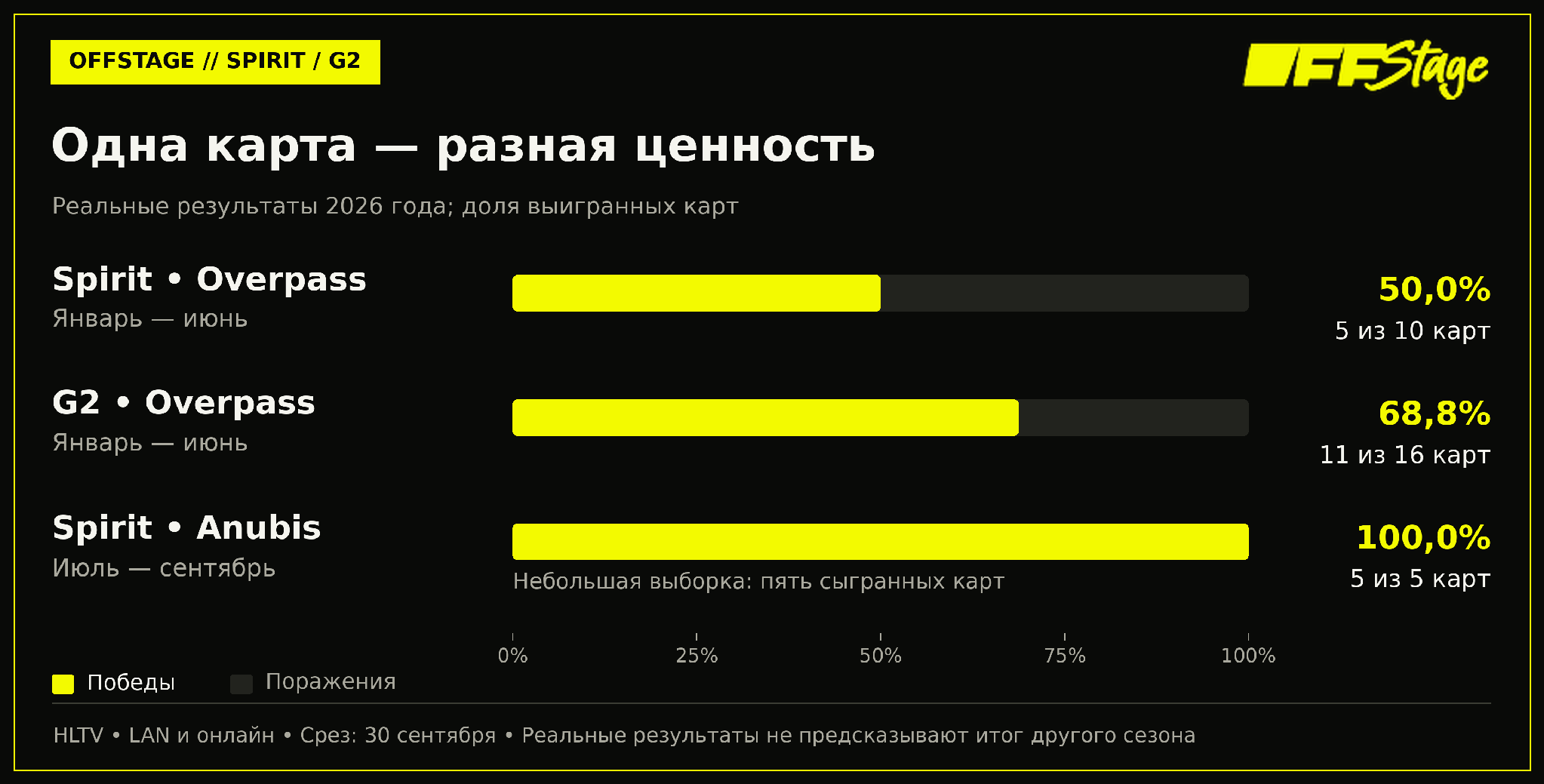
For Spirit, the spring effect could have been the opposite: on Overpass, they won five out of ten maps and lost to G2 twice. In the quarterfinals of the IEM Cologne Major 2026, G2 picked Overpass and won 13–9, even though Spirit took the series 2–1. Without Overpass, G2 would lose that specific map choice. For Spirit, this simplifies map selection but does not guarantee a more successful tournament.
In the summer, Spirit would lose Anubis, on which they won all five maps from July through September: against 100 Thieves, Liquid, FaZe, Vitality, and FUT. At the same time, Overpass would return with more modest spring results. The team would have lost a high-performing map and gained one that would need improvement.
Five wins, however, do not make Anubis indispensable. In the semifinals of the BLAST Open Porto 2026, Spirit defeated the Falcons on Nuke and Ancient, having banned Anubis as their second ban. A strong map is valuable as an available option: in a specific series, the team may prefer a different lineup.
In the spring, G2 would have lost Overpass, which accounted for 11 wins out of 16 maps in the first half of the year. At the Major, they won four out of five matches on it, including the map against Spirit. A return to the map in the summer would restore a familiar pick. But the overall balance would also depend on G2’s performance on the outgoing Anubis: one strong Overpass isn’t enough to declare the team the winner of the year-long reform.
The Falcons would have to prepare a map they had previously excluded
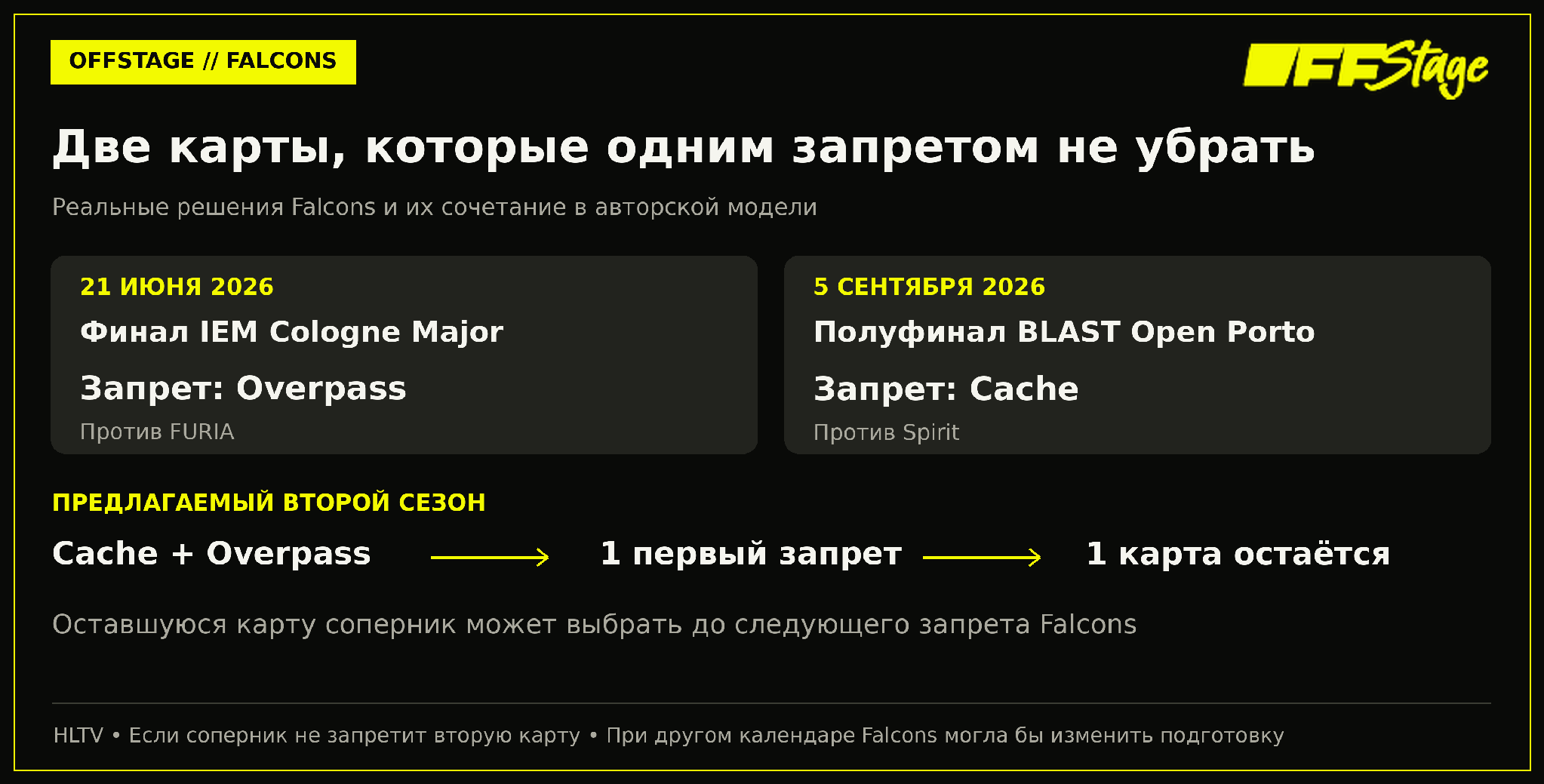
The risk for the Falcons is evident in their bans. In the June final of the IEM Cologne Major 2026 against FURIA, the team banned Overpass, and in the September semifinal against Spirit, they banned Cache as their first pick. In Season 2, both maps would be available simultaneously. A single initial ban wouldn’t eliminate both: an opponent could select the one remaining until the Falcons’ next ban.
At the same time, Anubis—the map on which the Falcons defeated Natus Vincere, Vitality, Spirit, and FURIA in June at the Major they won—would be gone. This represents both the loss of a proven pick and the need to prepare for at least one of the two previously excluded maps. Among the teams considered here, they face the most obvious risk when selecting maps. However, the known schedule would have allowed time to master Cache or Overpass: actual bans do not prove that the Falcons would have repeated them under different rules.
Who will win outside of a specific map pool
In the long run, teams capable of maintaining their preparation for the return of maps would gain an advantage. A large staff of analysts speeds up the analysis of opponents, while a small team has to choose the depth of preparation for each area. Early in the season, those who have mastered an incoming map ahead of time may also find success. However, as long as the VRS remains in place, invitations will continue to depend on past results: new in-game potential won’t immediately grant access to major tournaments.
Seasonal roster changes, which Thorin allows, are significantly more costly than adjusting training. For a direct invitation through the VRS, at least three players from the participating roster must be part of the invited starting five and play in every tournament match. Replacing three players after receiving an invitation already violates this condition. Therefore, it makes more sense to spend the first year with a continuous ranking, testing the adaptation of a single five-man roster, rather than assembling a new roster for each half-year.
In this model, Vitality and G2 lose their strong Overpass lineup in the spring, while Spirit loses its high-performing Anubis lineup in the summer. The Falcons would have to address the issue of the two previously excluded maps. The seasonal system changes the available options but does not crown new champions. The value of Thorin’s idea lies in the ability to plan for these changes in advance and test which teams’ preparation will withstand the shifting conditions.