Online vs. LAN—Why Do Favorites Fail to Qualify in CS2?


100 Thieves defeated Team Falcons, but lost to Nuclear TigeRES a day later in another qualifier—both series were played online but ended differently. We’re comparing the results of remote and LAN qualifiers to separate the impact of the format from the specifics of the short bracket.
Same Conditions, Different Results
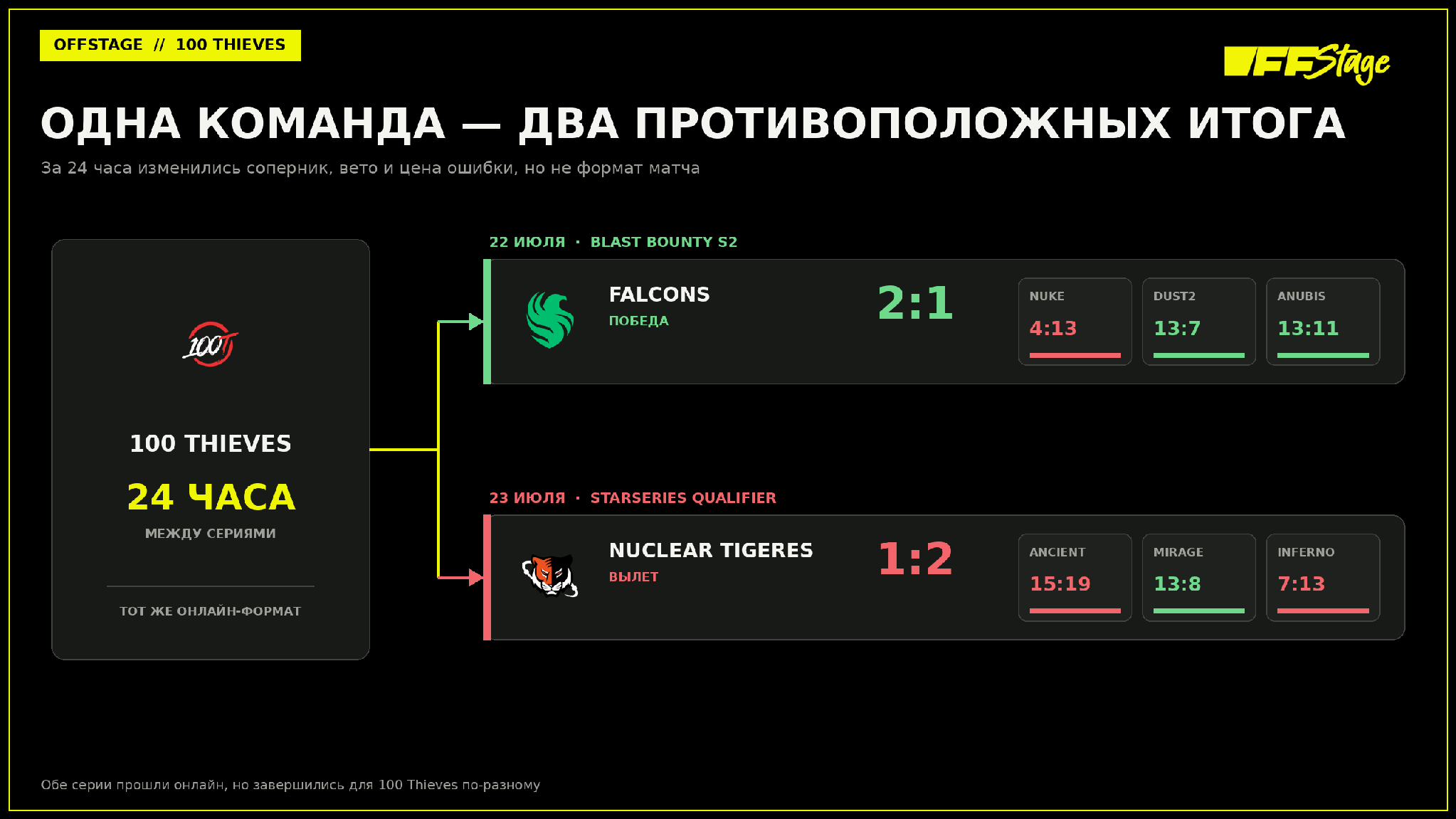
The match between 100 Thieves and Team Falcons took place on July 22 in the first round of BLAST Bounty 2026 Season 2. The No. 31 seed chose its own opponent, who was seeded third. On Nuke, the Falcons won 13–4, but 100 Thieves took Dust2 13–7 and came back on Anubis after trailing 3–9 on the attack side to win 13–11. In this series, the lower-seeded team won after losing the first map.
The next day, 100 Thieves competed in the StarLadder StarSeries Fall 2026 Europe Closed Qualifier. Nuclear TigeRES won Ancient in overtime—19–15, lost Mirage—8–13, and won Inferno—13–7. Over the course of 24 hours, the opponent, the map pick, and the score changed, but not the format: both series were played online. The difference in the results of these matches cannot be attributed solely to the online format.
In the September qualifier for the Thunderpick World Championship 2026, the team once again failed to advance through the bracket. 100 Thieves lost to BBL 1–2, then defeated Acend and 3DMAX 2–0, but lost to HOTU 0–2 in the quarterfinals. Over four matches, the team recorded two wins and two losses. The victory over the Falcons did not signal consistent performance in subsequent qualifiers.
What Changes During Qualifier Preparation
Before the match against the Falcons, 100 Thieves had faced only one known opponent. The team made that choice themselves and was able to focus their preparation on that opponent’s maps and previous series. However, the result alone doesn’t reveal how thoroughly both teams analyzed each other. We can’t attribute the victory solely to preparation without hearing from the players or coaches.
The qualifier bracket presents participants with a different challenge. They need to plan for several possible matches and, after each victory, quickly shift their focus to the next opponent. The more options remain in the bracket, the less time can be devoted to each one. This applies to all participants, not just the favorite.
In a best-of-3 series, losing a single map leaves only two chances to turn the situation around. An unexpected map choice or a strong start can influence the course of a match, but the final score doesn’t reveal the relative importance of each factor. Therefore, you can’t compare a single series or a run through several qualifying rounds without considering the bracket format.
Multiple series in a row multiply the risk
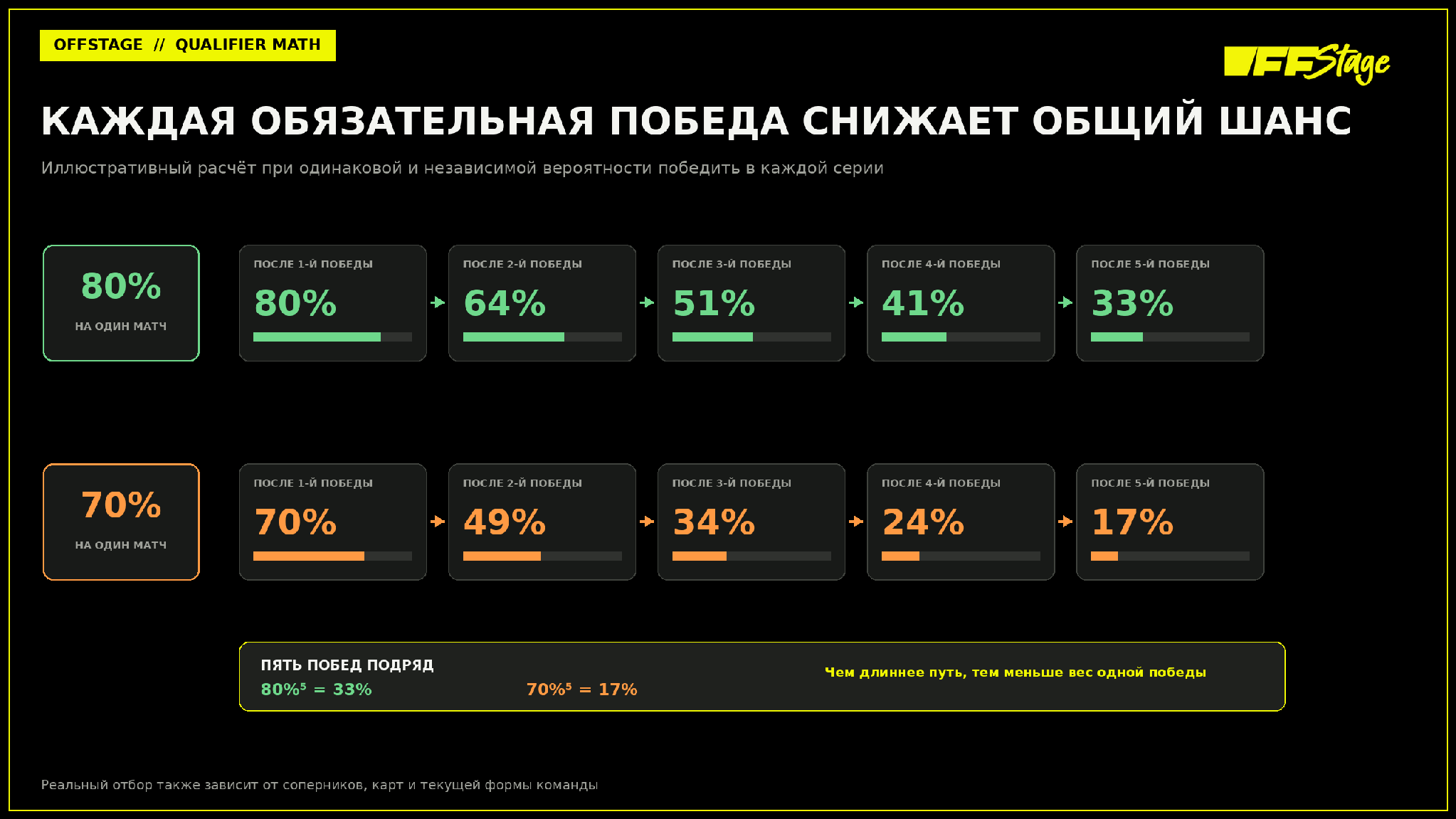
The risk can be illustrated using a hypothetical single-elimination bracket model. If the matches are independent and the probability of winning remains constant at 80%, the chance of winning four series in a row is approximately 41%, and five in a row is 33%. With a 70% probability, these figures drop to 24% and 17%. Even a high probability of winning a single match does not guarantee advancing all the way.
This calculation does not describe a specific team and does not account for differences between opponents, maps, or current form. Many tournaments also feature a lower bracket, so a loss does not always result in immediate elimination. The model only illustrates the accumulation of risk when several consecutive mandatory wins are required to advance. It cannot be used as a prediction for a specific qualifier.
BC.Game lost both online and at LAN events
BC.Game is a good benchmark because the new roster competed in qualifiers in both formats. In August, the team won the Elisa BreakOut Series 1 LAN tournament, and then defeated 1win and OG 2–0 in the in-person qualifier for the Esports World Cup 2026. In the decisive series, BC.Game lost to 100 Thieves 1–2 and failed to secure a spot in the main tournament. This series took place on LAN, so online conditions could not have influenced the result.
On September 4, BC.Game lost to FOKUS 1-2 in the online open qualifier for PGL Masters Bucharest 2026. The results in both formats were similar: the team won matches but fell short of advancing to the main tournament. These two examples do not allow us to pinpoint the reasons for the losses, but they do show that BC.Game finished the qualifiers both online and at LAN events. Therefore, one of these results cannot be explained solely by the venue.
Online qualifiers do not determine the outcome at LAN events
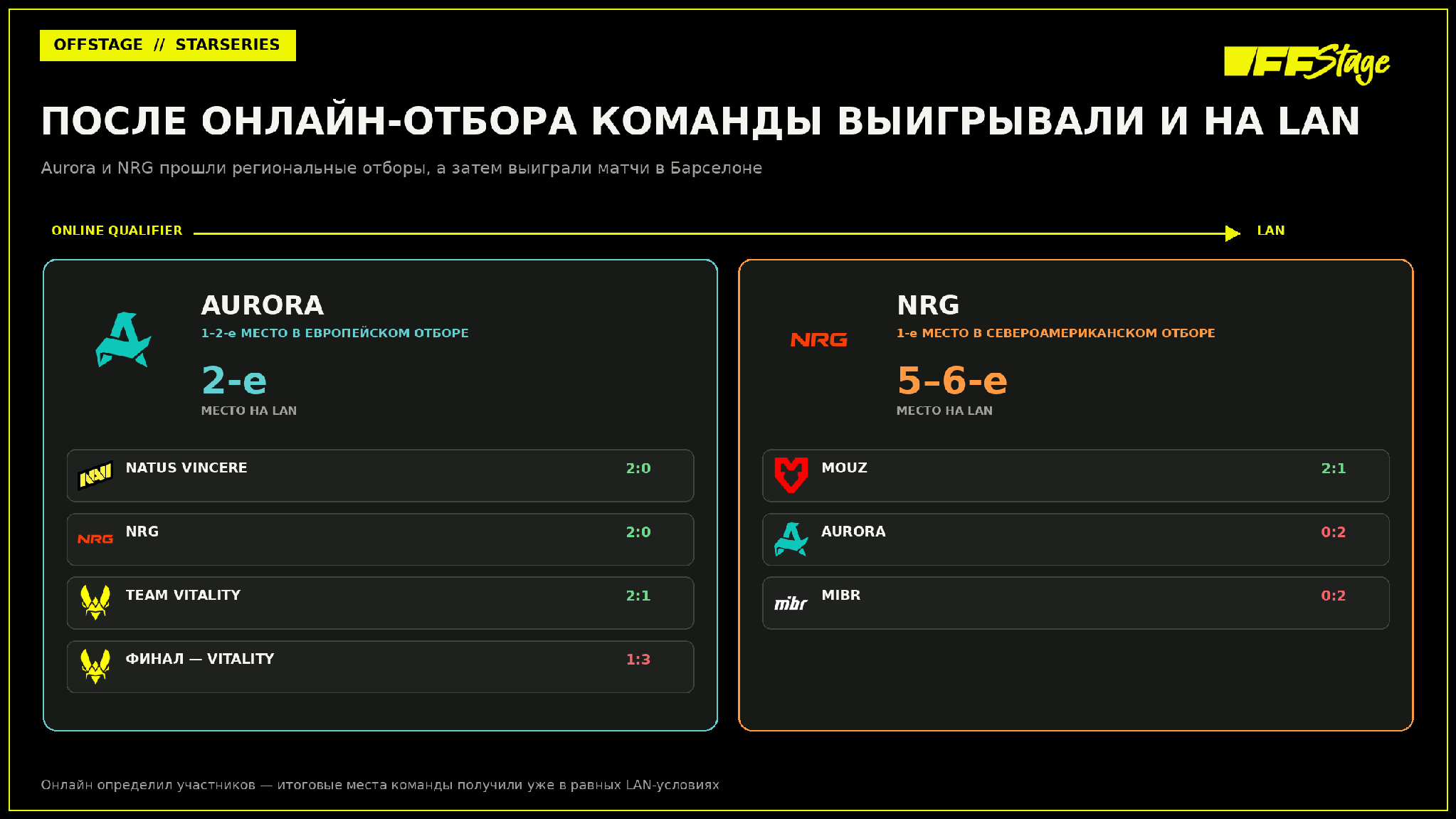
StarLadder StarSeries Fall 2026 revealed the other side of the qualifiers. Aurora advanced through the European online qualifiers, then defeated Natus Vincere and NRG 2-0 in Barcelona, followed by a 2-1 victory over Team Vitality. In the grand final, Aurora faced Vitality again, lost 1–3, and finished in second place. After advancing through the online qualifiers, the team won three series at the LAN event.
NRG won the North American qualifier and also started the tournament with a victory, defeating MOUZ 2–1. NRG then lost to Aurora 0–2 and to MIBR 0–2, finishing the competition in 5th–6th place. In both cases, the winners of the regional qualifiers won at least one series in Barcelona. The qualification format itself did not determine their final placement in the main tournament.
Short series are also common at LAN events
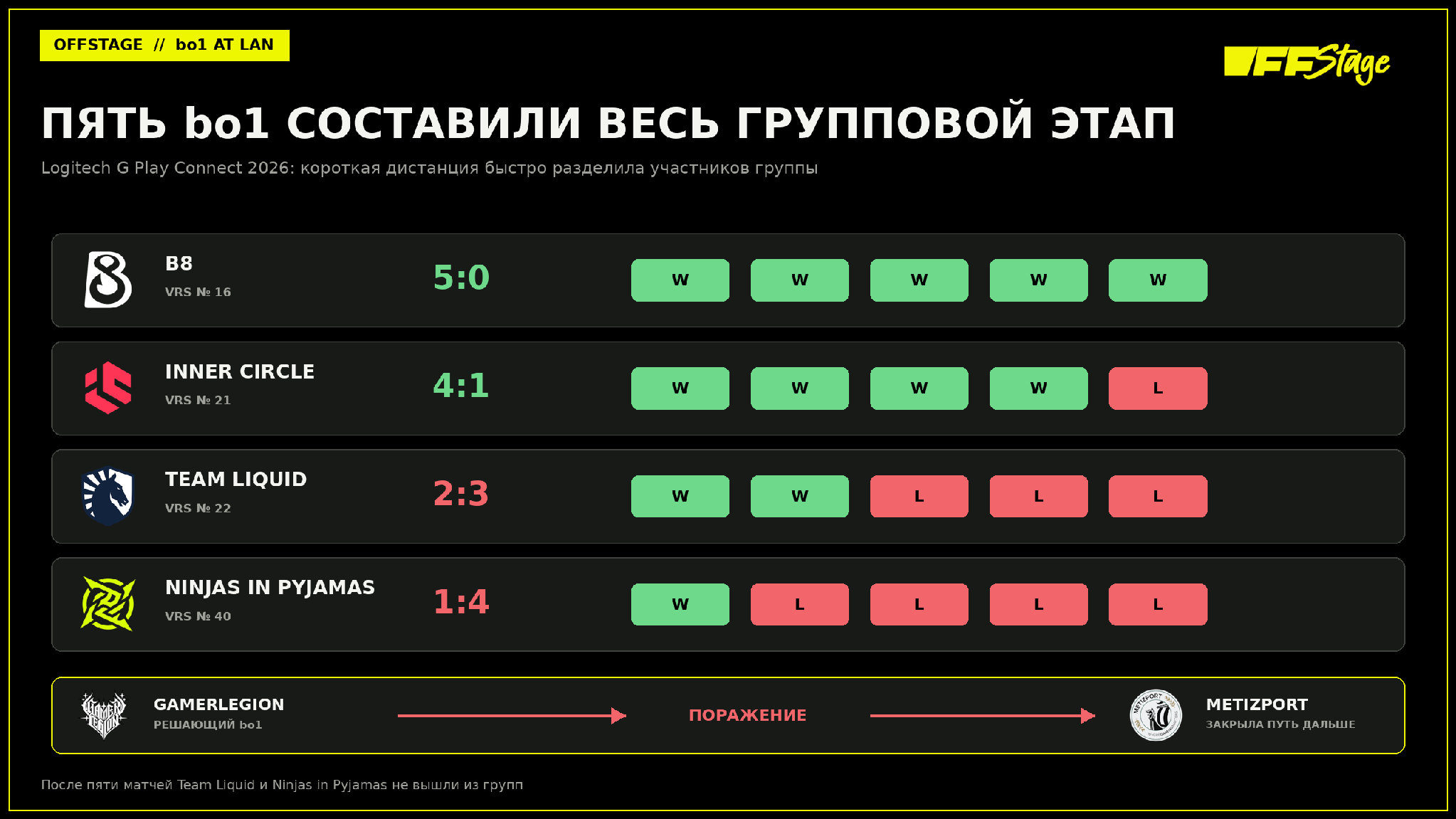
Logitech G Play Connect 2026 took place in Warsaw, and its group stage consisted of short series. Each participant played five best-of-1 matches. B8 won all their matches, while Inner Circle finished the group stage with a 4–1 record. Team Liquid finished with a 2–3 record, and Ninjas in Pyjamas went 1–4, failing to advance to the playoffs.
GamerLegion also lost its spot in the next stage after a one-map loss to Metizport. All teams were in the same venue, so internet connectivity and home setups did not affect the players’ conditions. With the best-of-1 format, every match directly impacted the group standings, and it was impossible to make up for a lost map within the same series.
Meanwhile, B8 advanced from the group stage undefeated, and Inner Circle won four out of five matches. These results do not explain why some teams performed better than others. They show something else: short-distance matches are not unique to online qualifiers and do not, by themselves, prove the influence of online play.
Online play changes the conditions, but it doesn’t explain everything
Playing from home and performing on stage are different: latency, workspace, noise, audience pressure, and communication methods all vary. These conditions can influence individual decisions, but the results presented do not indicate a general pattern. 100 Thieves won and lost online, while BC.Game advanced through qualifiers both at LAN and online.
Aurora and NRG advanced through online qualifiers and then won their series in Barcelona, while the short-format Logitech G Play Connect was used at LAN events. These examples do not prove that online play does not affect the outcome, but they also do not allow us to identify it as the primary cause of the favorites’ losses. An accurate assessment requires data from a larger number of series and feedback from the participants. A more limited conclusion is that several must-win matches and short series reduce the margin for error, and the venue itself does not explain the outcome of the qualifiers.