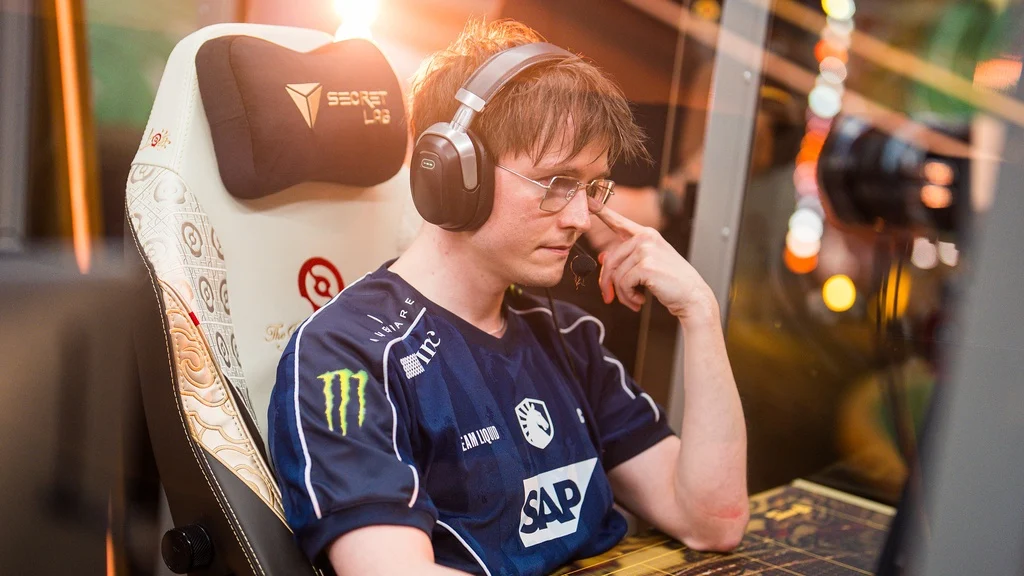
SUNSfan: “The last six months of working as a Dota 2 commentator have been the worst of my career.”


Commentators Troels “syndereN” Nielsen Lingholt and Shannon “SUNSfan” Scott spoke on the We Say Things podcast about Tier 5 items and the difficulty of closing out matches in Dota 2.
On Tier 5 items
syndereN: The challenge is to make Tier 5 items meaningful without turning them into a “You Win” button. I think the problem, especially in tiers three, four, and five, is that in each tier there are two items that are simply better than the rest, so they get picked all the time. In tier four, for example, it’s Conjurer’s Catalyst, especially for spellcasters. It’s just too good. At level three, it’s something like the Cloak of Flames. It really does seem very powerful. The same goes for the Greedy enchantment—for supports, it’s incredibly good in practically every game.
The system was supposed to be flexible and allow for experimentation, but in my opinion, there’s very little real room for creativity. And at level five, the situation is even worse, because if you look at the numbers, the difference is simply enormous. For example, what would you prefer for your carry: a 13 armor reduction from attacks or a single illusion of your hero?
Yes, of course, there might be a rare situation where you create that illusion and it takes a crucial spell. But I’d suggest looking at this from a probability standpoint again: how often will this item actually be useful in your game? There are items that will be useful in every match, and there are those that come in handy once every 20 games. Sure, if you’re lucky enough to run into that kind of situation—that’s really cool. But I’d prefer a solid item. You know what I mean?
On the TaiLung ban
SUNSfan: I used to take the position—and we’ve talked about this so many times—that lifetime bans are too harsh. Maybe I’ve changed with age. I don’t care anymore. Just go ahead and ban them for life—I don’t care. I think this has happened enough times for them to realize that they shouldn’t do this. I feel like I can honestly say: back then, maybe things really shouldn’t have been so harsh. But now it’s an old story—this keeps happening over and over again. Obviously, this is a huge disgrace, especially when it comes to a promising 17-year-old player from a region that desperately needs talent like this. It’s a massive blow. But screw it—just ban him for life. Now I agree with that.
There’s another point that isn’t discussed enough either. I don’t think it’s worth going into detail here, but I know that this kind of thing happens all the time in other regions. So this isn’t an isolated incident, and that’s perhaps the saddest part of the whole situation.
SyndereN: And I think this is largely due to the fact that professional Dota 2 is becoming increasingly concentrated in a single region. It feels like some regions are suffering much more from this problem than others. Specifically, I’m talking about China and South America. That’s where we most often hear about match-fixing cases. And obviously, for a talented player from such a region, this means not only having to perform at a very high level, but also constantly resisting the temptations that come their way.
When people talk about this, they usually say something like, “Well, he should have known what he was doing. He shouldn’t have gotten involved in that.” But we don’t know all the circumstances: what’s happening with friends, family, possible threats, or what kind of pressure a player at that level faces. That’s why I think it’s too simplistic to just say, “He was young; he should have known what he was doing.” I wish there were a way to make sure situations like this happened much less often in the first place, if you know what I mean. It seems to me that the problem here is much more serious than just a kid doing something stupid.
On the difficulty of finishing a match in the current meta
SUNSfan: I think the last six months of working as a Dota 2 commentator have been the worst of my career. For me, this is the most boring Dota ever. The EWC was probably the lowest point. The games were... Maybe KheZu and I were just unlucky. We literally only commentated on series that ended 2-0. Like you said, the outcome is already clear by the tenth minute, and then all you have to do is wait another 30 damn minutes for the game to end. This tournament [The International 2026] was definitely better. No question about it. There were some good games. Overall, I think that from a historical perspective, the meta was terrible.
But what’s interesting is that it’s kind of the opposite of TI4. We remember how awful TI4 was, and you always remind me that it was only the last few series that were the problem. The final series was truly terrible. If Team Spirit, say, had been eliminated... It would have been a terrible damn tournament. Although it wouldn’t have mattered who won, since all the teams were from Europe. But Team Spirit just seems to do everything a little differently, and they’re much more interesting to watch. If it weren’t for them, it would have been a total flop in terms of entertainment value, because at times it was just agonizing to commentate on.
SyndereN: I think what’s happening is this: if you take some of the matches from this TI where it’s already clear by the 15-minute mark who’s going to win, three or four years ago those games would have ended by the 30-minute mark. And back then, they would have just fallen into the category of: “Well, that was a blowout—it happens—let’s move on.” But now it’s: “Well, that was a blowout that lasted 50 minutes. Let’s move on.” And the fact that it’s so difficult to end a game is due to several reasons at once. I’d say it’s a combination of many changes that Valve implemented for a reason. They didn’t want a repeat of the Gaimin Gladiators patch, when literally every game ended at the 25-minute mark. They don’t need that. The option to play long games should remain, but not every game should be long, because then it ceases to be something unusual and interesting.
It seems to me that the balance is currently tilted too heavily toward the late game. The main reasons why it’s so difficult to end a game are that they’ve made capturing the high ground significantly more challenging and expanded the map. And when the map gets bigger, it’s much harder for the winning team to fully control it. When the map was smaller and you were dominating, that was such a strong advantage that you earned more gold much faster than your opponent and could end the game. Now, even with a massive lead, teams have learned to play so well from behind that they can still farm and occupy space on the map, because it’s practically impossible to completely lock them down at their base.
Read also: “Dark Carnival,” the MMR reset, and Patch 7.41e—highlights from the We Say Things 297 podcast
Earlier, PARIVISION coach Clement “Puppey” Ivanov, in an interview with Mrs. Marple, he discussed working with the team’s players, spoke about his legacy in the community, explained the reasons behind Team Secret’s hiatus, and named YapzOr the best person in Dota 2.
Photo by Shannon “SUNSfan” Scott.