Ranks in Rocket League: All Titles, MMR, and the Ranking System


Ranks in Rocket League indicate a player’s level in competitive modes and change based on match results. In this guide, we’ll break down all Rocket League ranks in order, explain how MMR works, what Elo is, and how many ranking points you need to advance to the next rank.
How Ranks Work in Rocket League
Ranks in Rocket League are used in competitive modes and indicate a player’s approximate skill level. At the start of the season, you must complete 10 placement matches, after which the system will determine your starting rank.
Rankings are calculated separately for different competitive modes. Therefore, a single player can have, for example, Diamond in 2v2 and Platinum in 3v3.
All Rocket League ranks in order
There are eight main ranks in the game. Most of them are further divided into three tiers—I, II, and III.
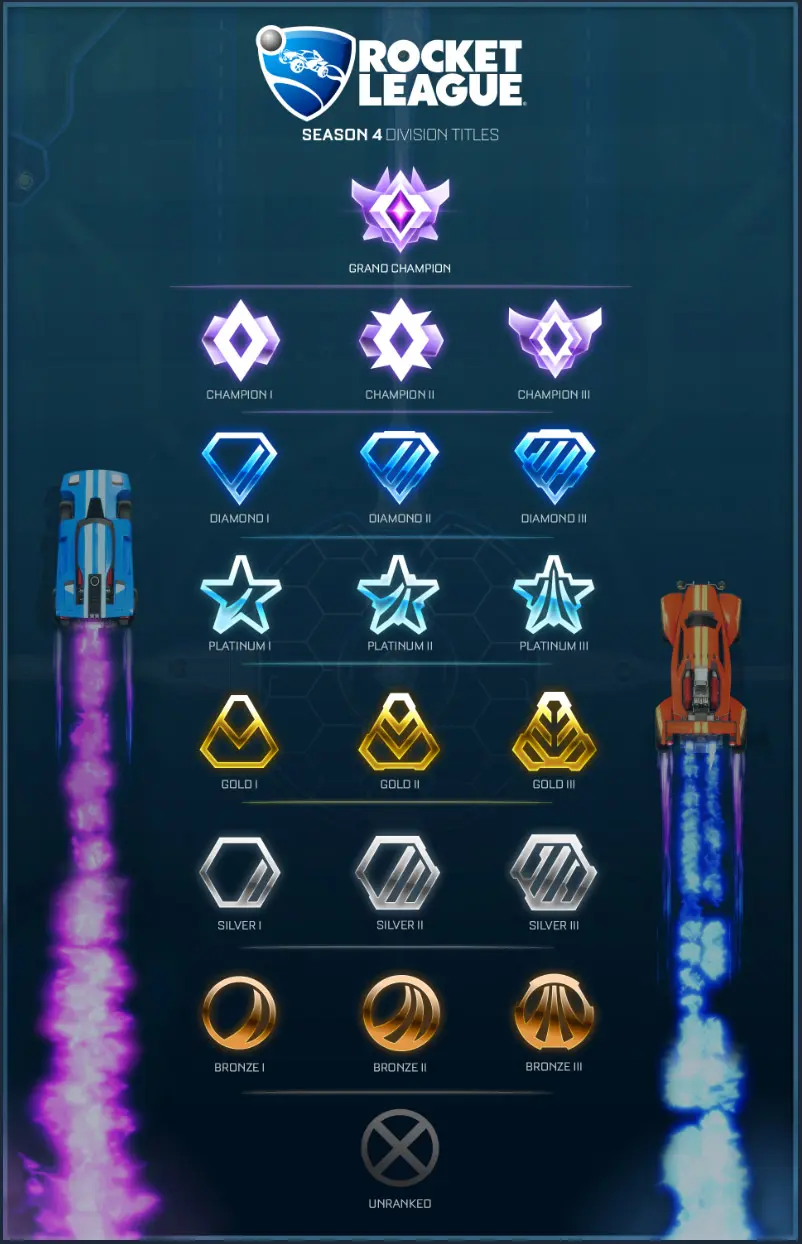
Rocket League ranks from lowest to highest:
- Bronze I, II, and III.
- Silver I, II, and III.
- Gold I, II, and III.
- Platinum I, II, and III.
- Diamond I, II, and III.
- Champion I, II, and III.
- Grand Champion I, II, and III.
- Supersonic Legend.
Until you qualify, the status “Unranked” appears instead of one of the titles listed above. Supersonic Legend is the highest competitive rank.
How Rank Reset Works
At the start of a new season in Rocket League, a soft rank reset is applied. Your rank isn’t completely reset to zero: the system takes your results from the previous season into account, so after calibration, you’ll usually receive a title close to your previous one. Calibration takes place separately for each competitive mode.
After the season starts, your rank is temporarily displayed as “Unranked.” Play placement matches so the system can determine your place in the rankings again.
Divisions in Rocket League
Each rank tier is further divided into four divisions: I through IV. For example, after Diamond II, Division IV, the next step is Diamond III, Division I. After the third tier, the next rank begins.
Divisions allow for more precise tracking of progress between ranks. Wins gradually promote a player to the next division, while losses can result in demotion.
What Are MMR and Elo in Rocket League
MMR is a skill rating that the game uses to determine a player’s skill level and match them against opponents. The value changes after competitive matches: MMR is added for a win and subtracted after a loss.
The number of points gained or lost depends, among other things, on the ratings of the match participants. For example, defeating stronger opponents can earn you more MMR, while losing to a team with a lower rating will result in a greater loss of points.
Some players use the term “Elo” to refer to MMR. It’s the same thing, but officially, the rating is still called MMR.
How to Climb the Ranks in Rocket League
To climb the ranks quickly, experienced players and esports athletes recommend:
- practice shots, aerial attacks, and defense in Training Mode;
- don’t constantly chase the ball and maintain good rotation with your teammates;
- save your boost and collect small speed boosts throughout the match;
- play with a consistent team or use Party Up after successful matches;
- Keep an eye on your MMR to see how close you are to moving up or down a rank.
Starting in Season 22, you can enable MMR in the settings and view it on competitive mode cards and the match summary screen.
Frequently Asked Questions (FAQ)
В игре восемь основных рангов: от Бронзы до Сверхзвуковой легенды, большинство из которых разделены на три ступени и четыре дивизиона.
MMR — числовой показатель навыков игрока, который меняется после матчей и определяет его ранг и подбор соперников.
Для повышения ранга необходимо побеждать в соревновательных матчах и набирать MMR, при этом фиксированного количества побед для перехода на следующее звание нет.
Да, в начале нового сезона происходит мягкий сброс рейтинга, поэтому ранг корректируется, но прогресс не обнуляется полностью.
Для каждого уровня сезонной награды необходимо одержать 10 побед на соответствующем ранге или выше.