Rush Mode in CS2: How the New 3-on-3 Format Works

Rush is a new 3v3 mode in CS2 featuring short rounds, turrets, and advancing toward the enemy’s castle. Valve added the new mode to CS2 on September 23 alongside the Rush Hour update. It’s easy to get confused here: Rush is the mode itself, while Rush Hour is the name of the update. In the new mode, two teams of three players face off. Instead of one large map, there are several small arenas, and each round is short. If you win, the next round takes place closer to the opponent’s castle. If you lose, you’ll return to your own side.
This is the first standalone mode that Valve has created specifically for CS2, rather than porting it from CS:GO. Shooting, buying gear, and trading remain familiar, but kills alone aren’t enough to win. By the end of the round, the tower must be under your team’s control.
New Mode: What Is Rush?
The CS2 Rush mode is a 3v3 match played on small arenas. Before the match starts, the game randomly selects five arenas and places them between the two final maps—the T and CT castles. On each arena, teams play one round, then move forward or backward. Each arena has a tower. At the start of the round, the tower already belongs to one of the teams, and the opponents try to capture it. The round lasts 40 seconds. When time runs out, the team that controls the tower wins.
How a Match Works in the New 3v3 Mode
Each match features seven maps: five random arenas and two castles—T Assault and CT Assault. Teams start on the central arena. The first round is played with pistols, and the game randomly determines which team will control the tower first. If you win a round, the next one takes place on a map closer to the opponent’s castle. If you lose, the battle shifts toward your own castle. To end the match, you must reach the opponent’s castle and win there: T plays on CT Assault, and CT plays on T Assault.
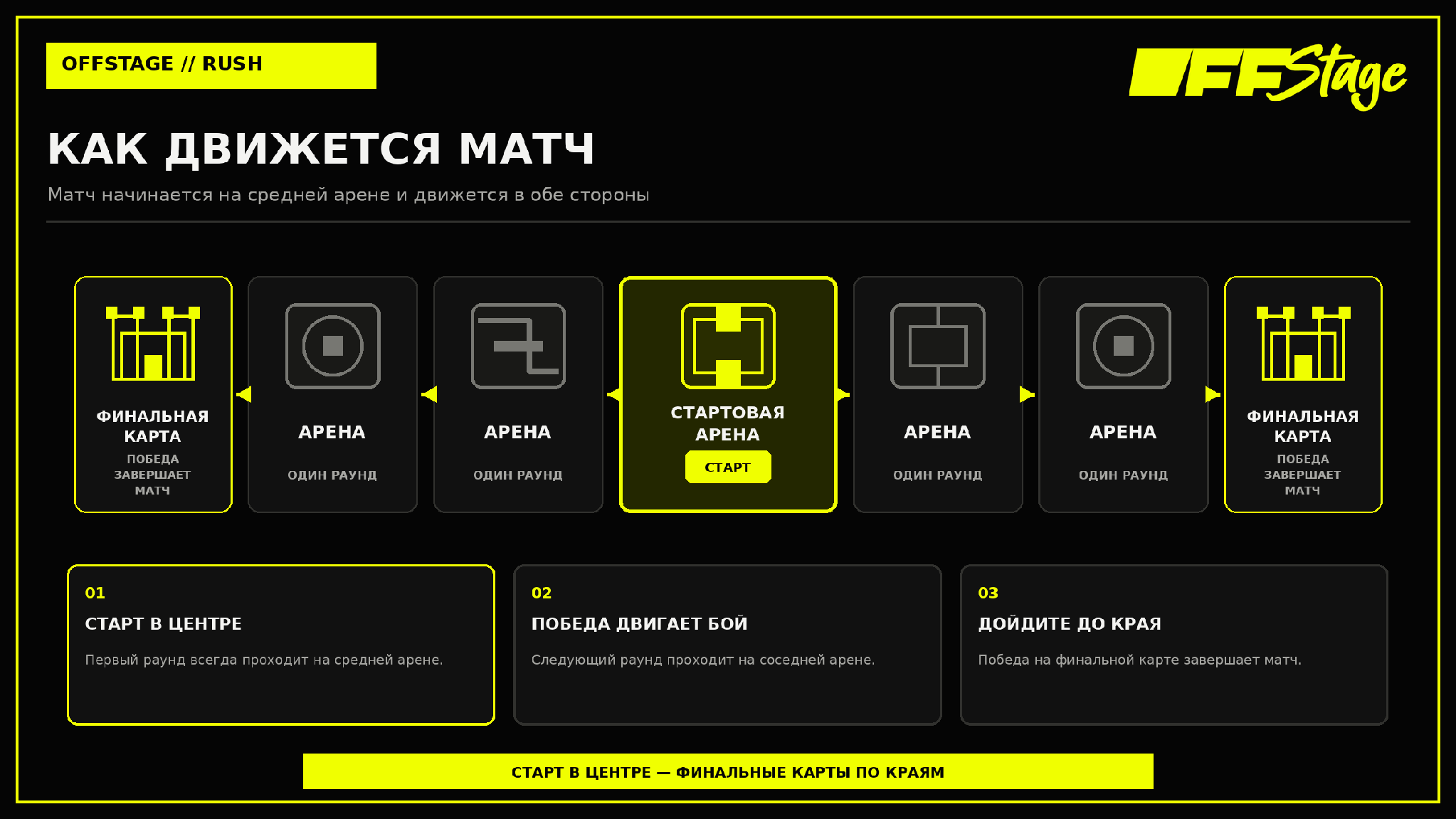
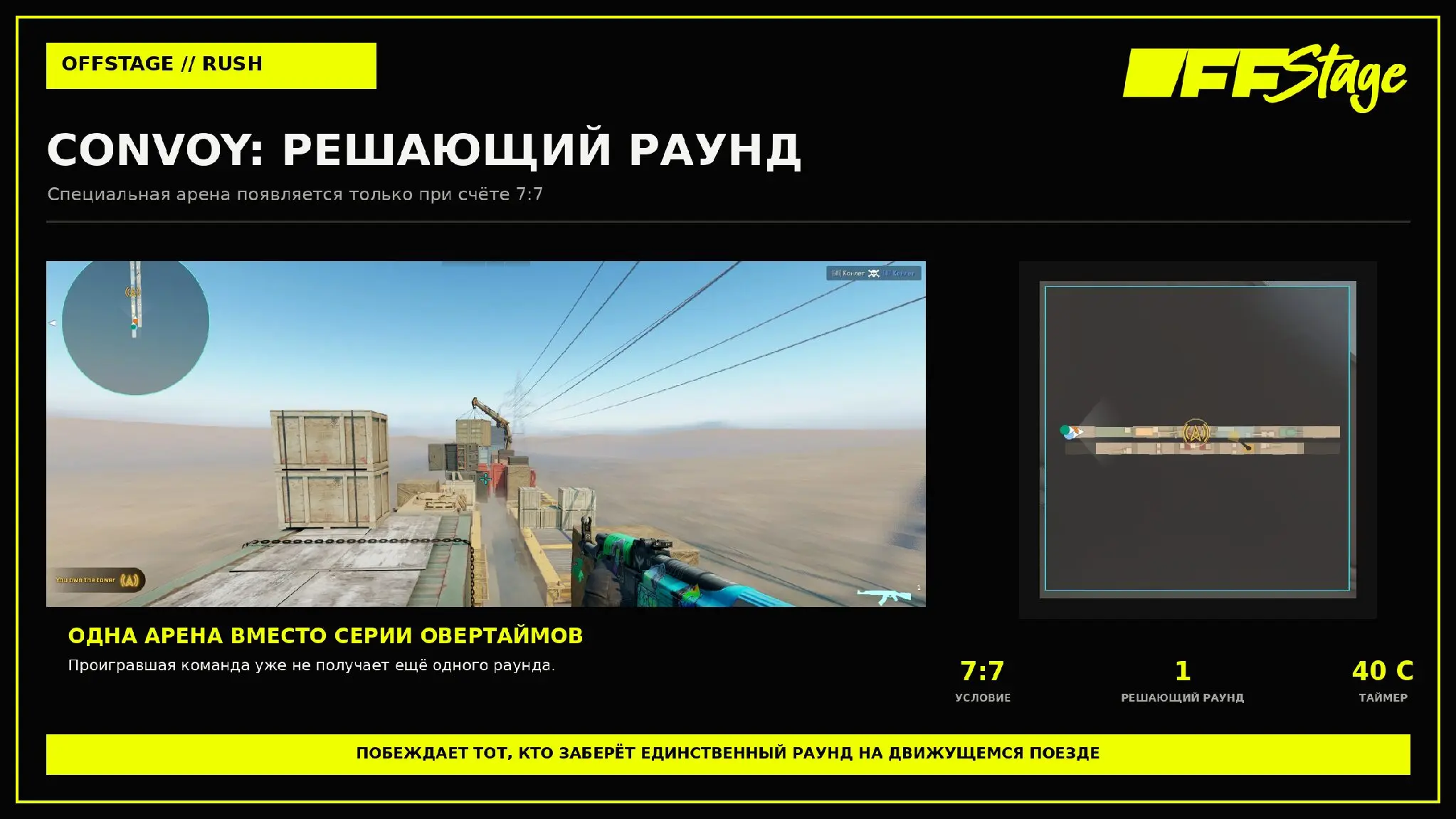
The fastest victory in Rush takes four consecutive rounds. A match never lasts more than 15 rounds. When the score reaches 8:6, the final round is skipped because the opponent won’t have time to tie the score anyway. If the teams reach 7:7, the winner is determined by a single round on Convoy—a separate arena with a moving train.
Also, if you win on an arena, the beacon is assigned to you. When you return to that same arena, the beacon will already be yours from the start. Four quick rounds can be played in about five minutes, but a regular match takes 10–15 minutes. All seven maps are visible in advance, so you can see where the next battle will take place and avoid spending money on weapons that will be useless there.
Convoy as an Alternative to Overtime
Convoy only appears when the score is 7–7. The final round takes place on a narrow arena with a moving train and containers. Whoever wins this round wins the entire match. It’s a short and unusual replacement for overtime. Instead of an extra series of rounds, teams get one map and one shot. Therefore, any mistake—an early death, a poor buy, or losing a turret—can immediately decide the outcome of the match. On Convoy, there’s almost no time for lengthy reconnaissance. Teams quickly meet near the central cars, and the moving train makes it hard to get your bearings. It’s better to move out together, save one grenade for the attack, and not send all three players off to hunt down the last opponent while forgetting about the turret.
How the tower works
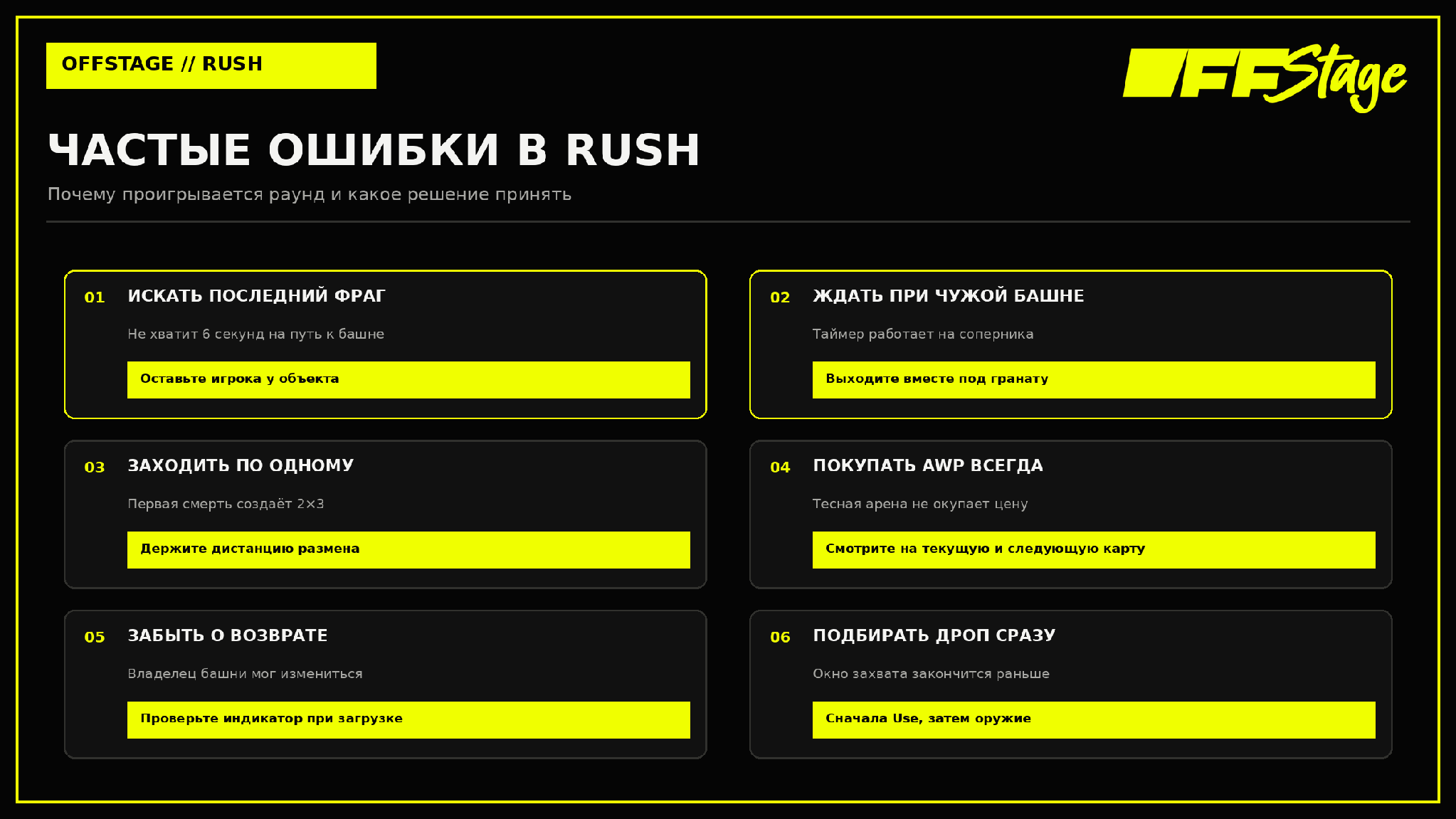
To capture the tower in CS2 Rush, simply approach it and press the use key. You don’t need to hold the button down. When the round timer runs out, the team that currently controls the tower wins. Even after killing all your opponents, you can still lose the round. If the tower was in enemy hands, you’ll have six seconds left after the last kill. During that time, you must run to the tower and press Use. If you don’t make it in time, the team you just eliminated will win.
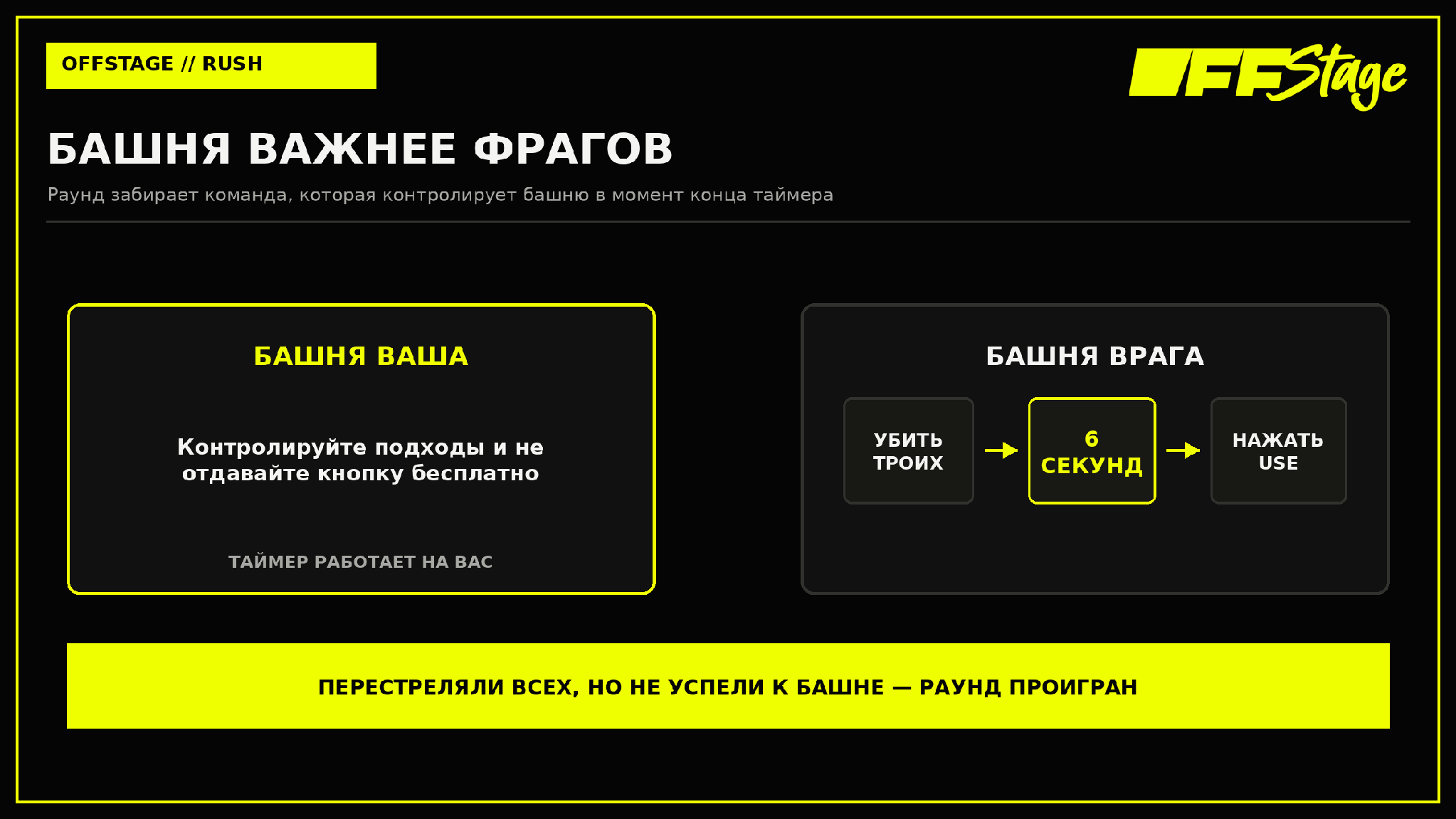
The main rule of Rush: focus on the tower, not on kills. If the tower is yours, you don’t necessarily have to look for an opponent—time is on your side, and they’ll have to come out to you. If the tower is controlled by the enemy, you can’t wait. One player must always remember where the button is and whether they’ll have time to reach it after a firefight.
All CS2 Rush Maps
There are 15 standard arenas in Rush. Sometimes Complex is mistakenly included among them, but that’s the name of the entire large map, within which the other arenas are located. T Assault and CT Assault are considered castles, and Convoy appears only in the decisive round when the score is 7:7.
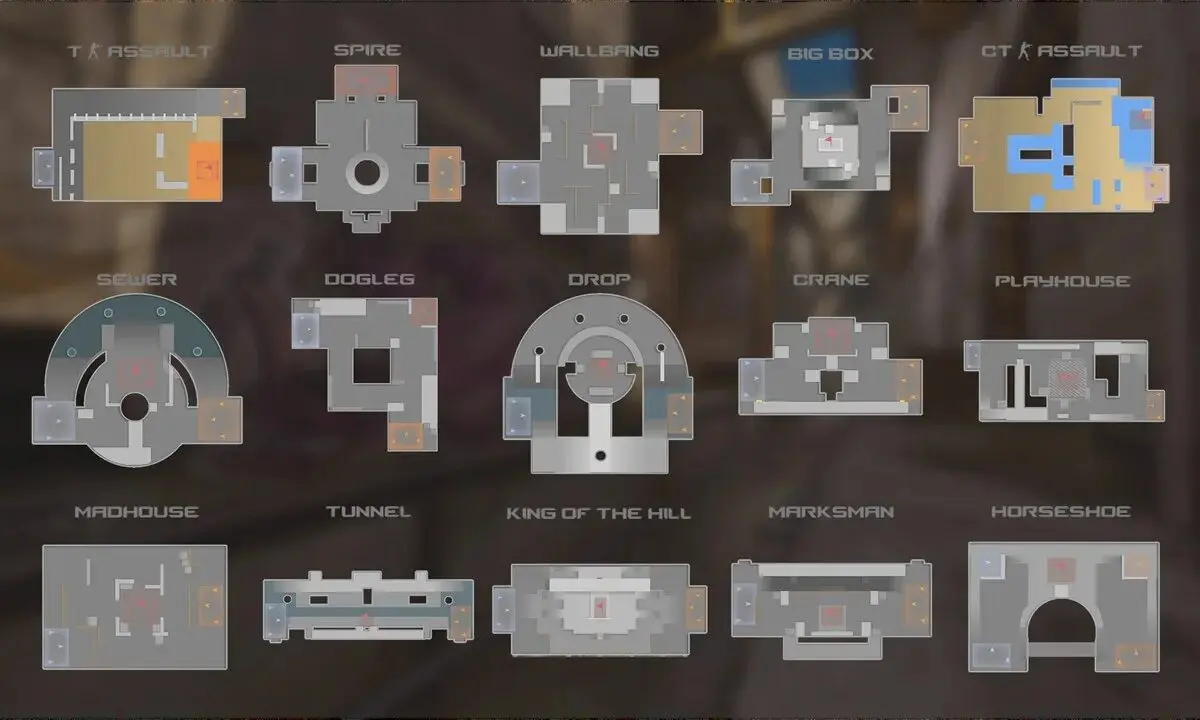
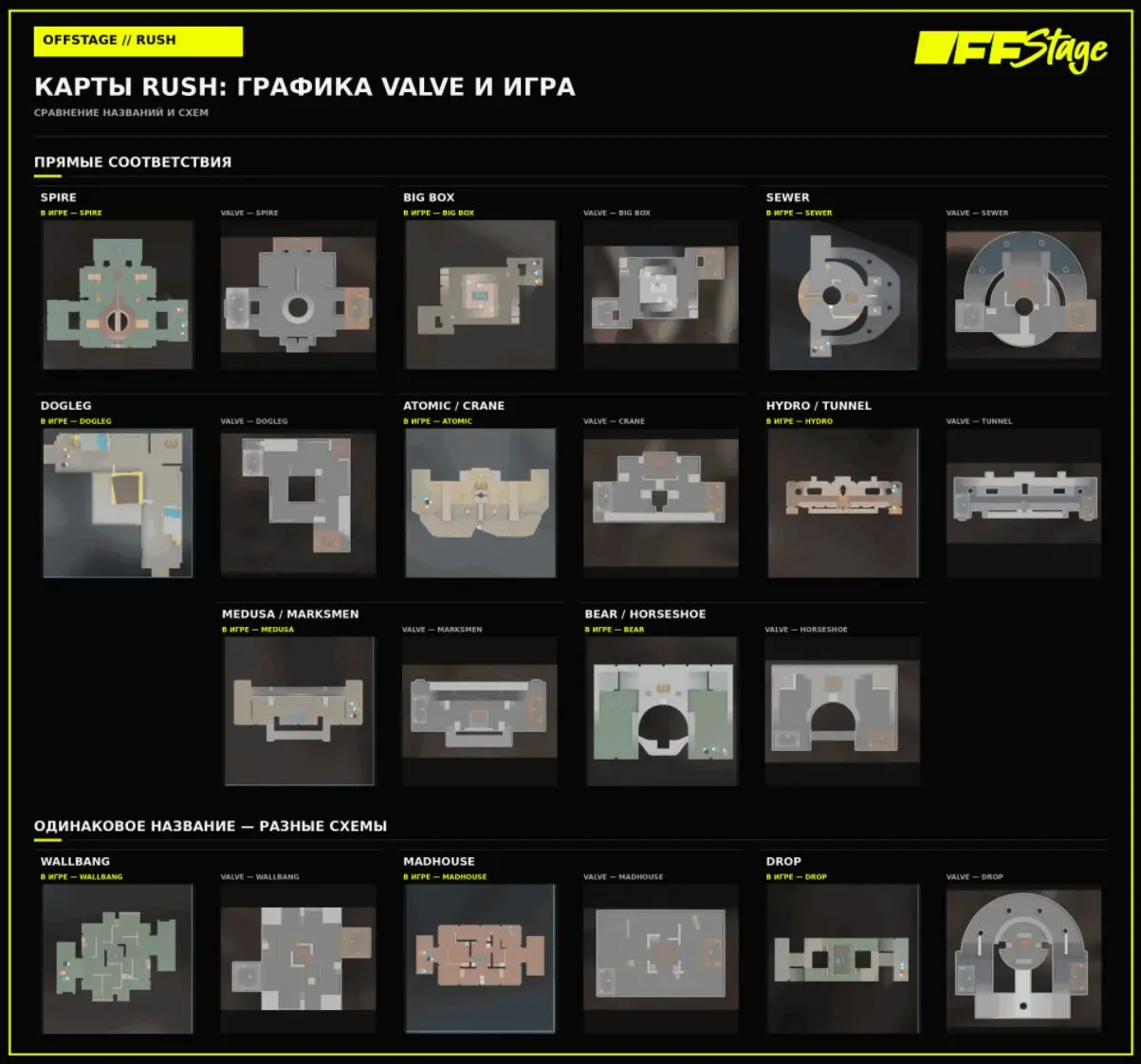
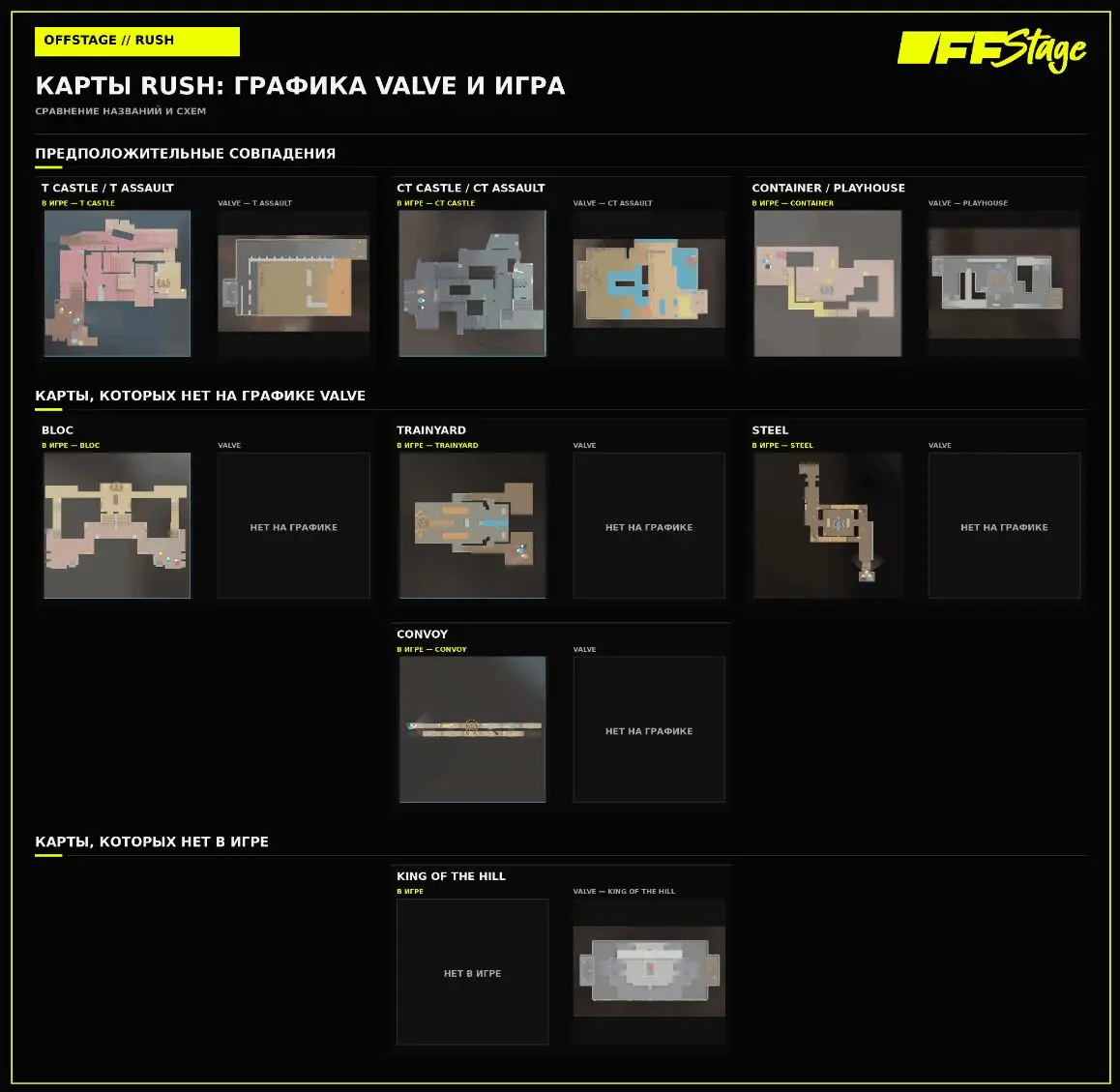
There’s a problem with Valve’s official graphic: the maps shown on it don’t always match the ones that made it into the game. Some arenas were renamed, while others were significantly redesigned. Bloc, Trainyard, Steel, and Convoy aren’t even shown in the image, but King of the Hill is there, even though there’s no such map in the mode itself. Therefore, the list of arenas from the game is provided below.
List of Rush Arenas
| Arena | Size | Feature | What to Bring |
|---|---|---|---|
| Sewer | Compact | Circular passages and short distances. | PP, shotgun, HE |
| Atomic | Medium | Open center and symmetrical cover. | Rifle, flashbang |
| Big Box | Compact | Central cover and quick flanking maneuvers. | Pistol, shotgun |
| Trainyard | Medium | Rail tracks and train car cover. | Rifle, SSG 08, or AWP |
| Medusa | Medium | Crossfire from multiple directions. | Rifle, PP |
| Madhouse | Compact | Winding corridors and sudden encounters. | Submachine gun, shotgun, HE |
| Hydro | Medium | Long, narrow lines of fire. | Rifle, AWP, flashbang |
| Wallbang | Medium | Thin surfaces and penetrable areas. | Rifle, HE |
| Container | Compact | Heavy cover and close-range duels. | Pistol, Shotgun |
| Steel | Compact | Tight corners and short rotations. | Pistol, rifle |
| Spire | Compact | Central tower and circular movement. | PP, rifle, HE |
| Drop | Medium | Elevation changes and short corridors. | Rifle, submachine gun |
| Bloc | Medium | Open lines of sight and vertical positions. | Rifle, SSG 08 |
| Dogleg | Medium | L-shaped routes and long-range duels. | Rifle, SSG 08 |
| Bear | Compact | Arch and tight approaches to the center. | Pistol, shotgun |
Final and Special Maps
In addition to the 15 standard arenas, Rush features two castles and a map for the decisive round. T Assault and CT Assault are located at opposite ends: a victory at the enemy’s castle immediately ends the match. Convoy appears only when the score is 7–7 and replaces overtime with a single round.
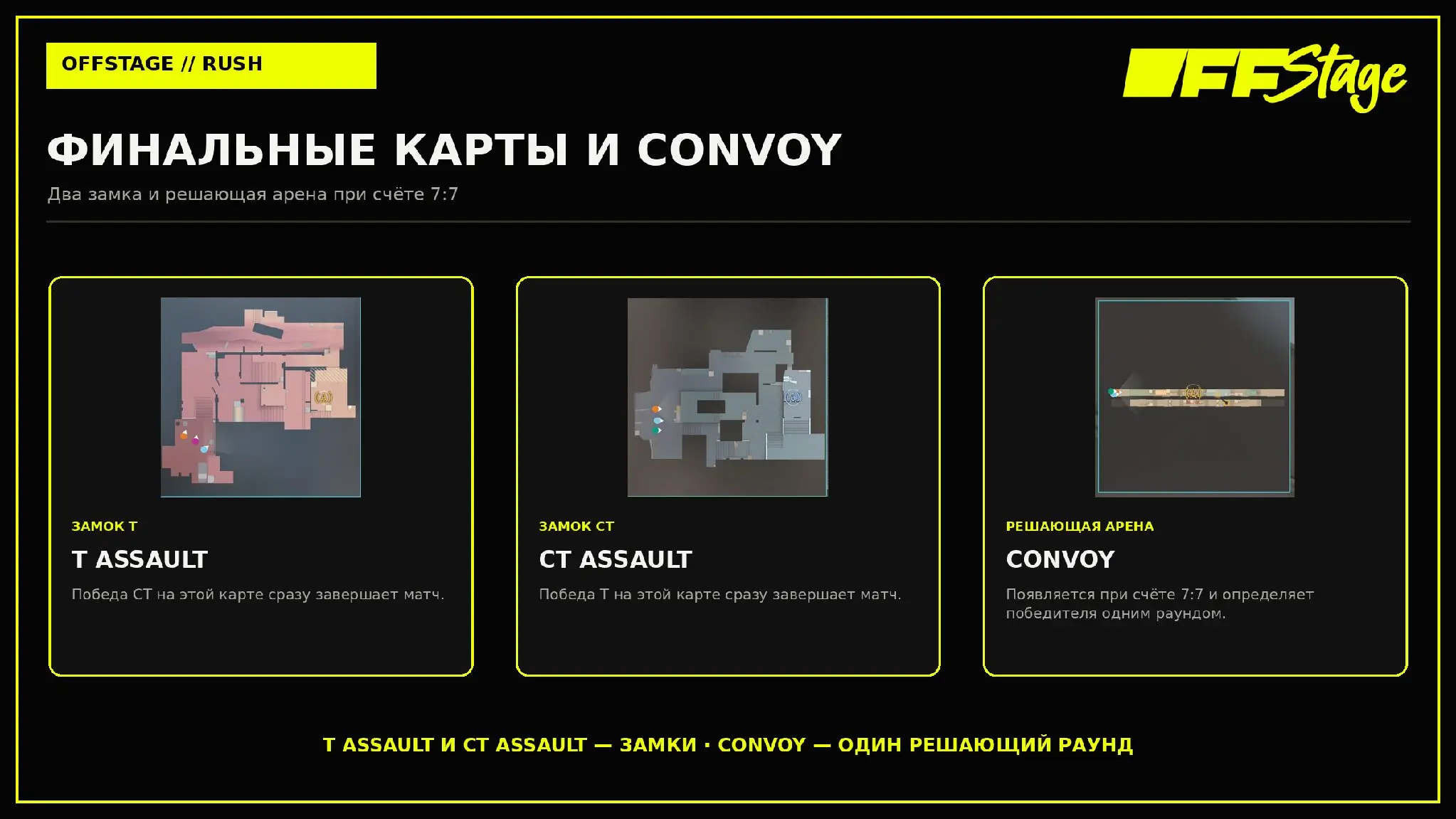
If you compare the in-game maps with Valve’s artwork, you’ll find fewer matches than you’d expect. Sometimes the layout is almost identical, but the name is different. Sometimes the name remains the same, but the map itself looks different. Bloc, Trainyard, Steel, and Convoy aren’t shown in the graphic, but it does include King of the Hill, which isn’t in the game. Therefore, you can’t compile an accurate list of arenas based on the official image.
Rush Economy
In Rush, the standard purchase menu opens, and weapons are selected from your inventory. There are no pre-made loadouts here. The first round is played with pistols, and before subsequent rounds, you can buy weapons and grenades. Each player receives $2,500 for a win. After the first loss, players receive $2,100. If the team continues to lose, the bonus increases by $750 each time, reaching a maximum of $4,350. The kill reward goes to the entire team, not just the player who secured the kill.
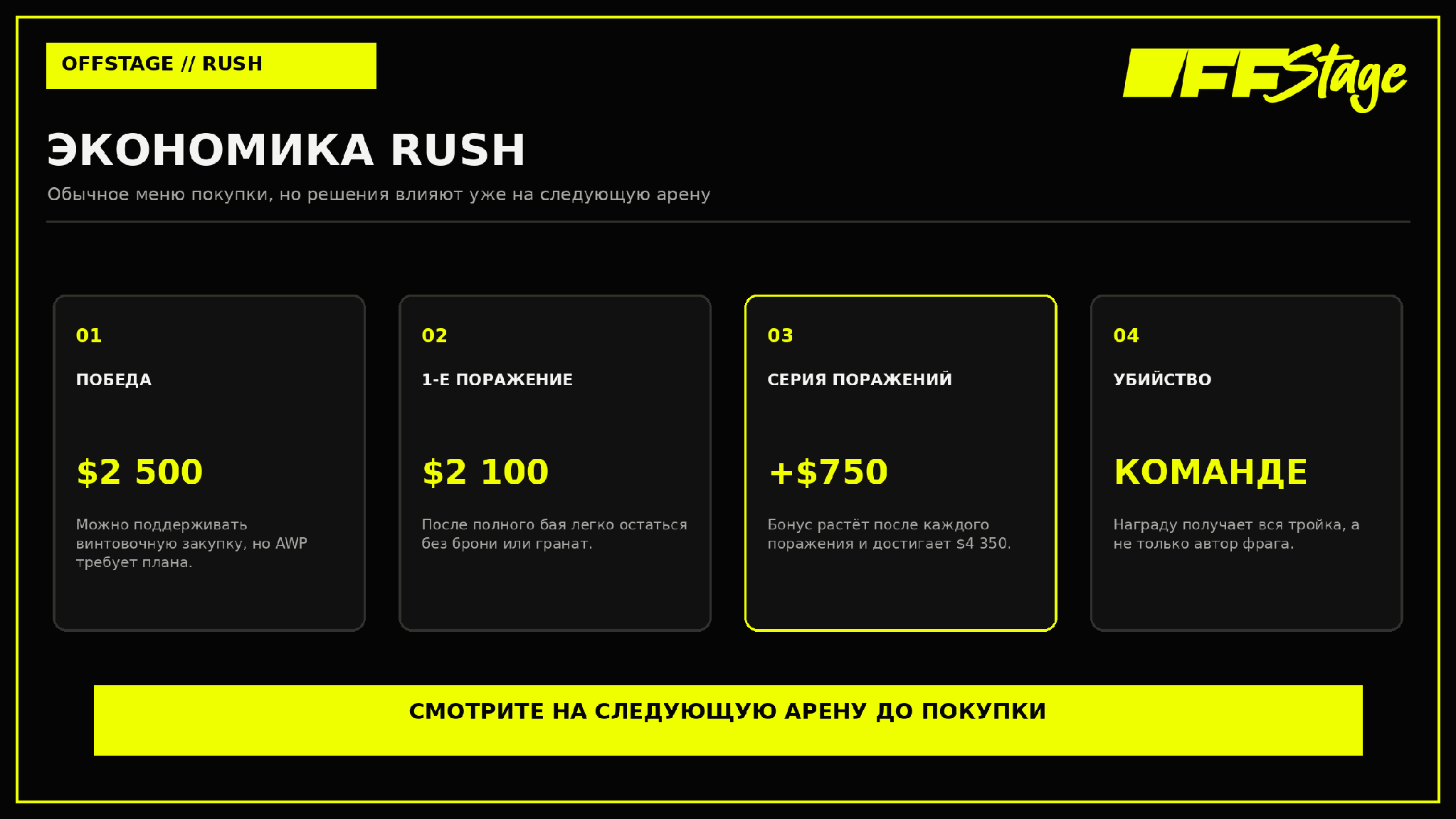
It’s worth planning your budget at least one round ahead. If all three players buy expensive rifles and lose right away, they won’t have enough for a good buy in the next arena. Before making a purchase, check not only where this battle will take place, but also where the next one will be.
Which Weapons to Choose
In tight arenas, pistols and shotguns are more effective: they make it easier to quickly rush the turret. Trainyard, Hydro, Bloc, and Dogleg have long-range lines of sight, so a rifle, SSG 08, or AWP is more useful there. But you shouldn’t buy an AWP every round. One missed shot can leave your team without a position, and losing the round can leave you without money.
- On a tight map, a submachine gun or shotgun is often more useful than an AWP.
- On an open map, one sniper rifle is enough. The other two players are better off sticking with assault rifles and grenades.
- A flashbang will help the whole trio reach the tower, and an HE grenade will flush an opponent out of a narrow passage.
- Check out the next arena before buying gear, and don’t automatically spend all your money.
Experience in Rush CS2 and Case Farming
You get 10 base experience points for every round won in the new mode. The number on the screen may be higher due to the weekly bonus. You don’t earn experience for a lost round. Rush can yield more experience per hour than Deathmatch if you find matches quickly and win often. But it can’t be called an easy way to farm experience. A skilled Deathmatch player can earn just as much, and a single Premier or Competitive match usually grants more experience. The total is also affected by matchmaking, load times, and the weekly bonus.
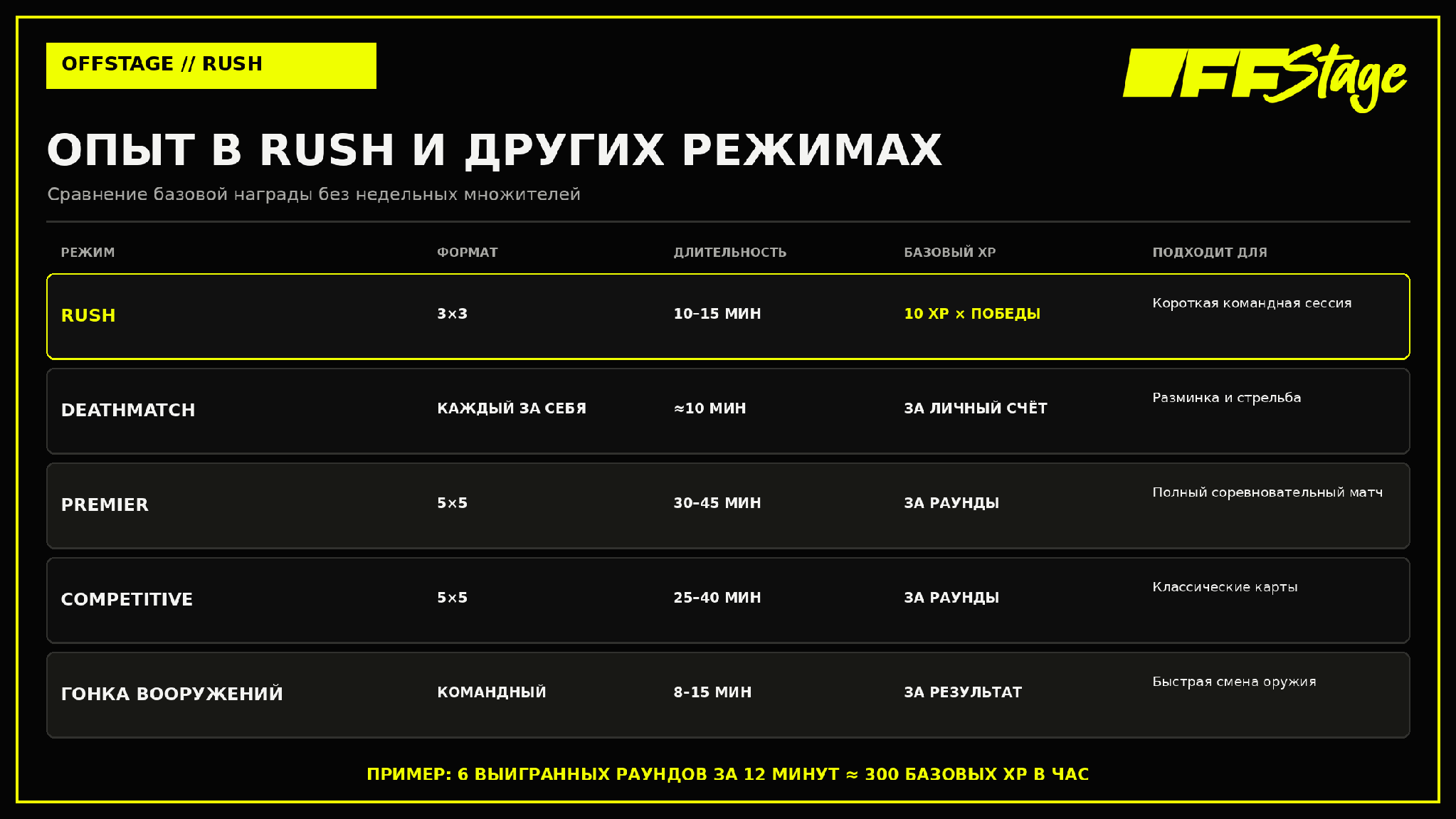
A simple example: six wins in 12 minutes will earn you 60 base XP. Excluding matchmaking time, that’s about 300 XP per hour. In Deathmatch, 250 points in ten minutes yield roughly the same result. Rush becomes more efficient only when matches end quickly and the team consistently wins rounds.
Tactics for a Trio
In this new mode, you shouldn’t engage enemies one-on-one. It’s better to attack as a trio: the first player checks the position, the second is ready to take him on, and the third watches the turret and the flanking route. If everyone starts a separate duel, the team will quickly be outnumbered.
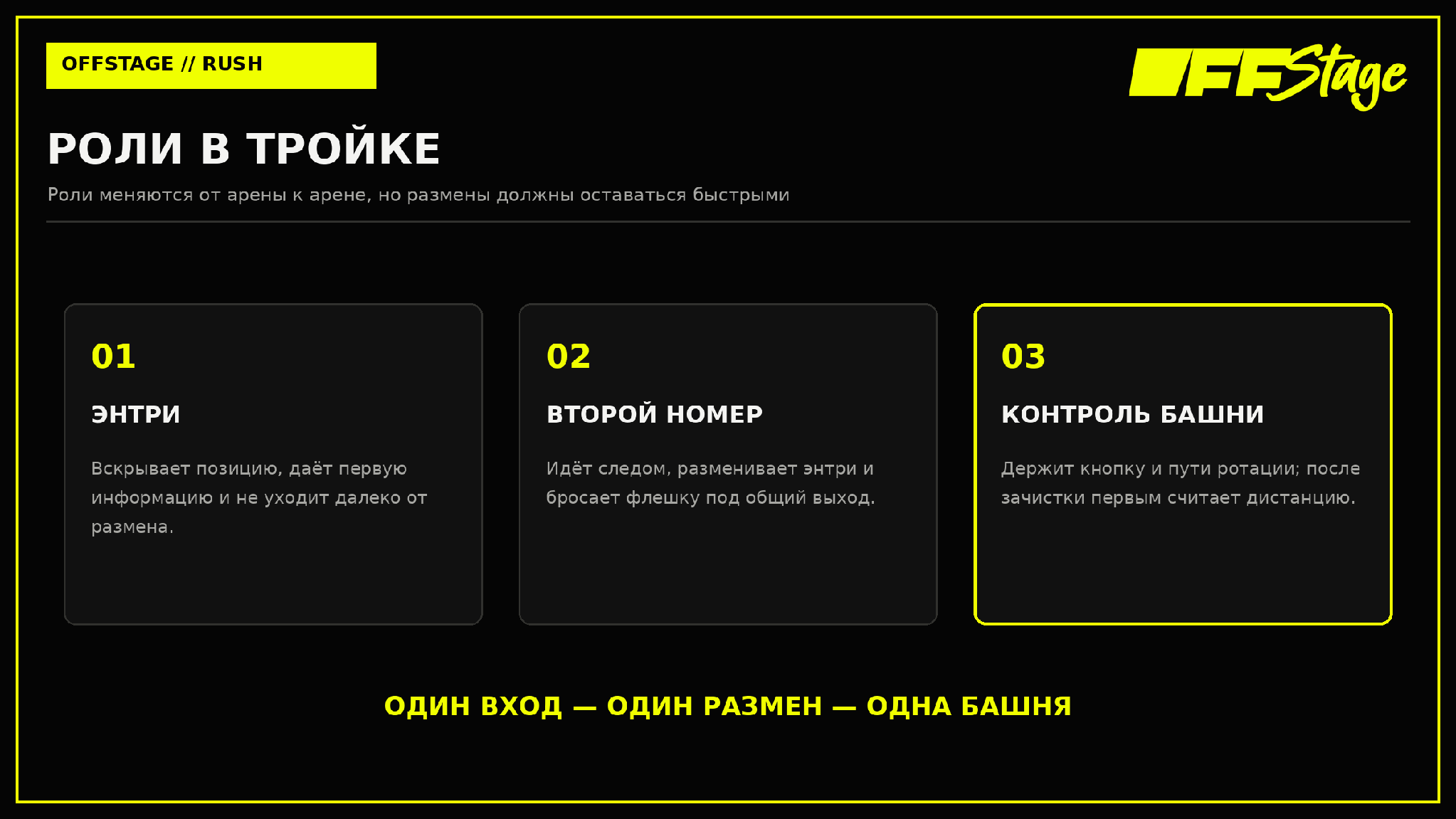
- Before moving out, quickly agree on where you’re going and drop a single flashlight for the whole team.
- The player at the tower doesn’t need to chase after the last kill. Their job is to maintain control.
- After eliminating all opponents, immediately run to the button. You only have six seconds to do this.
- If you’ve returned to an arena that’s already been played, check who now controls the tower.
- After dying, only say what’s important: where the enemy is, how much health they have, and how to get to the tower.
Who This Mode Is For
Rush is ideal for those who want to play a fast-paced team match and aren’t ready to spend 40 minutes on Premier. Newcomers can easily grasp the round’s objective, while a seasoned trio can practice coordinated pushes and trades. It won’t replace a full-fledged matchmaking mode: there’s less strategy here, the economy is simpler, and there are almost no slow rounds.
If you just want to shoot around, it’s better to choose Deathmatch. For ranked play and serious competition, Premier and Competitive remain the options. The new mode falls somewhere in between: matches are short, but it’s hard to win without communicating with your team.
Bugs and what people are saying about the mode
Players often mistake it for a bug when a team kills all opponents but still loses the round. In reality, that’s how Rush works. If the enemy had the turret, you must capture it within six seconds after the last kill.
There is also a real bug: when switching between the left and right hands, the slow reload animation may stutter and not match the reload time. The bug appeared in the Rush Hour patch and isn’t limited to Rush. It doesn’t affect the round’s outcome. Also, on several maps in the new mode, the ladders glitch: when climbing up from the top, the game might not let you let go of the ladder.
What Data Miners Found
In the CS2 files for Rush, they found a separate interface, arena radars, sounds, and transitions between maps. The mode has its own icon in the menu, so Valve originally designed it as a separate game type. It’s also clear from there that “Complex” is the name of the entire map, not just another arena. This is where the confusion about the “sixteenth arena” came from. The same files also contain placeholders for bots. It’s possible that Rush could be used for practice in the future, but Valve hasn’t announced anything about this. For now, it’s just a technical placeholder, not a confirmed feature.
Frequently Asked Questions (FAQ)
Выберите режим Rush и соберите команду из трёх игроков. Побеждайте на небольших аренах, двигайтесь к замку соперника и следите, чтобы в конце раунда башня была вашей.
Нет. Rush — режим 3 на 3, Rush Hour («Час пик») — название патча, в котором он появился.
От четырёх до пятнадцати. Победа на чужом замке сразу заканчивает матч, а при 7:7 проводится решающий раунд на Convoy.
В режиме есть 15 обычных арен. T Assault и CT Assault — замки, Convoy — карта для решающего раунда, а Complex — название всей карты Rush.
Это финальная карта каждой команды. Если T побеждают на CT Assault или CT побеждают на T Assault, матч сразу заканчивается.
Только если башня уже ваша. При вражеском контроле после тимвайпа есть шесть секунд, чтобы добежать до башни и нажать Use.
Перед раундом открывается обычное меню покупки. За победу дают $2 500. Бонус за поражение начинается с $2 100 и растёт на $750 до $4 350. Деньги за убийство получает вся команда.
По 10 базовых XP за каждый выигранный раунд. Недельные бонусы могут увеличить итоговое число на экране.
Выходите на соперника вместе, оставляйте одного игрока у башни, помните о шести секундах после убийства всех врагов и смотрите на следующую арену до закупки.